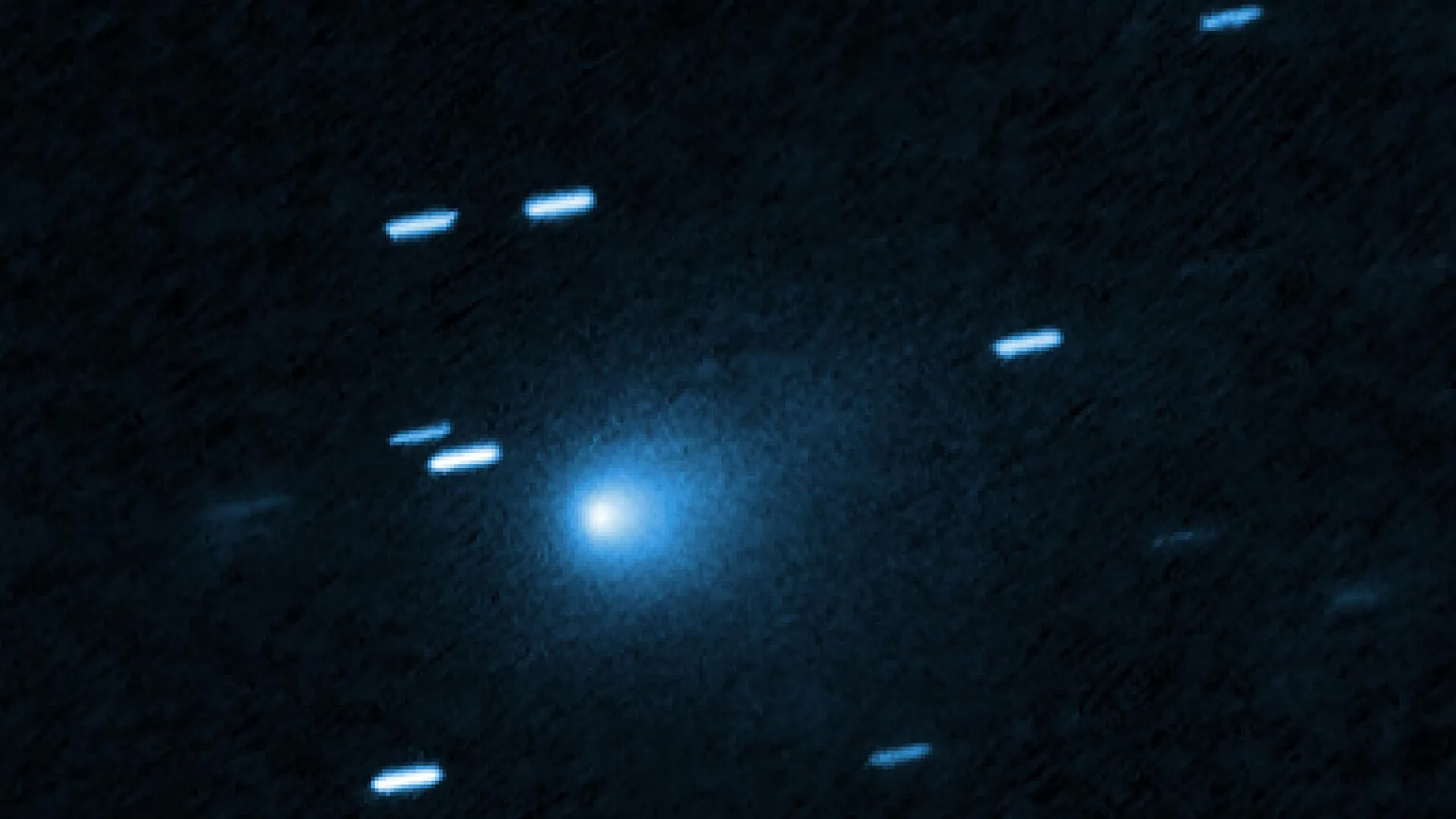
When NASA's James Webb Space Telescope turned its gaze on comet 3I/ATLAS last December, it revealed something never seen before: the unmistakable chemical fingerprint of methane on a visitor from beyond our solar system. The discovery, published in The Astrophysical Journal Letters, marks the first time scientists have directly identified methane on an interstellar object—a breakthrough that rewrites our understanding of how comets form in distant corners of the galaxy.
The findings matter because they tell us that other star systems produced comets in radically different ways than our own. When a comet travels through space, its chemistry is a kind of cosmic time capsule, preserving clues about the conditions where it was born. By studying 3I/ATLAS, astronomers can now peer into the formation environments of distant planetary systems and expand what we know about the universe's diversity.
Webb's observations came in two precise windows. Scientists used the telescope's MIRI instrument—the Mid-Infrared Instrument—on December 15 and 16, when 3I/ATLAS was about 205 million miles from the Sun, and again on December 27, when it had receded to 236 million miles away. Using MIRI's Medium Resolution Spectrometer, researchers separated infrared light into individual wavelengths, identifying the gases surrounding the comet's nucleus like reading a celestial periodic table.
What they found was startling. The methane itself was surprising enough—it's an extremely volatile substance that normally turns from ice to gas only when heated. Its appearance shortly after the comet's closest approach to the Sun suggested the methane had been locked away beneath the comet's surface, shielded from solar radiation until the sun's warmth finally penetrated deep into the icy interior. But there was more. The ratio of methane to water was far higher than anything typically observed in comets from our own solar system, with only a handful of known examples showing similar characteristics. The comet was also releasing exceptionally large amounts of carbon dioxide relative to water—again, dramatically different from what astronomers routinely measure in solar system comets.
These two unusual chemical signatures point to a formation history utterly distinct from most comets born around our Sun. 3I/ATLAS emerged from a chemical environment so different that it might as well come from another universe entirely. This is what makes the interstellar visitor so precious: it offers concrete evidence that planetary systems beyond ours operated under fundamentally different rules.
As Webb tracked the comet's retreat, another pattern emerged. The production of gases dropped sharply as the comet moved farther from the Sun and received less energy. Water showed the steepest decline, which makes physical sense—water is less volatile than methane or carbon dioxide, so it stops vaporizing more quickly as temperatures fall. By mapping how gases were distributed around the comet's nucleus, Webb's integral field unit capability gave scientists an almost three-dimensional view of the comet's activity.
The implications ripple forward. With each interstellar object that wanders into our cosmic neighborhood, Webb can now decode its chemical story, adding new chapters to our understanding of how planets and comets form across the galaxy. The universe, it turns out, is far more chemically diverse than we ever imagined.