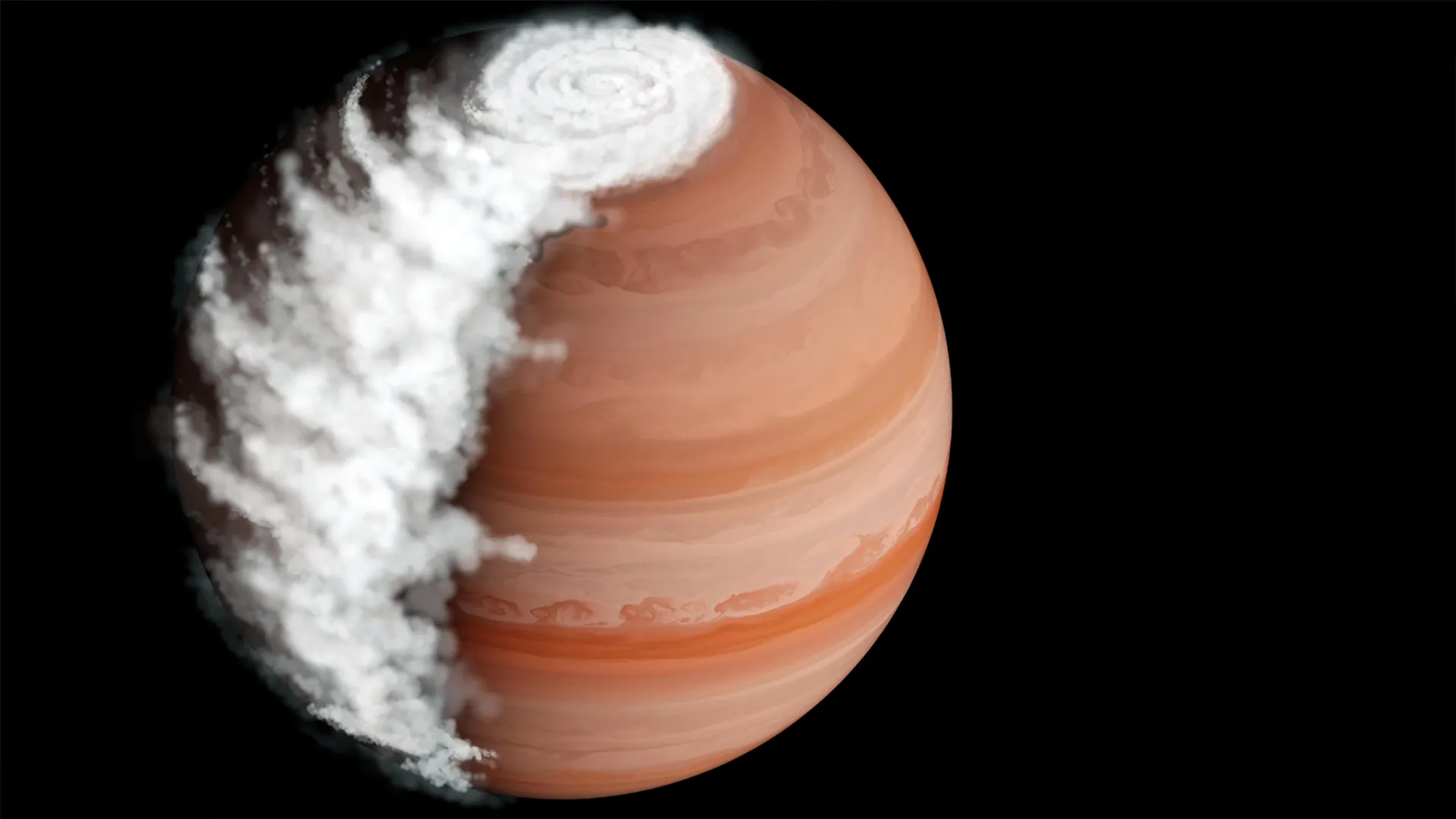
Every morning on WASP-94A b, a distant giant exoplanet nearly 700 light-years away in the constellation Microscopium, mineral clouds made of magnesium silicate sweep across the sky. By evening, they have vanished entirely—leaving behind an atmosphere so clear that astronomers using the James Webb Space Telescope could finally see straight through to the planet's true composition.
This discovery of dramatic daily weather cycles on a Hot Jupiter marks one of the first times scientists have directly observed clouds forming and dissolving on such a world, and it reveals something astronomers have struggled with for two decades: how to look past the cosmic fog that obscures exoplanet atmospheres. The findings, published in the journal Science, come from observations made as the planet crossed in front of its host star, allowing Webb to separately examine the morning and evening sides of this alien world.
The contrast between the two sides proved strikingly severe. The morning edge, where atmospheric winds carry cool air from the night side toward intensely hot daylight, glowed with magnesium silicate clouds. The trailing edge representing evening, where air circulates back toward darkness, appeared nearly cloud-free. Scientists suspect the clouds either get dragged deep into the planet's searing atmosphere on the day side, hiding them from view, or simply evaporate in temperatures exceeding 1,000 degrees—a process far more extreme than morning fog burning away on Earth.
"I've been looking at exoplanets for 20 years, and general cloudiness has been a thorn in our side," said David Sing, a Bloomberg Distinguished Professor of Earth and Planetary Sciences at Johns Hopkins and co-author of the research. "Not only have we been able to clear the view, but we can finally pin down what the clouds are made out of and how they're condensing and evaporating as they move around the planet."
That clear evening view solved a puzzle that had stumped researchers. Earlier measurements using older telescopes like Hubble had suggested WASP-94A b contained hundreds of times more oxygen and carbon than Jupiter—a finding that contradicted existing theories of how planets form. The new data painted a very different picture: the planet contains only about five times more oxygen and carbon than Jupiter, making it far more similar to the giant planet in our own solar system than previously believed. The difference came down to perspective. With Hubble, data from clouds and atmosphere merged together into an indecipherable blur. Webb's ability to isolate the cloud-free evening side finally allowed scientists to see the atmosphere itself.
Encouraged by this breakthrough, the research team examined eight additional Hot Jupiters—those extreme gas giants that orbit dangerously close to their stars, closer even than Mercury orbits the Sun. Two more worlds, WASP-39 b and WASP-17 b, showed similar cloud cycling patterns. The team now plans to expand the search with a larger Webb observing program investigating cloud cycles across many different exoplanets, including an unusual gas giant that travels through the habitable zone on an eccentric orbit.
For astronomers, this represents a fundamental shift in what's possible. Hot Jupiters, with their intense heat and radiation, serve as ideal natural laboratories for studying atmospheric chemistry and cloud behavior under extreme conditions. Now, for the first time, scientists can actually see through the fog.