A biohazard-orange neon sign glows in the front window of SITE Santa Fe: “EVERY AMERICAN FLAG IS A WARNING SIGN.” The words, by Diné artist Demian DinéYazhi', cut through the air like a declaration. This is not just an exhibition opener—it’s a threshold. “Indian Theater: Native Performance, Art and Self-Determination since 1969” doesn’t invite passive viewing; it demands reckoning. From the moment visitors step inside, they are asked to see Indigenous art not as artifact or aesthetic, but as living resistance.
The exhibition traces a lineage that begins in 1969—not just at the Institute of American Indian Arts (IAIA) in Santa Fe, but on Alcatraz Island, where the Indians of All Tribes occupation ignited a new era of Native self-determination. Curator Candice Hopkins draws a direct line between political action and artistic expression, showing how performance, ritual, and visual art have long been intertwined in Indigenous resistance. DinéYazhi’’s neon piece, titled “my ancestors will not let me forget this,” pulls no punches: for generations, the American flag has signaled invasion, erasure, and forced allegiance. The work forces non-Indigenous viewers to confront the discomfort of being the outsider in a space where their assumptions are no longer centered.
Inside, the mood shifts but the message holds. The first gallery is wrapped in pink and red burlap wallpaper designed in the 1960s by Linda Lomahaftewa (Hopi/Choctaw) during her studies at IAIA under Lloyd Kiva New (Cherokee), a co-founder of the institute. New’s 1973 diptych “Summer Spirit, Winter Spirit” hangs nearby, echoing ancestral ceremonial forms through mask-like imagery. Archival materials—videos, manifestos, performance scripts—document the birth of the Indian Theater movement, a radical reimagining of storytelling rooted in Indigenous cosmologies rather than Western dramatic arcs.
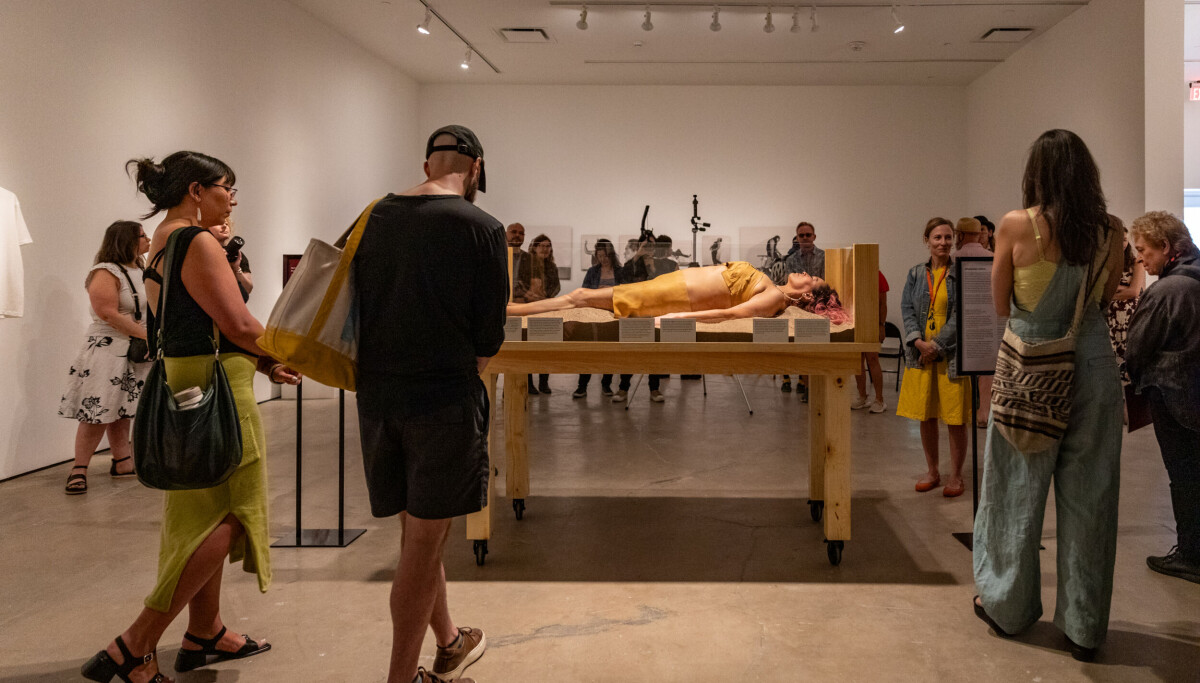
Visitors then choose their path. One leads to the monumental fiber sculptures of Eric-Paul Riege (Diné), whose hanging works resemble giant earrings for deities. Riege activates them through durational performances that blur the line between art and ceremony, embodying the principles laid out in Rolland R. Meinholtz’s 1969 “Notes on Indian Theatre,” which called for a narrative structure that doesn’t peak or climax like Western theater, but instead flows in cycles, like life itself. Other works across the exhibition—from performance documentation to experimental video—reaffirm that Native art is not a relic, but a dynamic, evolving practice of sovereignty.
Free to the public and running through September 7, “Indian Theater” doesn’t just challenge the colonial gaze. It replaces it with a vision grounded in resilience, memory, and futurity. This is art as ceremony, as protest, as continuity. And for those willing to listen, it offers a new way of seeing—one shaped not by conquest, but by care.