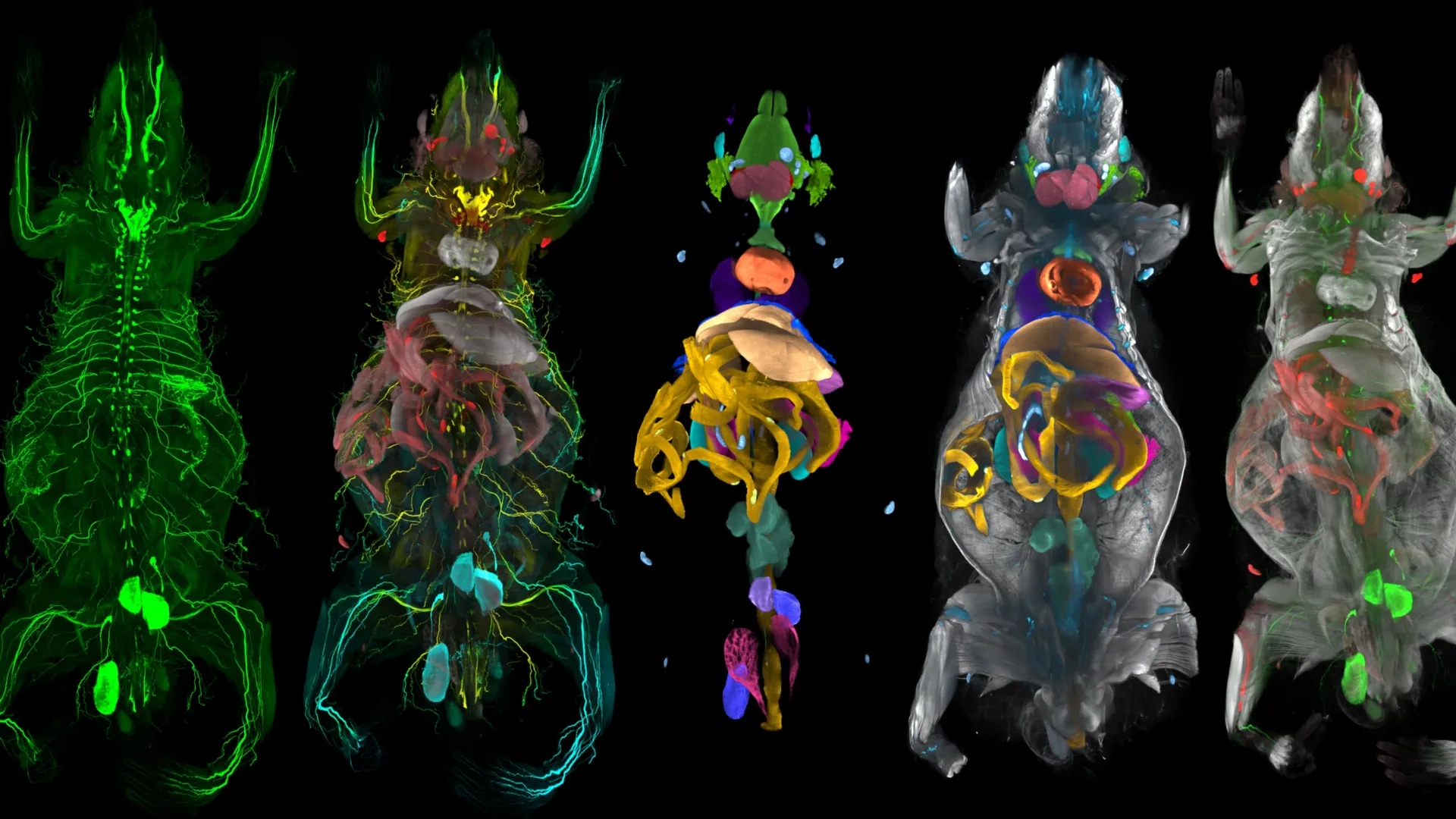
When researchers at Helmholtz Munich and Ludwig Maximilians University Munich made mice transparent and peered inside their entire bodies at cellular detail, they discovered something scientists had long suspected but never clearly seen: obesity silently damages facial nerves, shrinking their branches and deadening sensation across the face.
The finding matters because obesity has become a public health crisis affecting billions, yet its effects ripple far beyond weight gain. We know it increases risk of type 2 diabetes, heart disease, stroke, and cancer—but scientists have lacked the tools to understand how a single disease damages so many organ systems at once. Most research zooms in on one tissue at a time, missing the full picture. Until now.
A team led by Prof. Ali Ertürk, Director of the Institute for Biological Intelligence at Helmholtz Munich, created an AI system called MouseMapper to solve this problem. The technology uses foundation-model-based deep learning to analyze whole-body imaging datasets and automatically identify 31 different organs and tissue types while mapping nerves and immune cells throughout the body. To gather the images, researchers used fluorescent markers to tag nerves and immune cells in mice, then employed tissue-clearing methods to make the animals transparent while preserving those glowing signals. Light-sheet microscopy then captured three-dimensional images of entire mice—producing datasets containing tens of millions of cellular structures.
When the team fed mice a high-fat diet to induce obesity, MouseMapper revealed widespread inflammation and structural changes across multiple organ systems. But one discovery stood out: the trigeminal nerve, a major facial nerve responsible for sensation and motor function, showed major reductions in branches and nerve endings. Behavioral tests confirmed the consequence—obese mice were far less responsive to sensory stimulation than lean mice.
What made this finding truly significant was that researchers then analyzed trigeminal tissue from people with obesity and found the same molecular signatures of inflammation and nerve remodeling. "We revealed previously unknown structural and molecular changes in the trigeminal ganglion and its facial branches, and the same molecular signature was conserved in human tissue," said Dr. Doris Kaltenecker, senior scientist at the Institute for Diabetes and Cancer at Helmholtz Munich and first author of the study. "This kind of finding simply cannot emerge from studying one organ at a time."
The research, published in Nature, opens entirely new possibilities for understanding complex diseases that touch many parts of the body simultaneously. MouseMapper could become essential for studying diabetes, cancer, neurodegenerative diseases, and autoimmune disorders—any condition that damages multiple organ systems in ways science has yet to fully map. The generative foundation model powering MouseMapper also means it can be applied far beyond the original training data, making it adaptable to new research questions.
Most remarkably, the team has made their whole-body datasets publicly available online, inviting researchers worldwide to explore the data themselves. In an era when so much scientific work remains locked behind paywalls and proprietary algorithms, this open approach could accelerate discovery across multiple fields. The transparency—both literal and figurative—may help illuminate diseases that have long remained hidden in the body's shadows.