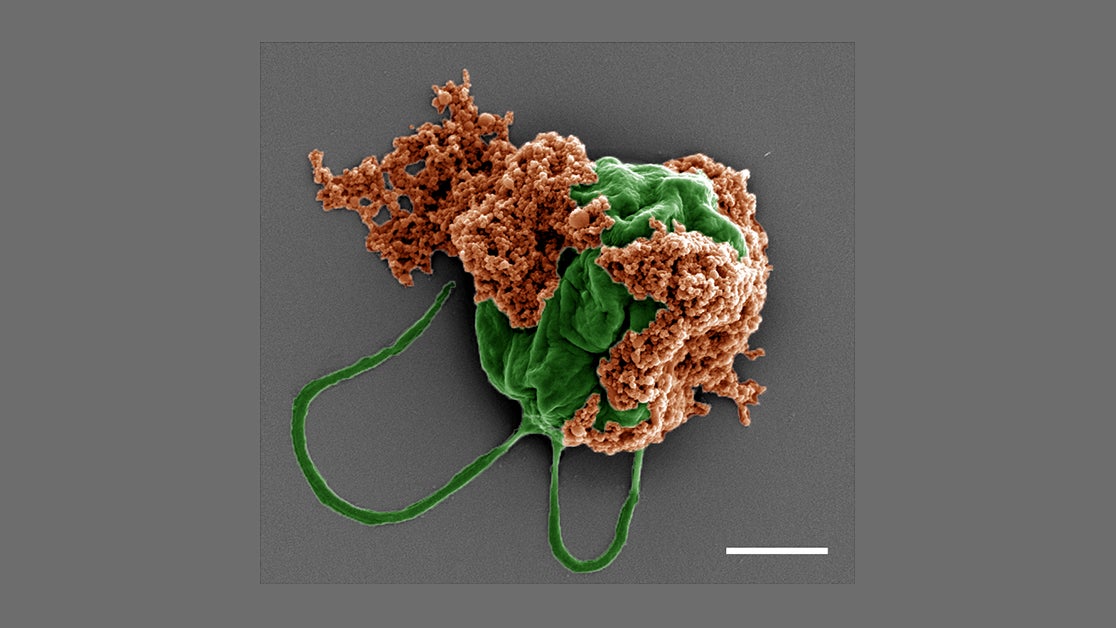
At the University of San Diego, researchers have engineered living microrobots no larger than a human hair, powered by algae and controlled by the flick of a colored light switch. These remarkable biohybrid swarms respond to blue light by clustering together and to red light by dispersing, assembling and disassembling into precise shapes on command—a breakthrough that could revolutionize how we deliver medicine and clean up environmental contamination.
The inspiration comes straight from nature's most impressive collective behaviors. Schools of sardines, swarms of locusts, colonies of bees—these creatures accomplish feats through coordinated movement that no individual could achieve alone. Roboticists have long sought to harness this principle in machines small enough to navigate the human body or slip into spaces too tight or delicate for conventional tools. Now they're succeeding by turning to biology itself.
The team chose Chlamydomonas reinhardtii, a single-celled freshwater algae commonly found in puddles and soil. Roughly 10 micrometers across—about the size of a skin cell—these organisms propel themselves using two whip-like appendages called flagella. More crucially, they're sensitive to different colors of light, making them naturally responsive to simple optical commands. By coating nanoparticles with drugs or chemical sensors and attaching them to the algae, researchers create programmable delivery systems that can reach places conventional medicine cannot.
In their demonstrations, the team projected blue and red light through masks onto petri dishes crowded with algae, essentially using stencils to shape living swarms. Within minutes, they sculpted the organisms into maps of the Americas and Afro-Eurasia, arrows that moved several millimeters while holding their form, and stars, letters, and triangles. By adjusting both the duration and intensity of the light, researchers could make the swarm double in size while maintaining a perfect circle or split into four separate colonies.
The implications extend across medicine and environmental cleanup. Algae-powered bots have already delivered antibiotics for bacterial pneumonia in mice and are being tested as treatments for inflammatory bowel disease, which affects millions worldwide. In one approach, scientists engineered nanoparticles to absorb and neutralize inflammatory chemicals in the gut, then packed them into a pill where the algae-powered swarm dispersed throughout the treatment area while largely avoiding other organs. In tests on simulated wounds, researchers used artificial skin and wound fluid—made of proteins and chemicals typically present after a scrape—to demonstrate how these living robots could concentrate treatment exactly where damaged tissue needed it most.
What makes this breakthrough distinct is that the algae remains alive throughout, powered by its own biological energy rather than external batteries or sustained external forces. Unlike previous microbot systems reliant on magnets, sound waves, or entirely synthetic materials, these biohybrid swarms are small enough to thread through delicate spaces, responsive enough to assemble and disassemble on command, and capable of sustained autonomous motion. The researchers have already written an algorithm that predicts how variations in light intensity and duration alter collective swarm behavior, opening pathways for increasingly sophisticated control.
As these living machines move from laboratory demonstrations into real-world applications, they point toward a future where medicine becomes radically more precise and environmental cleanup more effective—powered not by silicon and circuits, but by the same microscopic swimmers that have thrived in Earth's waters for over a billion years.