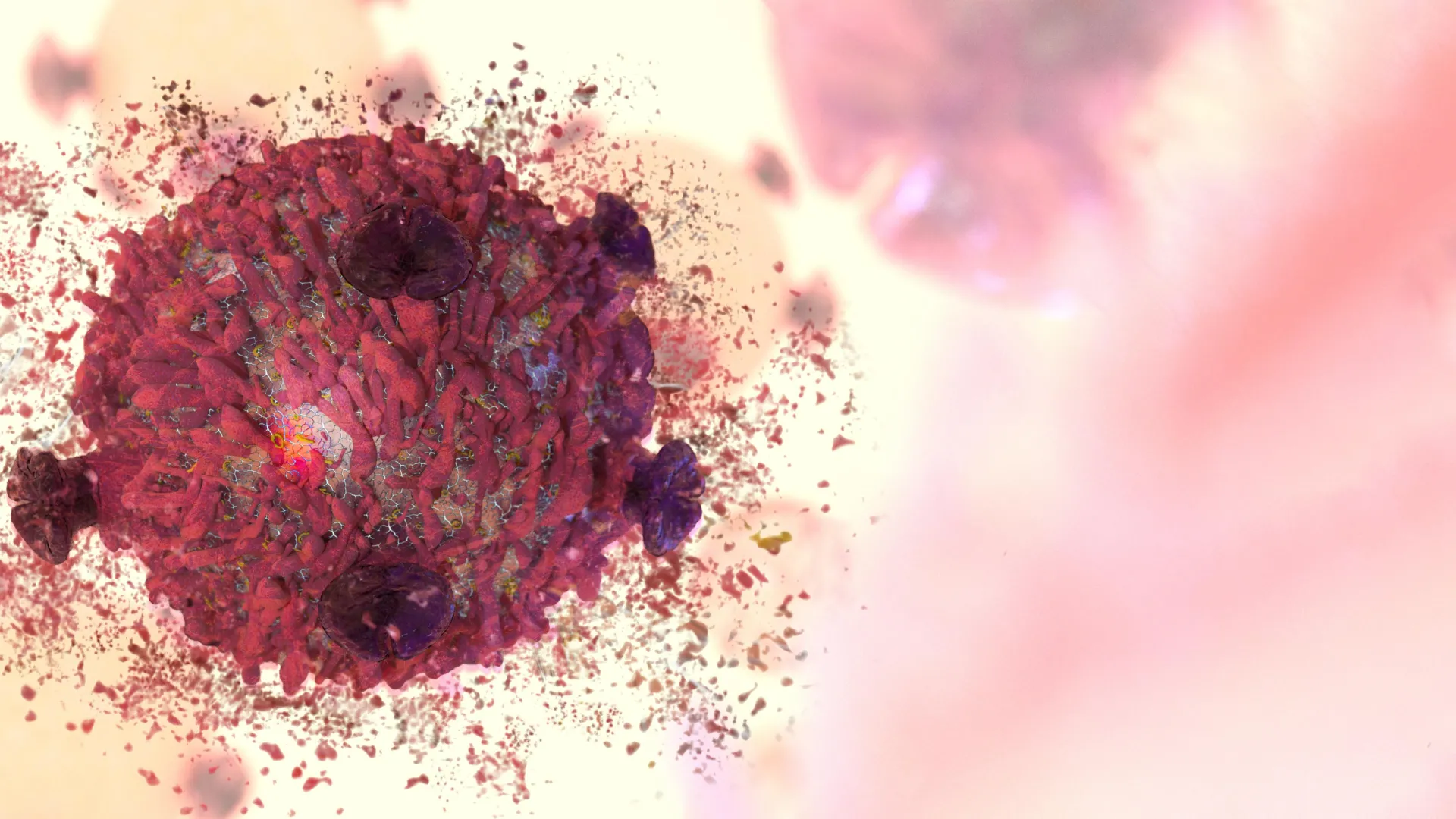
At Oregon State University's College of Pharmacy in Corvallis, researchers led by Oleh Taratula, Olena Taratula, and Chao Wang have engineered a material so precisely destructive that it obliterates breast cancer cells from within while leaving the surrounding healthy tissue untouched. The breakthrough emerges from a counterintuitive strategy: exploiting the chemical vulnerabilities that make tumors uniquely hostile environments.
The nanomaterial is built from an iron-based metal-organic framework—a lattice structure designed to trigger two powerful chemical reactions simultaneously inside cancer cells. Once the nanoagent enters a tumor, it generates hydroxyl radicals and singlet oxygen, two types of reactive oxygen species that attack cancer cells by stripping electrons from their essential components like lipids, proteins, and DNA. The tumor becomes overwhelmed by oxidative stress, essentially poisoned from within. Normal tissue, lacking the acidic conditions and high hydrogen peroxide levels that characterize cancer cells, remains largely unharmed.
This approach sits at the forefront of chemodynamic therapy, or CDT, an emerging cancer treatment strategy that weaponizes the unique chemical conditions inside tumors. Compared with normal tissue, cancer cells are distinctly more acidic and harbor higher concentrations of hydrogen peroxide—conditions that the new nanomaterial exploits with surgical precision. Traditional CDT agents, however, have struggled with a critical limitation: they typically generate either hydroxyl radicals or singlet oxygen, but not both, and they often lose catalytic power too quickly to sustain the robust reactive oxygen species production needed for lasting therapeutic benefit. Preclinical studies of existing agents frequently showed only partial tumor regression, leaving room for cancer to return.
The new iron-based nanomaterial overcomes these constraints. In mice bearing human breast cancer cells, the treatment delivered dramatic results. When administered systemically, the nanoagent accumulated efficiently in tumors and generated reactive oxygen species with such force that it completely eradicated the cancer. The tumors disappeared entirely, did not recur over the long term, and the animals showed no signs of systemic toxicity or adverse effects. For a field where the possibility of harming healthy tissue has long haunted cancer treatment, this outcome represents a meaningful turning point.
The research, published in Advanced Functional Materials, was funded by the National Cancer Institute and the Eunice Kennedy Shriver National Institute of Child Health and Human Development. Beyond the lead researchers, the team included Kongbrailatpam Shitaljit Sharma, Yoon Tae Goo, Vladislav Grigoriev, Constanze Raitmayr, Ana Paula Mesquita Souza, and Manali Parag Phawde.
Before this approach enters human trials, the researchers plan to test the nanomaterial against additional cancer types, including aggressive pancreatic cancer, to determine whether the same precision can be achieved across a broader range of tumors. The pathway forward suggests that chemodynamic therapy, refined through this new generation of dual-action agents, may soon offer cancer patients a treatment powerful enough to erase disease without the collateral damage that has long defined the oncology landscape.