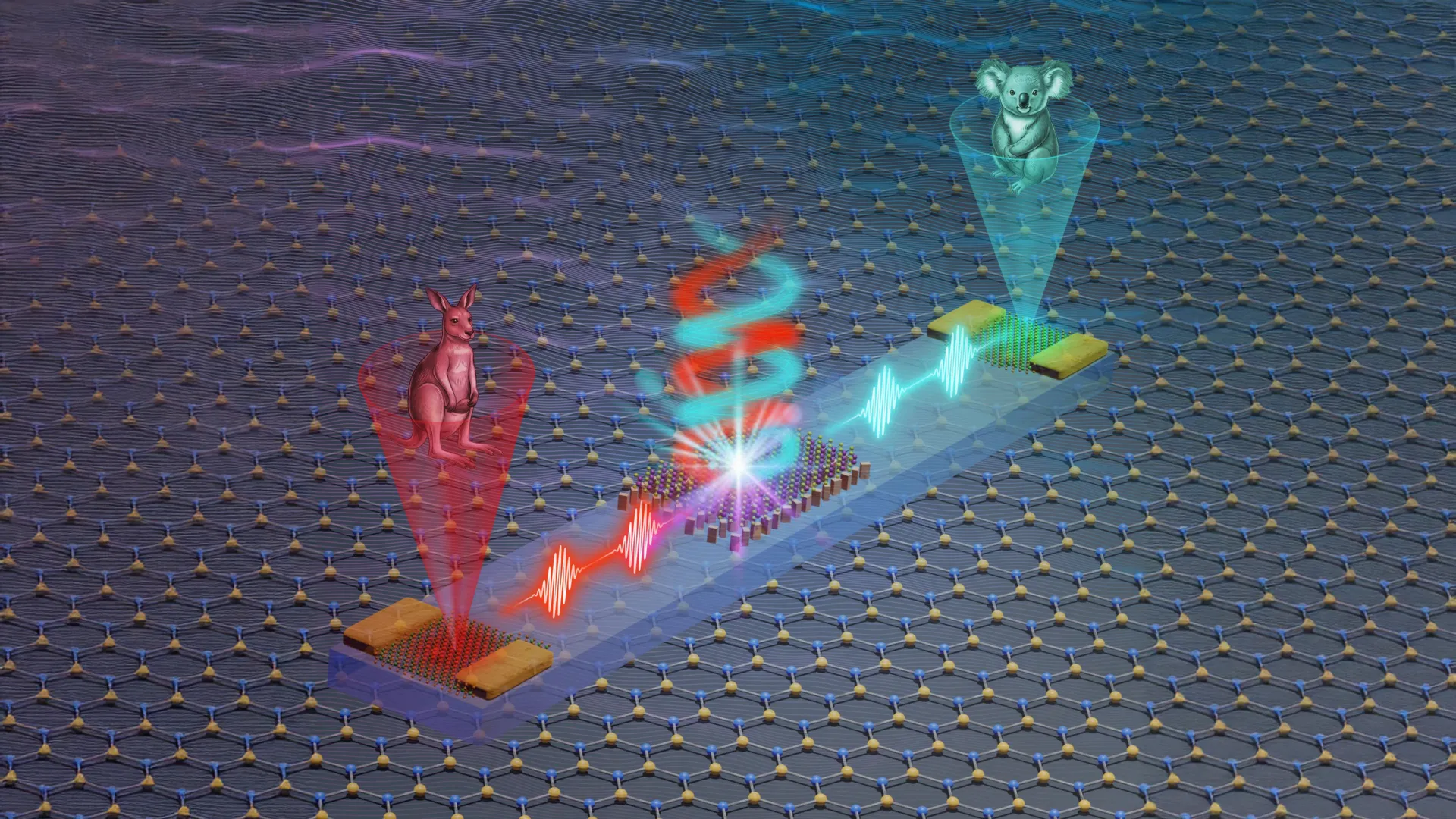
At Monash University in Melbourne, researchers have built something that seemed out of reach just months ago: a single chip that generates, steers, and reads light-based information all at once. The breakthrough, led by Dr. Chi Li and published in Nature Photonics, marks a watershed moment for valleytronics—a young but rapidly advancing field that could reshape how we compute, store energy, and process data in the decades ahead.
For years, scientists have understood the promise of using light instead of electricity to move information through computers and quantum systems. Light travels faster, consumes less power, and can be manipulated with extraordinary precision. But the engineering challenge has been brutal: researchers could create light-based signals or detect them, but doing both—plus routing those signals exactly where they needed to go—within a single integrated device remained out of reach. That's what made Dr. Li's achievement so significant. "Until now, we could generate or detect these signals, but not do everything in one integrated device," he said. "What we've built is a complete on-chip system that can create, route and read this information with very high precision."
The chip exploits a quantum property called the "valley degree of freedom"—essentially a new way to encode information using the characteristics of electrons in ultra-thin materials. The device itself is constructed from materials only a few atoms thick, layered with specially engineered nanostructures that control light at scales smaller than visible wavelengths. Dr. Kaijian Xing, co-first author of the study, explained how the team overcame the technical barriers that had stalled progress. "We employ a straightforward stacking approach to integrate ultra-thin materials with metasurfaces, overcoming the technical challenges of direct material growth on photonic structures, and enabling further advances in valleytronics," Xing said.
What makes this practical is something often overlooked in quantum research: temperature. Most quantum systems demand extreme cold—liquid nitrogen, liquid helium, specialized freezers that cost hundreds of thousands of dollars. Monash's chip works at room temperature, a genuine advantage for real-world deployment. Dr. Haoran Ren, senior author and leader of the Monash NanoMeta Group, emphasized the ripple effects. "This is a significant step toward scalable, chip-based technologies that use light instead of electricity to process information," he said. "Photonic devices use light to achieve massive bandwidths, ultra-fast data transmission speeds, and lower energy consumption."
To prove the chip could handle real computational tasks, the team encoded and processed two separate images simultaneously—demonstrating that the device can juggle multiple streams of information at once, a critical requirement for future systems. The implications are sweeping: faster computing, quantum breakthroughs, more secure communications, and next-generation optical networks that move data at the speed of light rather than the crawl of electrons through silicon.
The work was genuinely international, drawing expertise from researchers in Australia, China, Singapore, Germany, and Japan—a collaboration spanning the Monash School of Physics and Astronomy, Singapore University of Technology and Design, LMU Munich, and the University of Technology Sydney. As Professor Stefan A. Maier noted, the achievement bridges the gap between theoretical possibility and technological reality. "By combining light and quantum materials on a chip, we can access new ways of encoding and processing information."