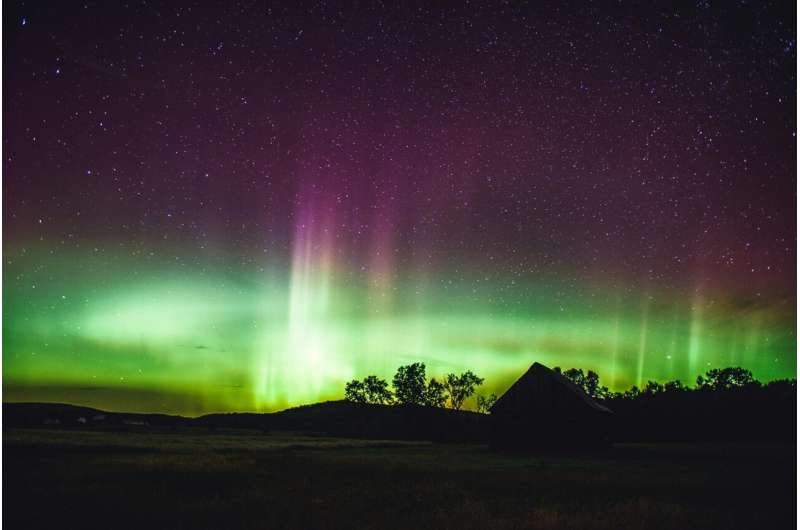
On the night of September 1, 1859, people across North America and Europe woke to brilliant lights dancing across the sky — lights so bright they thought morning had come. The cause was a massive storm on the sun, 150 million kilometers away. Back on Earth, telegraph operators were getting shocked, wires were sparking, and some lines caught fire. This event became known as the Carrington Event.
More than a century later, another solar storm hit. On March 13, 1989, the Canadian province of Quebec lost power in less than two minutes. Six million people sat in the dark for hours. Scientists call these disruptions space weather, and they start with explosions on the sun that send charged particles streaking toward Earth.
Today, as more of daily life depends on satellites and electricity, scientists are racing to understand these invisible threats better. A team at the Johns Hopkins Applied Physics Laboratory has built a new computer model called MAGE that simulates what happens in the space around Earth during solar storms.
MAGE stands for Multiscale Atmosphere Geospace Environment. The model tracks a region roughly 1.6 million kilometers (about 1 million miles) around Earth — a zone where solar particles crash into our planet's magnetic field and upper atmosphere. Earlier models looked at this space in pieces. MAGE stitches everything together, like how weather forecasts combine oceans, air, and land into one picture.
"We're trying to learn to understand it as a complex system, just like weather prediction or climate prediction," says Slava Merkin, who leads the NASA DRIVE Science Center for Geospace Storms at the Applied Physics Lab.
The model has already proven useful. When dozens of newly launched Starlink satellites lost altitude in February 2022 after a solar storm, MAGE showed how the storm heated Earth's upper atmosphere, making the air thicker and pulling the satellites down. During a giant solar storm in May 2024 — one of the strongest in over two decades — researchers used the model to trace how disruptions spread as GPS signals wobbled and auroras appeared far from the poles.
Ian Cohen, a space physicist at the lab, says the stakes keep rising as humans put more stuff into space. "We don't really know when these storms are going to happen, how intense they'll be, or how long they'll last," he says.
The team released MAGE as a free, open-source tool in 2025 so scientists worldwide can use it. The goal isn't to stop solar storms — nothing can — but to understand what happens when they hit. And that understanding might be the difference between prepared and powerless when the next great storm comes.