A 10-foot robotic arm that can feel surface textures and measure temperature is among 302 small-business projects NASA has chosen for early funding aimed at future missions to the Moon and Mars.
Together, the projects could receive up to $171 million through NASA’s Small Business Innovation Research and Small Business Technology Transfer program, known as SBIR/STTR. The awards support early research and development by entrepreneurs, startups and small businesses. They also address practical challenges facing NASA’s Artemis program and plans for a U.S. Moon Base, while helping companies develop technologies that may later reach wider use.
The latest awards cover two stages of work. Phase I contracts can provide up to $225,000 each, giving teams a chance to test whether an idea is useful and feasible. Some Phase I projects are Small Business Technology Transfer awards, which pair small businesses with research institutions. Phase II funding supports projects that began in Phase I in 2025; 98 contracts can receive up to $1.3 million each to demonstrate and deliver the technology.
Among the Phase II awards, Opterus Research and Development Inc. is developing rollable solar arrays that robots can handle. The modular arrays are designed to work in dusty conditions and attach to different support structures. They could be scaled to provide up to 50 kilowatts of power, supporting infrastructure built by NASA and commercial companies on the Moon.
A Phase I project from Intelligent Fiber Optic Systems Corporation focuses on a 10-foot extendable arm for lunar rovers. A camera and sensors would let the arm “see” and sense touch, measuring surface texture, force and temperature. That could help rovers clean solar panels, position habitat structures and collect samples in hard-to-reach places. On Earth, similar arms could inspect or repair power lines and nuclear reactors, where conditions can be dangerous.
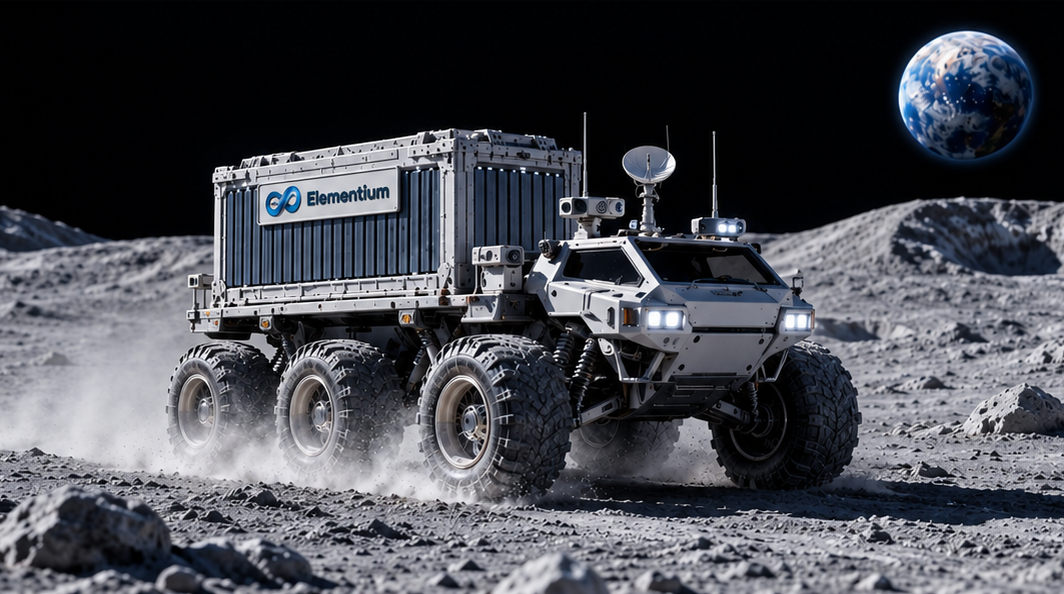
Elementium Materials Inc. is working on a battery module designed to operate at temperatures down to minus 76 degrees Fahrenheit without active heating. Using less heating equipment and insulation could save room and weight on spacecraft, leaving space for other tools and experiments. The battery could help rovers and habitats keep running during the Moon’s 14-day night, and may also have uses in cold regions on Earth or on Mars.
Another Phase I project brings together Slate Geotechnical Consultants Inc. and the Colorado School of Mines. The team will study two ways to prepare the Moon’s loose, gravel-like surface, called regolith, for repeated landings. Rocket exhaust can scatter that material, raise dust and carve craters, threatening spacecraft and nearby equipment. The researchers will also explore how rovers could repair and maintain landing pads.
These projects are still at early stages, and the awards do not guarantee that every design will be used on a mission. But the work tackles clear needs: power, dependable equipment in extreme cold, capable robots and safer places to land. If the ideas prove out, small teams could help build the practical systems needed for longer stays on the Moon—and, eventually, exploration of Mars.