Amelia Bruno and her MIT colleagues have engineered a propulsion system that does something satellites have never quite managed before: deliver both the raw power of a chemical rocket and the surgical precision of an electric thruster, all from a single fuel tank. The breakthrough opens an unexpected door for small spacecraft to venture far beyond Earth—to Mars, the asteroid belt, and beyond—while staying light enough to launch affordably.
For decades, small satellites have faced an unglamorous trade-off. Chemical thrusters excel at fast, forceful maneuvers—the kind needed to launch or quickly change course—but they guzzle fuel. Electrospray thrusters, by contrast, are remarkably stingy with propellant and brilliant at tiny, precise adjustments over long journeys, but they lack punch. Engineers have always had to choose one or accept carrying two separate, heavy propulsion systems. Bruno's team found a way around that constraint.
The key is a special ionic liquid propellant called ASCENT (Advanced SpaceCraft Energetic Non-Toxic propellant), originally developed by the U.S. Air Force as a less hazardous alternative to hydrazine for chemical thrusters. When Bruno and Paulo Lozano, MIT's Miguel Alemán Velasco Professor of Aeronautics and Astronautics, realized ASCENT was itself an ionic liquid—the same class of fuel their electrospray thrusters already used—they saw the possibility. "We said, hey, that's the stuff we typically use," Bruno recalls. "Theoretically, this should work. Let's go figure out how."
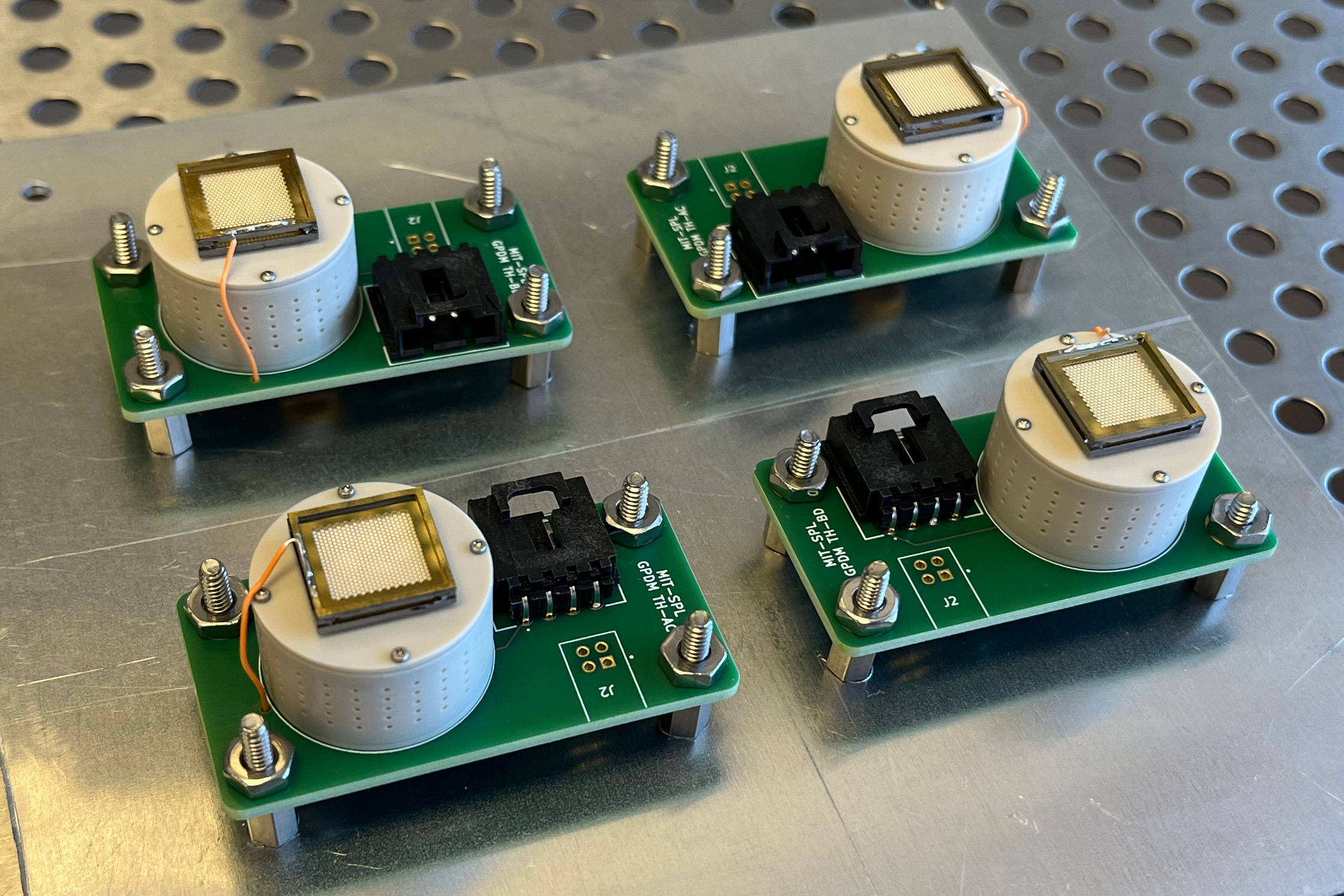
Their experiments, published this week in the Journal of Propulsion and Power, show it does work. ASCENT can fuel both types of thrusters with equal effectiveness, a finding that transforms what small satellites can accomplish. Imagine a briefcase-sized CubeSat equipped with one chemical thruster for bold maneuvers and four thumbnail-sized electrospray thrusters for fine-tuning—all drawing from a single propellant reservoir. That is exactly what NASA will soon launch in the Green Propulsion Dual Mode mission, a flight test that will be the first to demonstrate this two-in-one approach for small spacecraft.
The implications ripple outward. "If you can have chemical and electrical propulsion in one small package, it's the best of both worlds," Bruno says. Lozano envisions CubeSats making the slow, fuel-efficient journey to Mars or the asteroid belt using electrospray thrusters, then switching to chemical thrusters for rapid repositioning to observe interesting geological features. "You could have a lot more flexibility to do a lot more things," Lozano explains. Small satellites—significantly cheaper and lighter to launch than conventional spacecraft—could suddenly undertake missions once reserved for much larger, costlier platforms.
The elegance of the solution reflects the collaborative weaving of foundational research with practical needs. Lozano's lab, which designs and tests electrospray thrusters at scales ranging from thumbnail to thumbnail-plus, has spent a decade refining ionic liquid propellants because these substances remain stable in the extreme conditions of space. Ionic liquids are essentially salts in liquid form, structured as what Bruno calls "a sea of ions" that can be electrically charged and sprayed into space as thrust. The U.S. Air Force's development of ASCENT as a greener alternative to hazardous hydrazine happened to create a propellant that bridges both propulsion worlds.
With the Green Propulsion Dual Mode mission poised for launch, Bruno and her collaborators—including graduate student Matthew Corrado—have planted a flag at the threshold of a new era for small-spacecraft exploration. What was once a limitation of scale may soon become an advantage of agility.