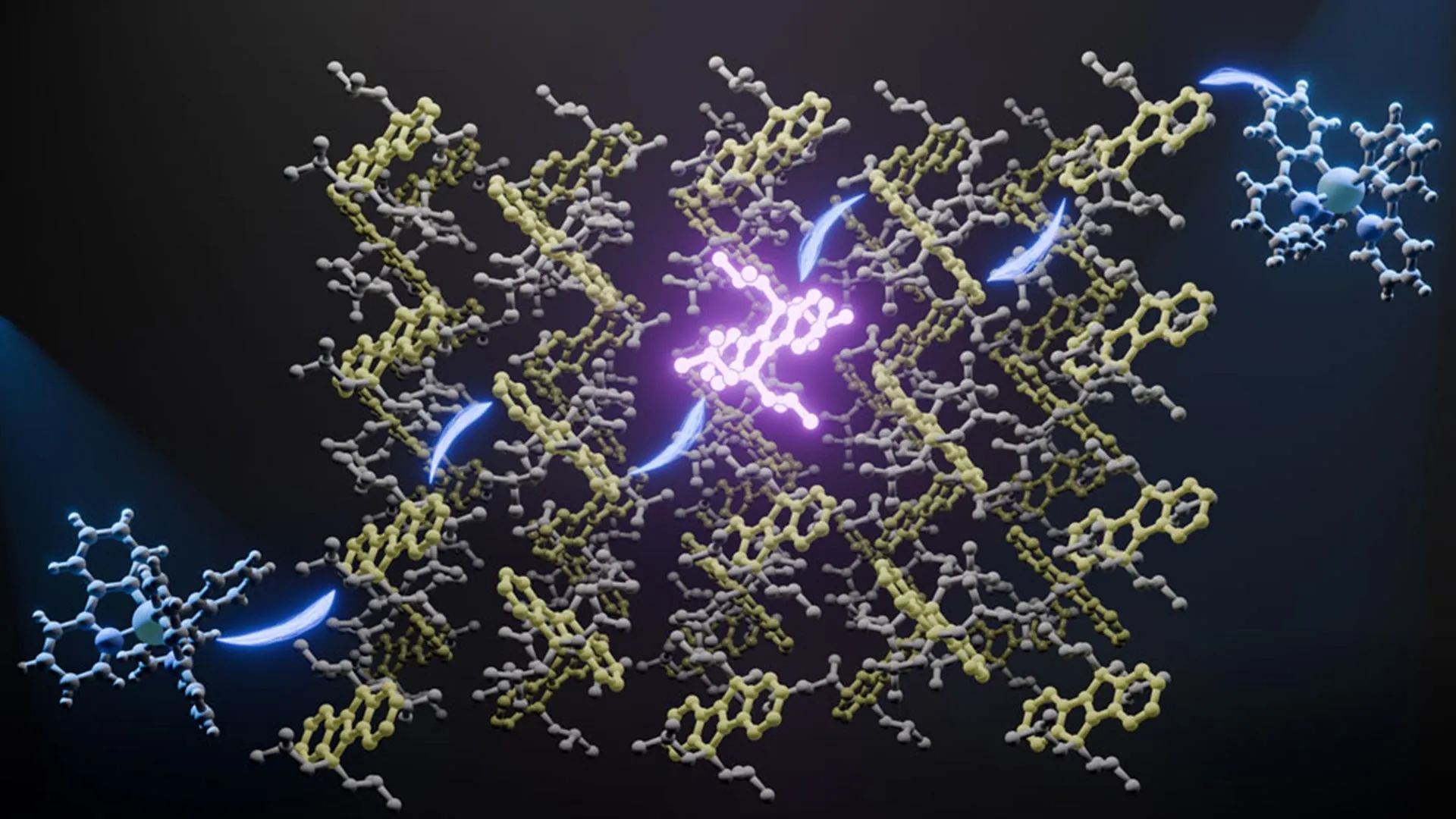
Imagine combining two cups of lukewarm water and ending up with a cup of boiling water. In everyday life, that's impossible—but at the quantum level, multiple low-energy particles of light can merge their energy to create a single, more powerful particle. Now, researchers at Kyushu University in Fukuoka have turned that quantum curiosity into a practical technology: a solid material that transforms visible sunlight into ultraviolet light, a feat that has eluded scientists for years.
The team developed a molecular material capable of photo upconversion under normal outdoor conditions, achieving an efficiency of 1.9 percent—meaning roughly two UV photons are produced for every hundred visible-light photons absorbed. While that may sound modest, the achievement lies in doing it at all. Most solid-state materials cannot accomplish this even with far more intense light sources.
"It may sound low, but it runs on natural sunlight alone," said Yoichi Sasaki, Associate Professor at Kyushu University's Faculty of Engineering and the study's corresponding author. "Most solid-state materials cannot realize this even at much higher light intensity."
The breakthrough centers on a material called dihydroindenoindenedene, which the researchers modified by attaching alkyl chains to its sp³ carbon atoms. This engineering created carefully calibrated spacing between neighboring molecules—close enough for efficient energy transfer, yet separated enough to prevent what scientists call "quenching," where excited states fizzle out before they can be useful. The result is a material with a solid-state fluorescence quantum yield exceeding 60 percent and strong luminescence.
The implications stretch beyond the laboratory bench. UV light powers air purification systems, 3D printing resin curing, dental filling hardening, and nail treatments. Yet it comprises only about 6 percent of the sunlight reaching Earth's surface, making efficient conversion from abundant visible light a compelling goal. The Kyushu team has already filed a patent application and believes their material could eventually power solar-driven photocatalysis, indoor air cleaners, and low-intensity 3D printing—all running on nothing but sunlight.
For the researchers, the journey to this moment spans 14 years. In 2012, Nobuo Kimizuka, now Professor Emeritus at Kyushu University's Research Center for Negative Emissions Technologies, began exploring photon upconversion in self-assembled molecular systems. His group made steady progress using solution and gel-based approaches, but reliable solid-state upconversion remained frustratingly out of reach. The breakthrough finally arrived in May 2024, just months before Kimizuka's retirement. Graduate students Naoyuki Harada, Hayato Shoyama, and Nutnicha Boonmong worked alongside Sasaki and then-Assistant Professor Kiichi Mizukami to transform more than a decade of research into a published discovery.
What makes this story remarkable is not just the science, but the timing—years of patient work culminating in the final stretch of one researcher's career, with a new generation of scientists carrying it forward.