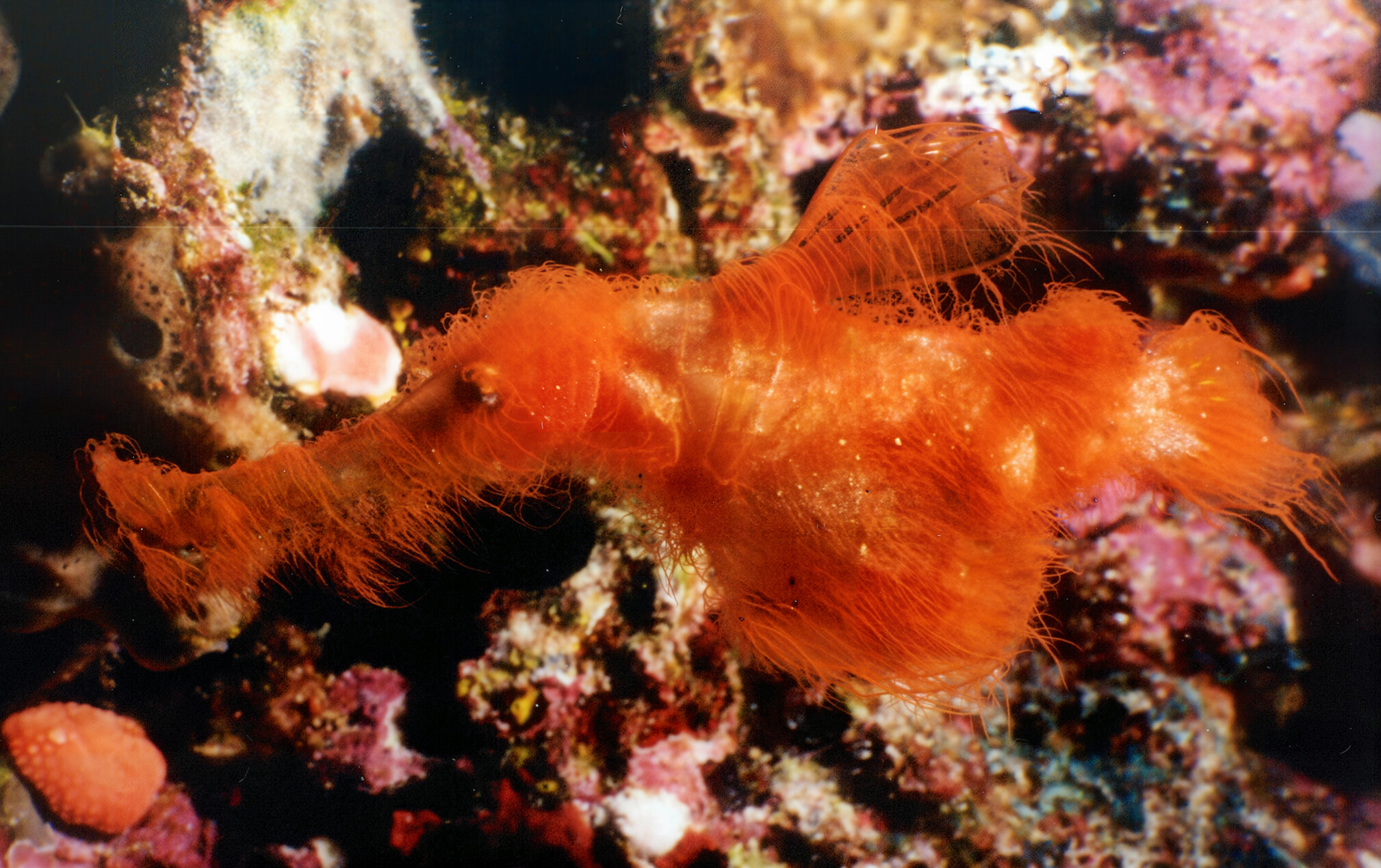
David Harasti was diving near Papua New Guinea in 2001 when he spotted something that stopped him cold—a shaggy, bright orange creature with a long trunk-like snout that didn't match any entry in his reference books. Two decades later, after patient detective work and help from thousands of citizen scientists who posted photos on social media, that creature finally has a name: Solenostomus snuffleupagus, the hairy ghost pipefish, formally described for the first time in the scientific literature.
The discovery matters because it reveals how much we still don't know about our planet's most-visited marine ecosystems. The Great Barrier Reef has been studied for generations, yet even there, entirely new species are hiding in plain sight, camouflaged so perfectly they can drift through the water looking like floating debris. This shouldn't be surprising—but it is, and that gap between our assumption of knowledge and reality points to how urgent it has become to study and protect the places we think we already understand.
Ghost pipefish are distant cousins of seahorses and pipefishes, with the distinctive long snouts that give them their name. But they buck the family pattern in one striking way: while male seahorses and pipefishes carry brooding pouches, in ghost pipefish it's the females who nurture eggs in specialized abdominal pockets. Until 2022, only six species were known to science. The hairy ghost pipefish becomes the seventh.
The animal's story began with Harasti's moment of perplexity in 2001, followed by years of confusion. Local divers around the Great Barrier Reef had been posting images of the orange-red fish on Facebook groups and iNaturalist since 2005, but the creature kept getting misidentified as a rough snout ghost pipefish—a similar-looking species with its own "hairy" appearance. The resemblance was close enough to fool even experienced observers, until Graham Short and David Harasti brought specimens back to the Great Barrier Reef in 2022 for formal examination.
What they found was unmistakable. The new species has 36 vertebrae—more than any other known ghost pipefish—and possesses unique star-shaped bony structures in its skin that no other species shares. Genetic analysis revealed it diverged from its closest relative roughly 18 million years ago, having traveled its own evolutionary path in silence ever since.
Short marveled at the creature's mastery of disguise. "They're just stunning underwater," he told Science News. "It's just amazing that they're actually fish." The hairy ghost pipefish has evolved to move like floating seaweed, visually mimicking the drifting red macroalgae around it. In an environment already crowded with camouflaged animals competing for invisibility, this species elevated the art form.
The name itself is a gentle nod to the beloved Sesame Street character Mr. Snuffleupagus—a fitting tribute that drew a warm response from Sesame Workshop. The connection captures something essential about why we name new species at all: to make them real to ourselves, to claim them in language, to say they matter. As Rosemarie Truglio, senior vice president of global education at Sesame Workshop, noted, the fish represents "a wonderful reminder that there is still so much to explore and learn about the world." In oceans we've sailed for centuries, mysteries that still beckon. That's worth celebrating.