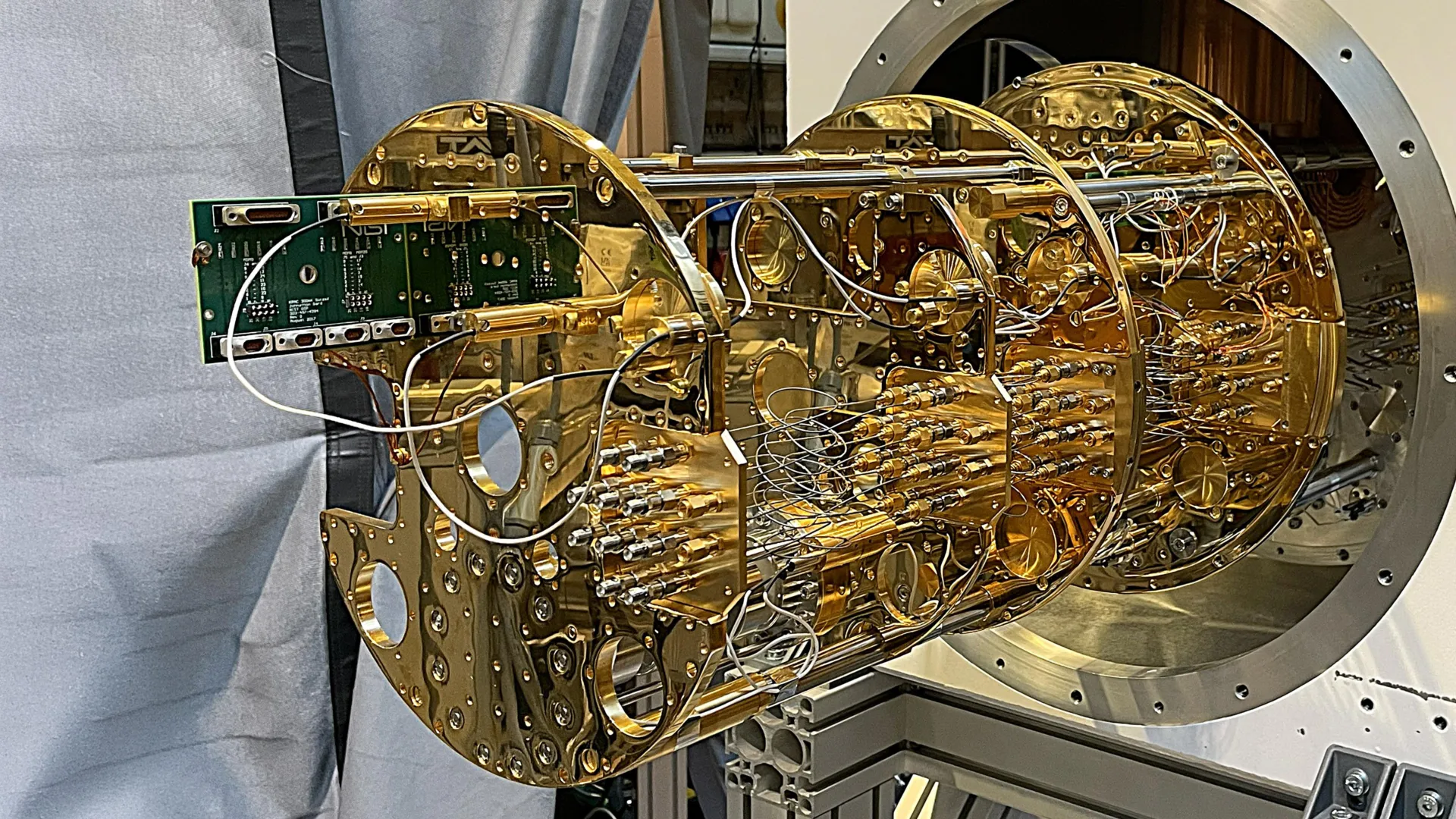
Régis Decker flicks on a monitor in the control room at BESSY II, and within seconds, the faint glow of X-ray emissions from a single atomic layer flashes across the screen—data that once would have taken hours to capture, now gathered in less than a minute. This leap in speed and sensitivity comes from a groundbreaking new instrument now live at the synchrotron facility in Berlin: Europe’s first and only superconducting Transition Edge Sensor (TES) spectrometer. Developed jointly by Helmholtz-Zentrum Berlin (HZB), the Max Planck Institute for Chemical Energy Conversion (MPI-CEC) in Mülheim-an-der-Ruhr, and the National Institute of Standards and Technology (NIST) in Boulder, Colorado, the device marks a transformative moment for X-ray science. For decades, techniques like X-ray Emission Spectroscopy (XES) and Resonant Inelastic X-ray Scattering (RIXS) have been bottlenecked by the need for large, concentrated samples to generate detectable signals. That limitation is now shattered.
The TES spectrometer’s 248 superconducting sensors, cooled to just 25 milli-Kelvin by a helium dilution refrigerator, can detect individual photons with unprecedented efficiency. When an X-ray photon strikes a sensor, the tiny temperature rise disrupts its superconducting state, triggering a measurable shift in electrical resistance—captured with extreme precision by an array of Superconducting Quantum Interference Devices (SQUIDs). This system boosts photon detection efficiency by a factor of 100 to 1,000 compared to conventional spectrometers, opening the door to studying ultra-dilute samples, quantum materials, and atomically thin structures like graphene with remarkable clarity. Experiments that once demanded hours of beamtime can now be completed in minutes, dramatically expanding access and throughput.
Installed at the UE52-SGM beamline, the instrument operates under ultra-high vacuum with precise temperature control from 10 K to room temperature, and full polarization capabilities. It complements other techniques like ARPES by providing detailed insights into electronic and magnetic properties in low-dimensional systems. Researchers are already planning investigations into molecular catalysts, quantum impurities, and novel 2D materials. Future upgrades will add in-situ sample preparation and the ability to apply magnetic fields, enabling advanced studies in X-ray Magnetic Circular Dichroism (XMCD) and RIXS-MCD.
Globally, only five other TES spectrometers operate at X-ray facilities—four in the U.S. and one in Japan—making BESSY II’s new instrument a rare and powerful asset for European science. As Régis Decker puts it, 'We are looking forward to receiving exciting research proposals from our user community.' With its unmatched sensitivity and speed, this instrument isn’t just upgrading capabilities—it’s redefining what’s possible in X-ray spectroscopy.