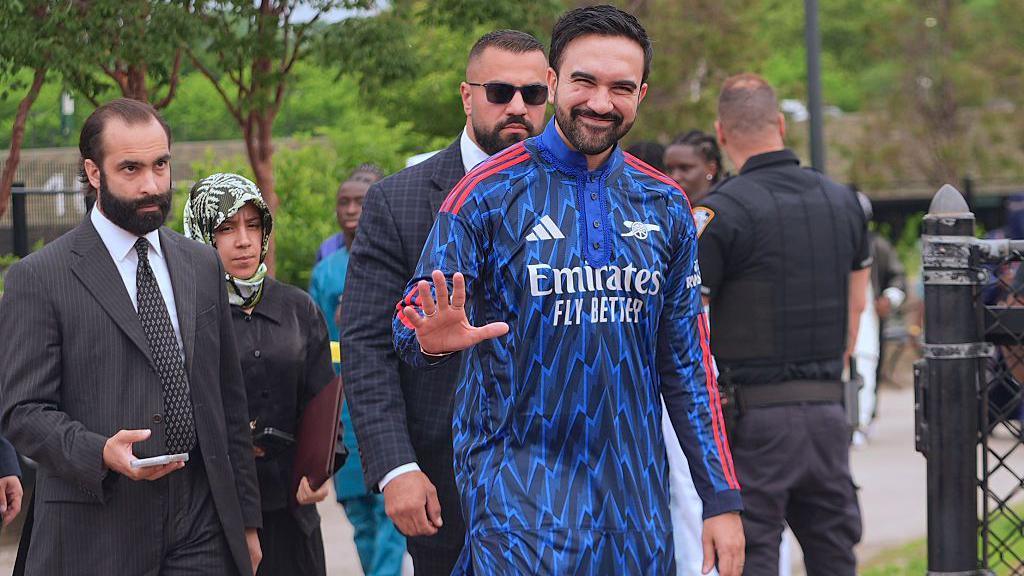
When Zohran Mamdani walked into Eid al-Adha prayers in the Bronx on Wednesday, he brought something with him that few mayors have dared to wear to a religious celebration: a custom Arsenal-themed kurta, tailored after the club's 2025-26 navy and red lightning bolt away shirt. At 34, Mamdani is New York's first Muslim and Asian-American mayor, and the images of his ensemble quickly went viral—a moment that felt both deeply personal and unmistakably his.
The kurta represents something larger than football fandom. It's a quiet statement about belonging, about the possibility of honoring multiple parts of yourself simultaneously. Mamdani, born and raised in Uganda, began supporting Arsenal at age 10 when his uncle gave him a set of fridge magnets featuring Gunners legends—Sylvain Wiltord, David Seaman, Sol Campbell, and Thierry Henry. That childhood gift planted a seed that has only grown. Today, whether leading the city or celebrating one of Islam's most important holidays, his Arsenal passion remains inseparable from who he is.
What makes Mamdani's fandom unusual isn't just its visibility—it's its depth. His social media followers have marveled at his ability to recall obscure 1990s footballers with ease. More remarkably, in 2012, he was among 20,000 people who participated in an international share-buying campaign to save Spanish side Real Oviedo from bankruptcy. As a shareholder in a club thousands of miles from New York, he demonstrates that football devotion knows no geographic bounds.
Since his election as mayor in November, Mamdani has continued to weave his passions into his public role. He recently became a vocal critic of FIFA's dynamic pricing for World Cup tickets, and he's channeled his frustration into action. He announced a lottery for 1,000 New York residents to win the chance to purchase $50 tournament tickets—a direct response to pricing that has locked out ordinary fans. The response was staggering: the 50,000-person daily limit for entering the lottery was reached within three minutes on its opening day. That kind of hunger speaks to something Mamdani understands intimately: the power of sport to unite people across economic divides.
The 2026 World Cup will be hosted across the United States, Mexico, and Canada, with the final taking place at MetLife Stadium in New Jersey between June 11 and July 19. It's a tournament that gives Mamdani another opportunity to blend his roles as administrator and advocate.
But there's a question hanging in the air that even the Arsenal-themed kurta hasn't answered: What will Mamdani's celebrations look like if Arsenal win the Champions League? On May 30 in Budapest, the club faces Paris Saint-Germain in European football's most prestigious tournament. Whether that match becomes the occasion for another custom garment—perhaps a kurta inspired by their European glory—only time will tell. For now, Wednesday's Eid prayers in the Bronx offer something rarer and more valuable: proof that the things we love, the traditions we honor, and the cities we lead don't have to compete for space in our lives. They can, with imagination and courage, exist together.