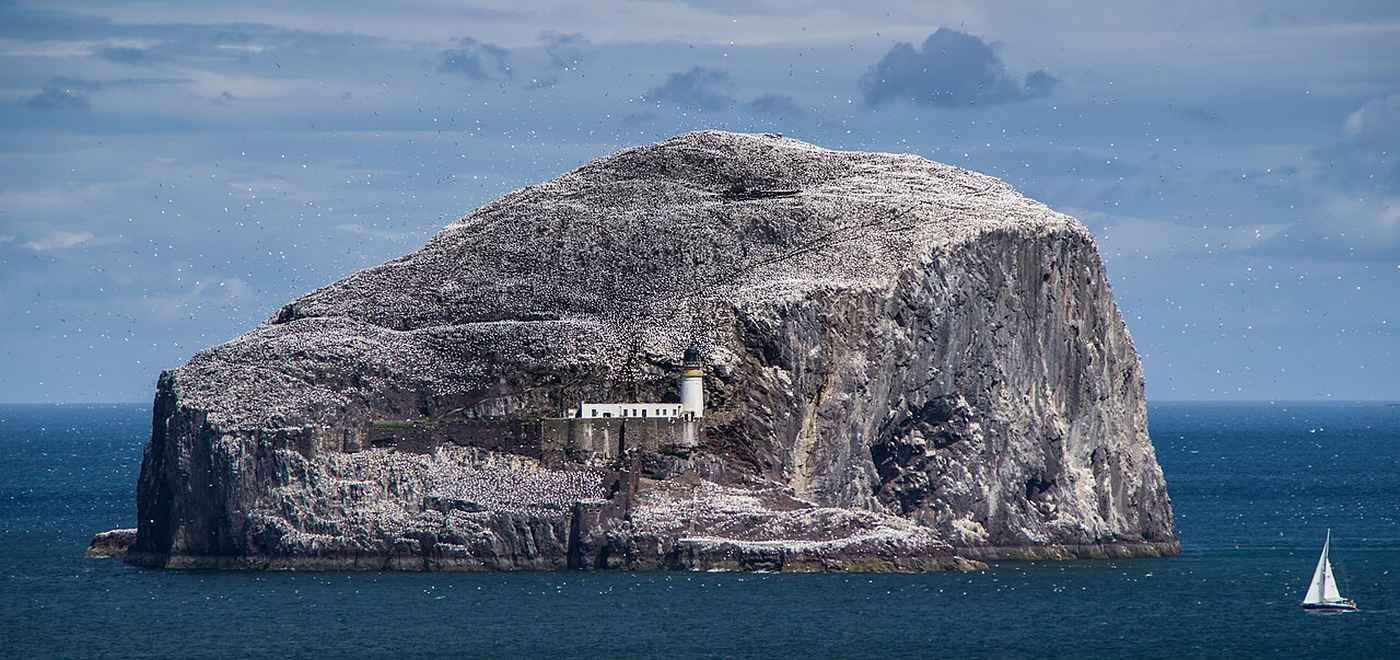
Sir Hew Dalrymple stood on Bass Rock, the ancient fortress of his family's 320-year stewardship, and made the decision to let it go. The Scottish noble and his descendants, the Dalrymples, have watched over this towering island in the Firth of Forth since 1704, but rising seabird fatalities and the specter of an offshore wind farm convinced him that the Royal Society for the Protection of Birds could safeguard the colony better than a private landowner ever could.
Bass Rock has long captured the world's imagination as one of nature's most extraordinary concentrations of life. Sir David Attenborough himself called it one of the "12 wildlife wonders of the world." The island's 100,000 gannets create a living cloud above its rugged cliffs, nesting among the weathered stones of a 14th-century castle and the remnants of a 17th-century prison that earned the grim nickname "Scotland's Alcatraz." Beyond the gannets, 10,000 puffins make their homes on Bass Rock and the neighboring uninhabited island of Craigleith, drawn to these storied rocks across generations.
The decision to sell carried emotional weight. "I made the decision to do this because of the risk these birds are now facing," Sir Dalrymple explained to reporters from the island itself. "I thought an organization like the RSPB would be better equipped to protect the islands and their wildlife than a private individual." He acknowledged the significance of stepping away after so many decades: "Although with some emotional regret, they are now custodians of these two islands."
What makes this transition particularly striking is the trajectory of conservation already underway. The Dalrymple family had collaborated closely with the Scottish Seabird Centre for years, implementing measures that transformed Bass Rock into an even more vital refuge. The puffin colony, once a fragile presence, has grown to five-figure numbers through sustained effort. An invasive tree species was systematically eliminated, restoring the natural character of the islands. Despite these successes, the family recognized that threats were mounting.
The offshore wind farm approved nearby crystallized the concern. Though renewable energy is vital for combating climate change, the potential impact on the gannet population—which has already faced mounting pressures—tipped the scales toward placing the islands in the hands of an organization with full regulatory freedom and dedicated expertise. The RSPB, working alongside the Scottish Seabird Centre, will inherit not just these islands but the responsibility to steward one of Europe's most significant seabird sanctuaries as environmental pressures intensify.
The acquisition cost approximately £680,000, with support from the National Heritage Memorial Fund and lottery funding. Simon Thurley, chairman of the funds through the National Trust, framed it as transformative: "For the Memorial Fund, this is a once in a lifetime opportunity to secure the islands for the public and ensure that, with RSPB Scotland and the Scottish Seabird Centre at the helm, their role as seabird sanctuaries is protected for the future." Bass Rock and Craigleith will remain open to the public while gaining the professional infrastructure needed to thrive in an uncertain climate.
The transfer represents something rare in conservation: a powerful landowner voluntarily stepping aside not from pressure but from genuine conviction that someone else is better positioned to protect what matters most. For the 100,000 gannets and 10,000 puffins whose lives depend on these Scottish rocks, the island's greatest gift may be this act of letting go.