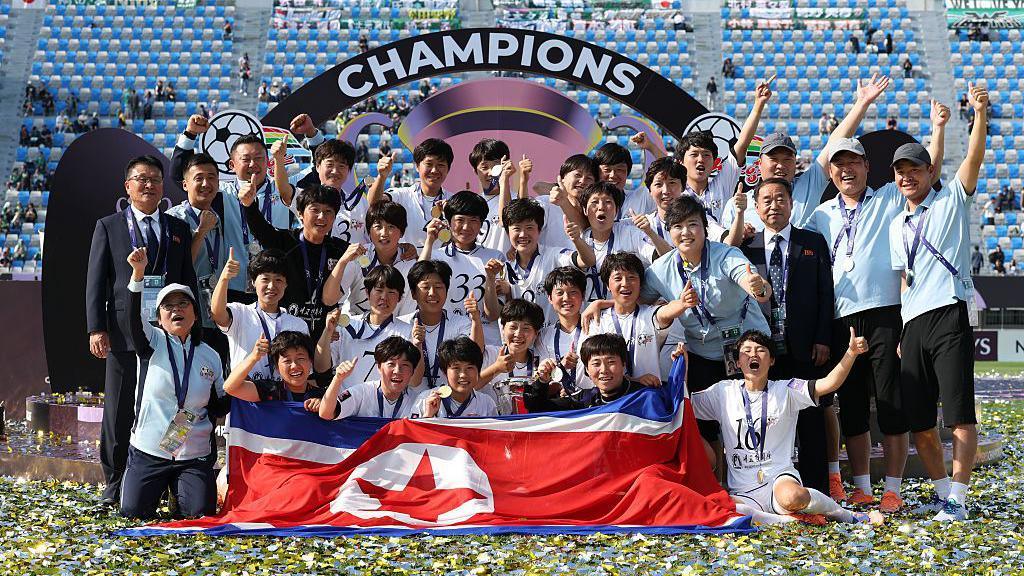
On a Seoul football pitch on Saturday, the Naegohyang team from North Korea lifted the Asian Women's Champions League trophy—and in doing so, crossed a border that has remained largely closed for seven decades. The victory marks the first time a North Korean women's team has won continental club football's top prize, and it arrived not just as a sporting triumph, but as a quiet signal that even amid decades of animosity, moments of shared competition and respect can still find room to flourish.
The two Koreas are technically still at war, having failed to sign a peace treaty when the Korean War ended in 1953. In recent years, relations have deteriorated significantly, with North Korea labeling South Korea its "most hostile state" and declaring it would no longer seek reunification. Yet on Saturday, roughly 1,200 members of civic groups backed by Seoul's unification ministry attended the final—a modest but meaningful show of cross-border solidarity. Official travel restrictions meant no away supporters from the North could attend, making this gathering of South Korean civilians an especially poignant gesture.
The match itself came alive when Kim, one of Naegohyang's key players, scored the goal that settled the contest. Coach Ri spoke afterward with restrained pride about the team's single-minded focus. "All of our players focused solely on winning today's match, putting in the effort while cherishing every minute and second," he explained. When a South Korean reporter posed a question that referred to North Korea as the "north side," both Ri and Kim walked out of the news conference—a moment that underscored the sensitivities still present, even in moments of athletic fellowship.
Before the semi-final, South Korea's Unification Minister Chund Dong-young had expressed hope that the competition would set a "positive precedent" for inter-Korean relations. President Lee Jae Myung has signaled a broader commitment to improving ties, and this football championship appears to have provided a platform—however modest—for that thawing to take shape. The victory itself carries immediate weight: Naegohyang will now represent Asia at next year's FIFA Women's Champions Cup, the global tournament that brings together the champions of all six continental confederations.
What makes this moment notable is not that it resolves decades of division, but that it reminds both nations and the watching world that competition can create space for humanity. Two nations separated by a heavily militarized border, with a war that never formally ended, found themselves sharing a stadium in celebration of athletic excellence. The fact that it happened—quietly, without fanfare, through the simple framework of sports—suggests that even in the coldest political climates, pathways for connection can still emerge. Whether this victory becomes the first step toward broader warming or remains a singular bright moment remains to be seen. But for now, North Korea's Naegohyang team has reminded the world that borders, however fixed they may seem, are not immutable when people choose to meet across them with respect and shared purpose.