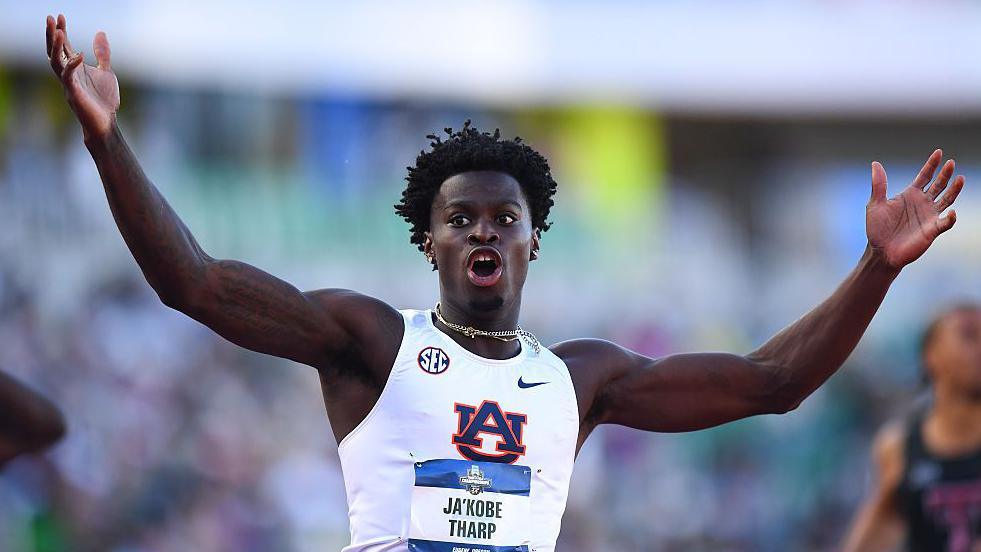
When Ja'Kobe Tharp crossed the finish line in Eugene, Oregon on Wednesday, he didn't just break a record—he shattered one that had stood for twelve years, and he did it with a modesty that made his achievement even more remarkable. The 20-year-old from Auburn, Alabama, clocked 12.75 seconds in the 110m hurdles at the NCAA championships, erasing the world record of 12.80 set by Aries Merritt in Brussels in 2012.
What makes Tharp's feat extraordinary is not just the time itself, but the context. He came into the meet expecting to improve on his previous personal best of 13.01—a solid ambition. Instead, he dropped more than a quarter of a second, the kind of jump that happens once in a generation. And he did it during heats, not even the final, meaning there are still more opportunities for him to run even faster.
"I knew I was ready to drop something crazy," Tharp told reporters afterward, his disbelief evident. "I knew what I was capable of, but I didn't know about that. It wasn't on my bingo chart for this meet, not at all. I'm speechless, seriously." Those words capture something essential about elite athletic achievement—the gap between preparation and the lightning strike of a perfect moment.
This is only the beginning of Tharp's week. He'll compete in Friday's final, chasing a milestone that would place him among the sport's elite: becoming the first hurdler since Grant Holloway in 2019 to win a second straight NCAA title. Holloway, now the Olympic champion, set the previous collegiate record of 12.98 in 2019, a mark that Tharp has decisively surpassed.
The historical weight of Wednesday's performance cannot be overstated. Tharp is the first athlete to set a world record at the NCAA championships in fifty years—a span that encompasses generations of collegiate competitors pushing the boundaries of what's possible. The NCAA championships have been a proving ground for American track and field, yet world records rarely emerge from that stage. That Tharp did so at age 20 suggests he is only scratching the surface of his potential.
His achievement arrives at a moment when American hurdling remains a global powerhouse. Between Merritt's 2012 record and Holloway's Olympic dominance, the discipline has belonged to the United States, and Tharp is stepping into that lineage with authority. But where Merritt and Holloway earned their records in major international competitions—Brussels for Merritt, the Olympics for Holloway—Tharp's record came at a college championship, a reminder that the highest levels of sport sometimes emerge from unexpected stages.
Friday's final will tell us whether Wednesday was the peak of his week or merely the opening act. Either way, Ja'Kobe Tharp has already entered the record books, not just in times and distances, but in the rare category of athletes who reset what we thought was possible.