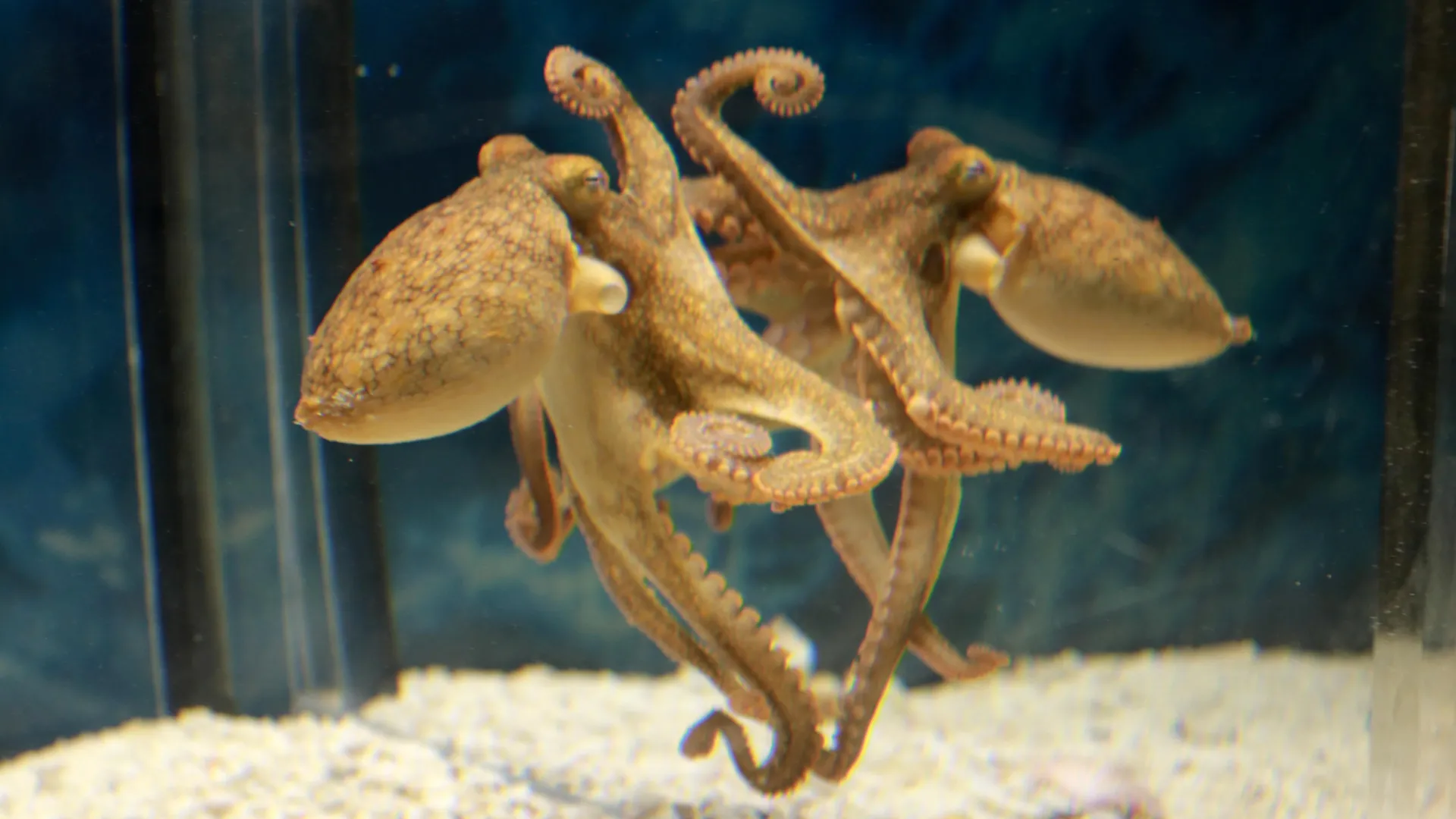
In a laboratory at Dartmouth, three California two-spot octopuses faced a puzzle that would have stumped most animals: locate a virtual crab visible only in a mirror's reflection, then turn away from the mirror and swim toward the actual location of the prey. They succeeded about 73% of the time, a finding that has upended our understanding of where sophisticated thinking lives in the animal kingdom.
Researchers led by Mary Kieseler, now a postdoc at Switzerland's University of Fribourg, have documented the first known instance of invertebrates learning to use mirrors as a tool to understand their environment and hunt. Mirror use had been observed before—in certain mammals and birds—but octopuses occupy a different branch of the evolutionary tree entirely. Their last common ancestor with humans was a worm that lived 350 to 500 million years ago, making octopuses among the most evolutionarily distant animals from ourselves.
The experiment was carefully designed to isolate mirror cognition from the octopuses' other sensory abilities. These animals possess chemoreceptors that allow them to smell and taste through touch, so researchers used a projected crab image rather than real prey. Each octopus was placed in an open-fronted start box with a mirror positioned directly ahead. The virtual crab appeared behind the animal, on either its left or right side, visible only in the mirror's reflection. To earn a live crab reward, each octopus had to recognize where the image actually was and navigate toward that location—not toward the mirror itself.
The animals showed clear learning over time, becoming faster at reaching the correct side as trials progressed. Some even climbed over the edge of the box rather than swimming around it, demonstrating an emerging efficiency in their problem-solving. While the octopuses did not always take the shortest path, their improving speed suggested they were developing an internal map of the space around them.
Peter Tse, the senior author and a cognitive neuroscientist at Dartmouth, draws a parallel to human skill acquisition. "We don't enter the world knowing how to use a mirror but learn how to use a mirror," he notes. "Just as new drivers learn to use a rearview mirror to track other vehicles, octopuses can also learn how to use a mirror to infer where things are in the world." The study, published in Current Biology, suggests that this kind of spatial reasoning may evolve independently across vastly different species—a phenomenon scientists call convergent evolution.
The octopus's hunting strategy likely explains why such cognition would be advantageous. These animals live in complex environments filled with obstacles—coral reefs, rocky seafloor—and must sneak up on prey and strike quickly to avoid becoming prey themselves. Hunters are more effective when they possess what Tse calls "an internal representation of space," a mental map that tells them where they are in relation to their surroundings. The new findings hint that octopuses may indeed maintain such maps, though researchers acknowledge that more investigation is needed to confirm this hypothesis.
The work opens a new window into how intelligence itself evolves. If an invertebrate so distant from humans can independently develop the cognitive machinery to use mirrors as a spatial tool, it suggests that these neural processes may be fundamental solutions to survival challenges—not unique to our branch of the tree of life, but solutions that nature has discovered and refined across hundreds of millions of years.