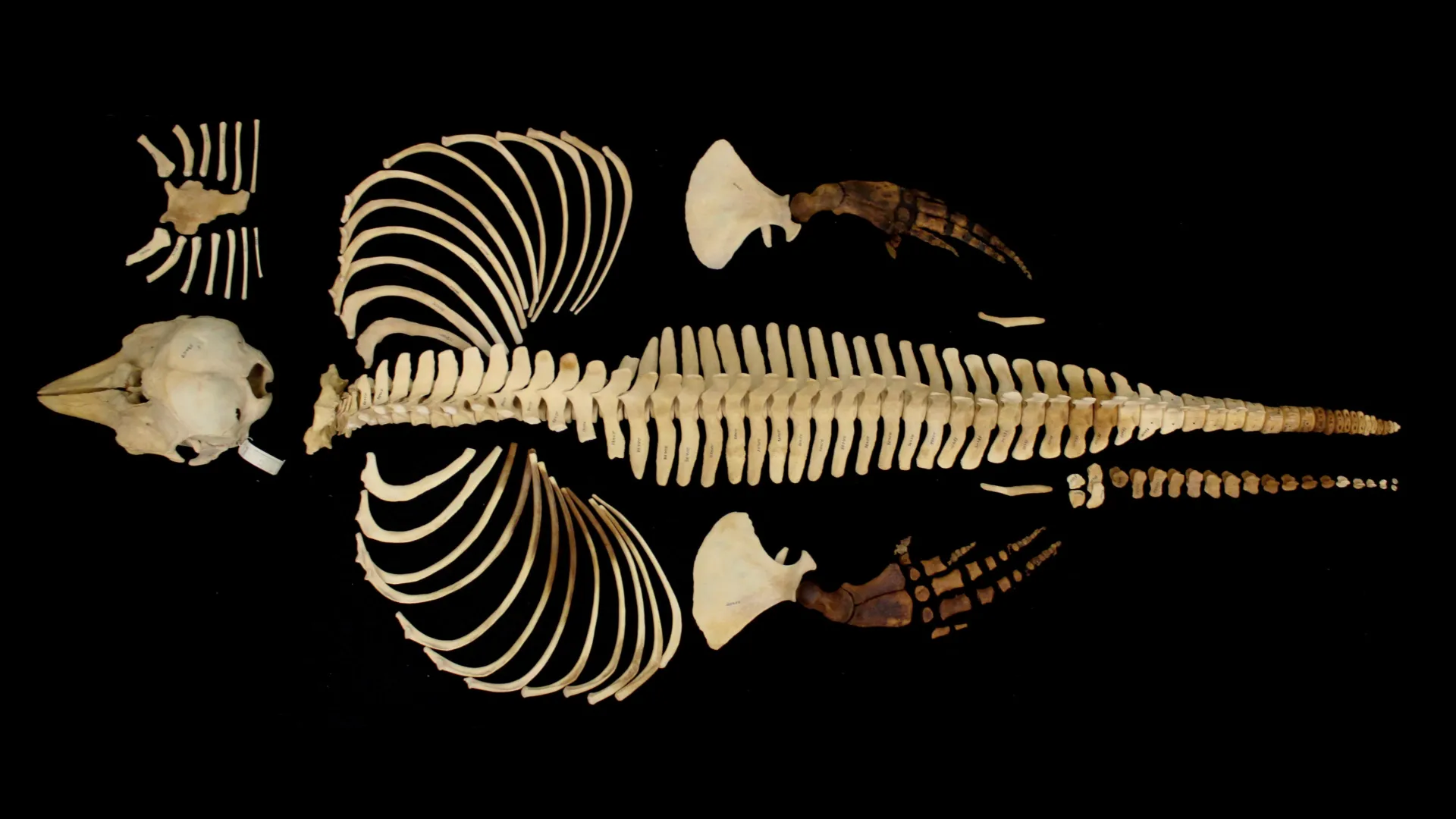
When marine biologist Robert L. Brownell Jr. collected a small, unassuming porpoise skeleton in the Gulf of California in 1966, he couldn’t have known it would one day become one of the most important digital records of a species on the brink of vanishing forever. Now, over half a century later, that single female vaquita—Phocoena sinus, the world’s rarest marine mammal—has been reborn in stunning digital detail, thanks to a groundbreaking imaging project led by scientists from Florida Atlantic University, the San Diego Natural History Museum, SeaWorld California, and NOAA Fisheries. With fewer than ten individuals estimated to remain in the wild, the vaquita’s survival hangs by a thread, its decline driven by illegal gillnet fishing targeting the totoaba fish for its valuable swim bladder. But even as the species teeters toward extinction, science is ensuring its legacy won’t disappear with it.
The new digital archive, published in Marine Mammal Science, combines medical CT scans, micro-CT imaging, and high-resolution photography to create an interactive 3D model of the vaquita’s entire skeleton—capturing features as small as a few microns, finer than a human hair. This level of detail allows researchers to study the internal architecture and external morphology of each bone without ever touching the fragile original specimen. The project was spearheaded by Jamie Knaub, a Ph.D. candidate at FAU, alongside Brittany Aja Dolan, Philip Unitt, and Brownell, whose early fieldwork laid the foundation for this vital preservation effort.
What makes this work truly transformative is its accessibility. The digital models are open-source, meaning scientists, educators, and students around the world can explore, rotate, and magnify the vaquita’s bones in three dimensions—enabling everything from classroom lessons to advanced anatomical research. Museums can even 3D-print accurate replicas for exhibits, bringing awareness to a creature most people will never see alive. “By combining advanced imaging technologies with open-access data sharing, the effort not only safeguards a valuable record of one of the planet's most endangered marine mammals, but also makes that information accessible to anyone,” said Knaub. This digital lifeline ensures that even if the vaquita disappears from the wild, its scientific and educational value endures.
Beyond preservation, the archive offers crucial insights for conservation. Understanding the vaquita’s unique anatomy can inform future efforts in marine biology and cetacean evolution, and may even aid in identifying remains if illegal trafficking is suspected. Every scan, every reconstructed bone, becomes a quiet act of resistance against extinction. While the fight to save the vaquita continues—through gillnet bans, international enforcement, and habitat protection—this digital record stands as both a warning and a gift: a testament to what we’ve nearly lost, and a tool to inspire future generations to protect what remains.