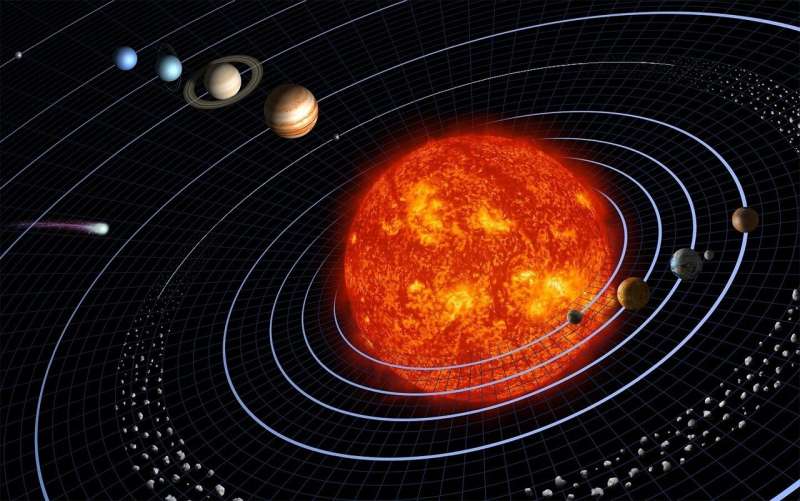
Four to four and a half billion years ago, the outer solar system tore itself apart. According to a new study published in Icarus, this violent planetary reshuffling—known as the Nice Model instability—may have been triggered by a fifth or even sixth giant planet that no longer exists, a discovery that helps explain how our current solar system came to be.
The early solar system looked nothing like the orderly arrangement we see today. When Jupiter, Saturn, Uranus, and Neptune first formed, they didn't stay put. Instead, their orbits shifted dramatically during a period of extreme chaos, with the giant planets drawing dangerously close to one another and pulling at each other with tremendous gravitational force. Astronomers have long puzzled over how the moons of Jupiter and Uranus survived this cosmic demolition derby—yet they did. A team of researchers used 122 computer simulations to uncover the answer, selecting these models from thousands of options because they accurately reproduced the features of today's outer solar system.
The simulations tracked the intricate gravitational dance between planets, moons, the sun, and passing space rocks over millions of years. The researchers tested scenarios with five or six giant planets, since current versions of the Nice Model suggest one or two additional giants may have been ejected from the solar system early on. What they discovered was sobering: the survival rate for Jupiter's and Uranus's original moon systems was remarkably low. As the paper states, both had a survival probability of less than 15 percent. Of all the scenarios tested, only one allowed the original moons and planets to survive together.
When planets strayed too close to Uranus, the ice giant's gravity nearly guaranteed destruction of its moons. But these moons didn't simply vanish into space—they collided with each other at tremendous speeds, creating a massive field of ice debris. Over time, according to the research team, these fragments clumped back together, potentially explaining the origin of Miranda, one of Uranus's most distinctive moons. The violent history didn't stop there. The simulations suggest that Uranus's moons were perturbed to the point of collision at least twice: once from the impact that tilted the planet itself, and again during the broader giant planet instability.
The research paints a portrait of a solar system far more chaotic and dynamic than once imagined, yet the scientists behind the work remain measured in their claims. Computer simulations, they acknowledge, cannot capture every detail of what actually happened billions of years ago. More modeling will be needed to determine the specific fates of individual moons and to confirm whether that missing sixth planet truly existed.
Still, the study offers something profound: a reminder that order often emerges from catastrophe. The quiet, stable solar system we inhabit today—with Earth orbiting safely in its habitable zone—is the result of ancient collisions and gravitational near-misses that somehow, improbably, allowed life to take root. In unraveling the chaos of our past, scientists are learning how we came to exist at all.