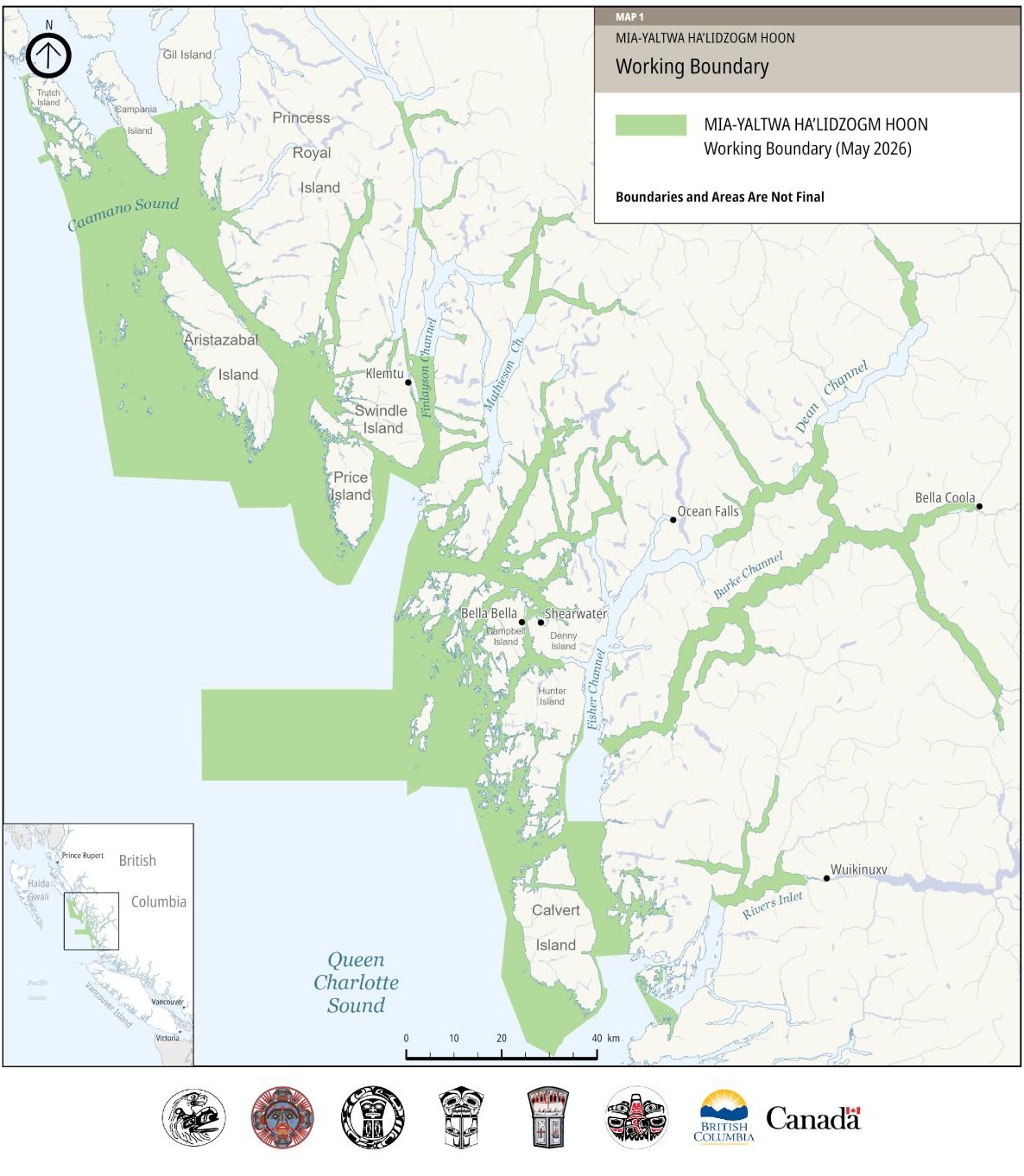
On B.C.'s Central Coast, six First Nations have drawn a line around 6,700 square kilometres of ocean and declared it home — a vast marine realm now protected by both Indigenous law and government agreement, in what leaders are calling one of the world's strongest marine conservation models.
The new Indigenous Protected and Conserved Area, Mia-yaltwa Ha'lidzogm hoon, takes its name from the Salmon — "Realm of the Salmon, Home of the Salmon" — and spans territory larger than Prince Edward Island. The Wuikinuxv, Nuxalk, Kitasoo Xai'xais, Heiltsuk, Gitxaała, and Gitga'at nations established the area under the authority of their Hereditary Chiefs, titles and responsibilities that Doug Neasloss of the Kitasoo Xai'xais Nation notes are "older than Canada" and date back thousands of years. "We've always had a responsibility to look after and take care of our territory," he told The Tyee, "and that knowledge and responsibility is passed from generation to generation."
What makes this moment unprecedented is the formal power it grants Indigenous nations. "This is the first time, at least in the last 150 years, where our people have a formal say in marine management," Neasloss said. The area is now both an Indigenous Protected and Conserved Area under Indigenous law and a national marine conservation area reserve — a designation that gives it the legal weight of an ocean national park. Tourism, logging, and some fishing will continue, but bottom trawl fishing is prohibited. Oil and gas exploration, mining, and any new pipelines are barred. "Anything that threatens" the "protection and restoration of biodiversity," said B.C. Minister Randene Neill, "will not be allowed."
The timing carries symbolic weight. Prime Minister Mark Carney has been discussing new pipeline projects to Canada's coast, yet the federal government signed on as a partner to this agreement, committing to a region explicitly designed to block such development. "No pipelines will be allowed through this area," Neill stated flatly.
The protection model itself represents a shift in how conservation science understands stewardship. A recent study showed biodiversity flourishes under Indigenous management — data that informed Canada's 2030 Nature Strategy, which identifies Indigenous Protected and Conserved Areas as central to the country's goal of protecting 30 per cent of its lands and waters within this decade. Michael Bissonnette, a staff lawyer with West Coast Environmental Law, explained that national marine conservation area reserves establish "a legal baseline for industry or development that is just so damaging that it can't occur," while allowing sustainable pursuits like selective logging.
For the six nations, the agreement formalizes what they have always done. "We've been doing it for thousands of years on the Indigenous side," Neasloss said, "but to formalize it with the provincial and federal governments is super powerful." The Hereditary Chiefs, trained and identified by Elders to inherit their ancient titles, now have legal recognition of their role as stewards — a bridge between centuries-old governance and modern conservation law. The waters of Mia-yaltwa Ha'lidzogm hoon will be managed not just for extraction, but for restoration: strengthening the abundance of flora and fauna, protecting species at risk, and ensuring that salmon — the namesake and lifeblood of these territories — thrive for generations to come.