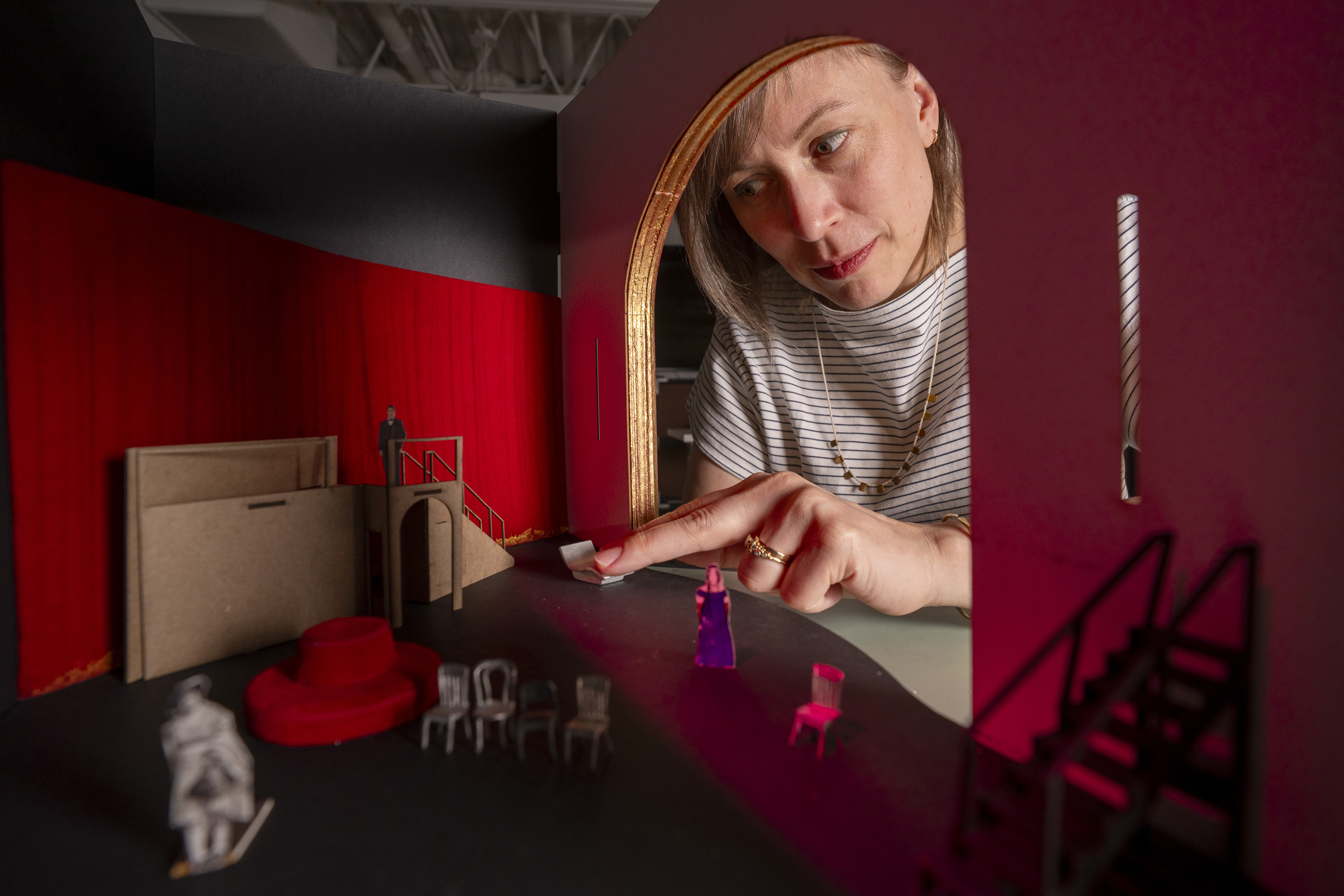
Sara Brown read the script for "Hagoromo" in 2015 and made a choice that would reshape how an entire chamber opera spoke to its audience: three high walls, nothing more. The decision was deceptive in its simplicity. In adapting the canonical Japanese Noh play—where an angel loses her cloak, a fisherman reluctantly returns it after witnessing a ritual dance, and the angel ascends to the heavens—the Brooklyn Academy of Music needed a set that could honor both the play's formal structure and the bodies moving through it. Brown, an MIT Associate Professor of set design, created something that did more than frame action on stage. It created a visual language: musicians elevated behind the walls as if in a heavenly realm, dancers spotlighted against plain backdrops, the audience's eye drawn upward through vertical layering. "That set was a framing device more than anything else," Brown explains. "It lifted the musicians to a different plane, almost a heavenly place, so we have a heaven-and-Earth contrast."
For Brown, this kind of collaborative problem-solving is the heart of set design. Working closely with lighting designer Clifton Taylor, she insisted they cut vents into the high walls and rig spotlights to capture the dancers precisely as imagined. The work was painstaking, but therein lay the artistry: an idea grounded in what matters most about the play, executed with both vision and pragmatism. "Solving for those things is what makes the design," Brown says. "There's an artistic idea that underbeds everything, and there are practical considerations, which are as important, to make the piece work the way you want."
This balance of aesthetics and mechanics has defined a career that stretches across major venues and genres—from "Carmen" to "Death of a Salesman" to lesser-known productions seeking their first professional staging. Brown earned her BA from Gustavus Adolphus College in Minnesota and an MFA from the University of Virginia. At MIT, where she also serves as associate head of the Music and Theater Arts program, she has woven professional design work into her teaching, helping students think visually, intellectually, and creatively about what stage design actually does.
Her approach to every new project is methodical. First, she reads the script with full attention. Then she sits down with the director, carrying with her—as the late set designer Skip Mercier once advised—only a genuine love for the material. "You come understanding the material, wanting to find something within it you love and are excited to work on," Brown says. "You're not closed; you're there to discover what you have in common." She gravitates toward simplicity and adaptability, designing circular spaces that can shift between settings for works like "Pride and Prejudice," or creating modular environments ingenious enough to serve two entirely different productions running simultaneously: "Death of a Salesman" and "Skeleton Crew," a play about an auto plant closing in Detroit.
What threads through all of this work is Brown's commitment to theater as a collective act. Directors, performers, and designers—lighting, sound, media, costumes—will not always agree. But from that creative friction, something emerges that no single person could make alone. "You might bump up against some rough edges," Brown says, "but you develop strategies to work with everybody with dignity, and that's important." This philosophy, shaped by her Minnesota upbringing, where humility was paramount, earned her tenure at MIT last year. It is work that recognizes a fundamental truth: on stage or in a classroom, the real power lies not in individual brilliance but in what we build together.