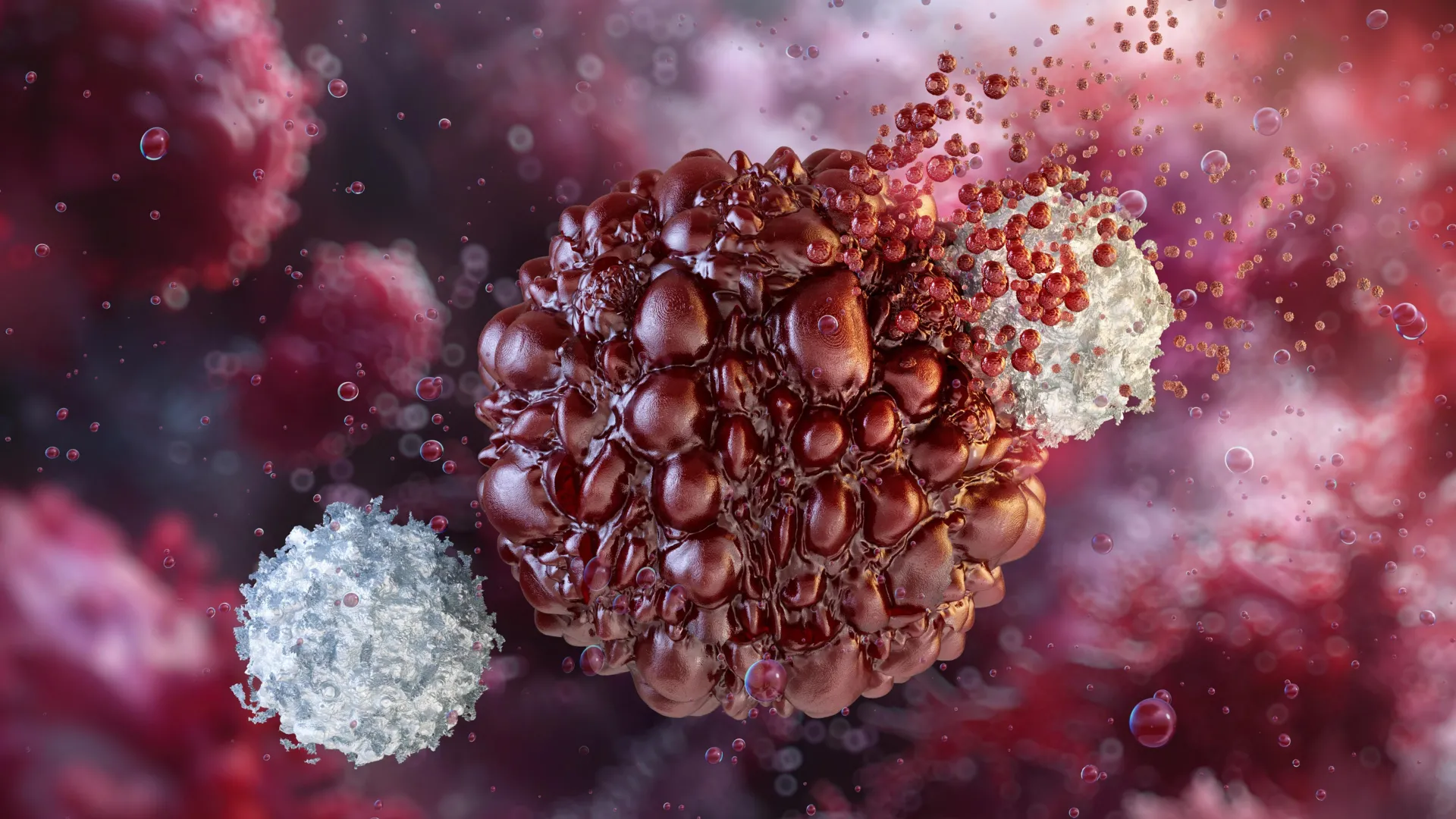
At the Institute of Zoology of the Chinese Academy of Sciences in Beijing, Prof. WANG Jinyong's team has cracked a problem that has haunted cancer immunotherapy for years: how to mass-produce the immune cells that naturally hunt down tumors without draining time, money, and resources in the process. Their breakthrough, published in Nature Biomedical Engineering, shows that a single stem cell can generate as many as 14 million tumor-killing NK cells—a transformation that could reshape how we manufacture the next generation of cancer treatments.
Natural killer cells, or NK cells, are the body's frontline sentries against cancer and viral infection. Unlike other immune soldiers that need instruction, NK cells arrive pre-programmed to recognize and destroy abnormal cells. Scientists have long wanted to weaponize this ability by adding a CAR—a lab-designed receptor—that helps NK cells lock onto specific cancer markers and strike with precision. The problem was always production. Traditional approaches relied on harvesting mature NK cells from blood or cord blood, modifying them, and multiplying them. The process was slow, expensive, unreliable, and wasteful.
Wang's team took a radically different path. Instead of starting with mature cells, they went back to the blueprint: CD34+ hematopoietic stem and progenitor cells from cord blood. Working at this early stage, before cells had hardened into their final form, the researchers performed a three-step dance. First, they expanded the stem cells roughly 800- to 1,000-fold in just 14 days using specialized feeder cells. Next, they cultured these expanded cells with OP9 cells to create artificial hematopoietic organoid aggregates—tiny structures that coax the cells toward their destiny as NK cells. In the final stage, they let the committed cells mature and multiply further, producing pure populations of both induced NK cells (iNK) and CAR-engineered versions (CAR-iNK).
The numbers are staggering. A single CD34+ stem cell yielded 14 million iNK cells, or 7.6 million CAR-iNK cells. The researchers estimate that just one-fifth of a typical cord blood unit could theoretically supply enough cells for thousands or tens of thousands of treatment doses—a shift from scarcity to abundance that would transform patient access.
The cost savings are equally remarkable. The new method used roughly one-140,000th to one-600,000th of the viral vector typically required to engineer mature NK cells. In practical terms, this cuts the engineering bottleneck that has made CAR therapies expensive and difficult to scale. Laboratory testing in mouse models of human B-cell acute lymphoblastic leukemia showed both iNK and CAR-iNK cells could powerfully suppress tumors and extend survival, validating the approach in disease settings that matter clinically.
What makes this breakthrough remarkable is not just the engineering wizardry, but the permission it grants. For years, the high cost and complexity of NK cell manufacturing has kept these therapies locked away from patients who need them most. By moving the genetic engineering step earlier in development—to the stem cell stage rather than the mature cell stage—Wang's team dissolved multiple bottlenecks simultaneously: efficiency, purity, cost, and scalability all improved at once. The work, supported by China's Ministry of Science and Technology and the National Natural Science Foundation, suggests that abundant, affordable NK cell therapies may finally be within reach.