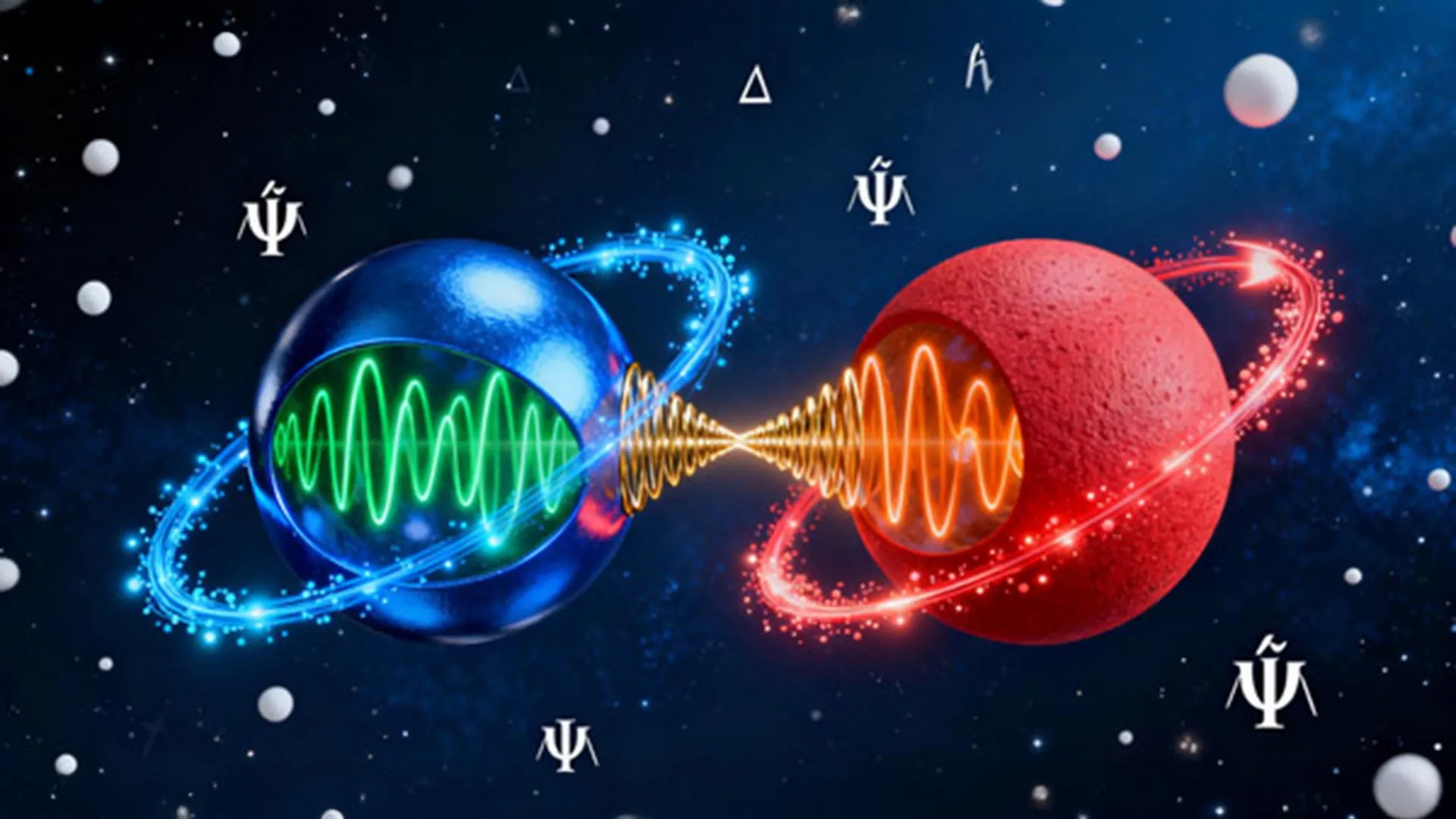
A team of theoretical physicists at RIKEN's Center for Quantum Computing has cracked a stubborn problem: how to make quantum systems behave like one-way streets, staying synchronized when information flows in one direction but refusing to sync when it comes from the other way around. The breakthrough matters because it works even when manufacturing imperfections and environmental noise try to break it—a discovery that surprised the researchers themselves.
Nonreciprocal systems are everywhere in our world. They direct signals down desired paths while blocking them from going backward, preventing unwanted echoes in microwave and optical systems. Franco Nori, a physicist at RIKEN's Center for Quantum Computing, explains the appeal: "This ability finds applications ranging from signal processing to invisible cloaking." For years, researchers have wanted to create a quantum version of this one-way behavior, a phenomenon called nonreciprocal quantum synchronization. Two quantum systems would sync up when information arrived from one side, but remain unconnected if the same information came from the other direction. It's an elegant concept, but turning it from theory into something that actually works has proven devilishly difficult.
Earlier attempts stumbled on a fundamental weakness. Adam Miranowicz, also at the RIKEN Center, describes the problem plainly: "Practical quantum technologies face critical challenges from random fabrication imperfections and environmental noise. These factors profoundly suppress—or even completely destroy—quantum resources in conventional approaches." In other words, the fragile quantum effects at the heart of these systems would collapse under the messy realities of the real world.
Enter Nori, Miranowicz, and colleague Deng-Gao Lai. Their new theoretical framework combines two separate quantum effects into a single unified system. The result: phonons—particles associated with sound—can now be synchronized when light or a magnetic field approaches from one direction, but synchronization fails when that same influence comes from the opposite direction. Crucially, the approach holds together despite manufacturing defects and environmental interference that would have destroyed earlier designs.
Deng-Gao Lai captured the team's astonishment at their own results: "We were thrilled to discover that quantum synchronization persists even in the presence of substantial imperfections and noise. Previously, this was thought to be impossible without employing complex protection schemes." The robustness arrived almost unexpectedly, suggesting the researchers had stumbled onto something more elegant than they'd anticipated. Rather than fighting noise and imperfections with increasingly complicated workarounds, their framework seemed to tolerate them naturally.
The implications ripple outward across quantum technology. Nori frames the significance crisply: "This development establishes a new foundation for generating fragile-to-robust nonreciprocal quantum resources with future practical applicability." In translation: the bridge between brilliant quantum physics and machines that actually function has just grown shorter and sturdier.
The team is already thinking ahead. Lai and his colleagues plan to explore how these findings could strengthen quantum processors and unlock new possibilities in quantum networking and error-resilient quantum information processing. If they succeed, quantum computers—machines that have long promised transformative computing power but have struggled with reliability—could become genuinely dependable. The one-way street the physicists have built in theory might soon become the foundation for quantum technologies that work reliably in the uncertain, imperfect real world.