The factory floor of VinFast's sprawling 335-hectare manufacturing complex on Cat Hai Island in Hai Phong hums with the synchronized rhythm of more than 1,400 ABB welding robots moving in perfect tandem, a sound that tells the story of an automotive transformation unlike any other.
Four years ago, this same facility felt like a demonstration site in transition—portions operating at a fraction of capacity, the company still proving it could complete the most audacious pivot in modern automotive history. VinFast had just halted all internal combustion engine production entirely and committed itself to an all-electric future, a decision that drew relentless criticism from Western manufacturers and reviewers skeptical of a Vietnamese startup's ability to compete globally. What observers often missed was the larger story: VinFast wasn't simply building vehicles. It was constructing an industrial ecosystem that would improve through iteration, learning, and relentless scaling.
Today, the plant operates continuously across three shifts, with giant Schuler presses stamping body panels around the clock and paint lines running without pause. The transformation has become impossible to ignore, and the numbers validate what the factory floor makes viscerally clear: this is no longer a company preparing for growth—it is a company already experiencing it.
In 2023, VinFast delivered roughly 35,000 electric vehicles globally. That figure nearly tripled to 97,399 units in 2024. By the end of 2025, deliveries had surged to 196,919 vehicles, representing growth of more than 100 percent year on year, with annual revenue doubling to approximately $3.6 billion. The Hai Phong factory alone produced more than 200,000 electric vehicles during 2025 while operating at roughly two-thirds of its installed capacity of 300,000 vehicles annually—a capacity designed to surge to full utilization this year.
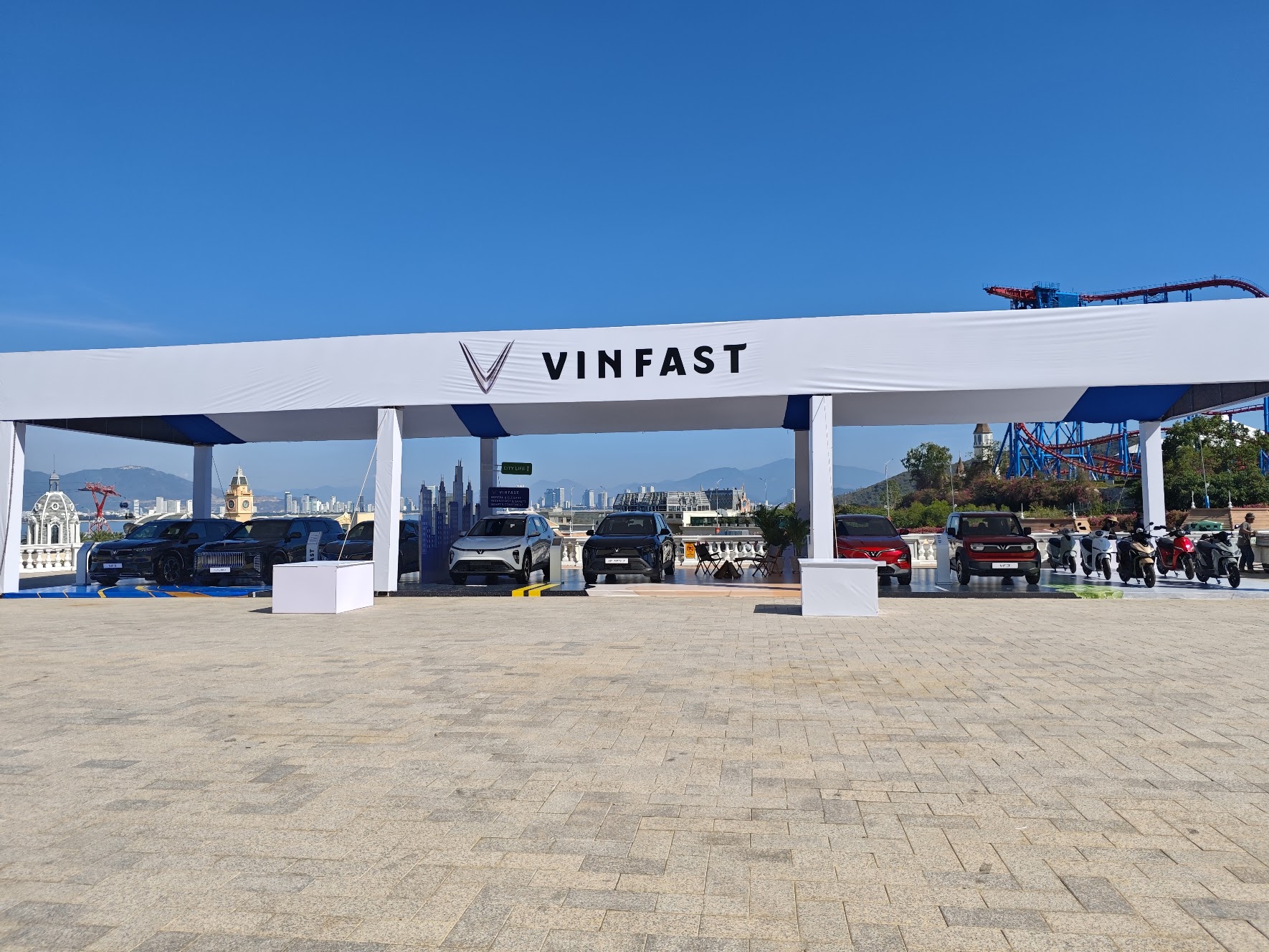
The product lineup reflects this ambition. The tiny VF3 city car, sized like a Japanese kei-car, has become VinFast's top seller in many countries and a massive hit in the Philippines. At the opposite end of the spectrum, the ultra-luxurious Hac Long 900, built on the VF9 platform and armored for discerning clients, demonstrates the company's ability to serve multiple market segments simultaneously. This diversity of offering, backed by genuine manufacturing scale, represents the kind of portfolio flexibility that established automakers take decades to develop.
Perhaps even more striking is VinFast's electric two-wheeler division, which surpassed one million units in sales during the same period, with the Hai Phong facility recording 406,453 domestic e-scooters produced in 2025 alone—a 473 percent year-over-year escalation driven by continuous three-shift rotations. This parallel growth in mobility solutions reveals a company thinking far beyond traditional automotive boundaries.
As VinFast CEO Pham Nhat Vuong prepares to hand leadership to his son Quan Anh, the company stands at the threshold of maximizing its installed capacity. The original thesis—that a Vietnamese startup possessed the speed, ambition, and willingness to take risks that most established automakers would never consider—has moved from proposition to demonstrated reality. The question is no longer whether VinFast can build electric vehicles at scale. The more relevant question today is how far this momentum will carry it.