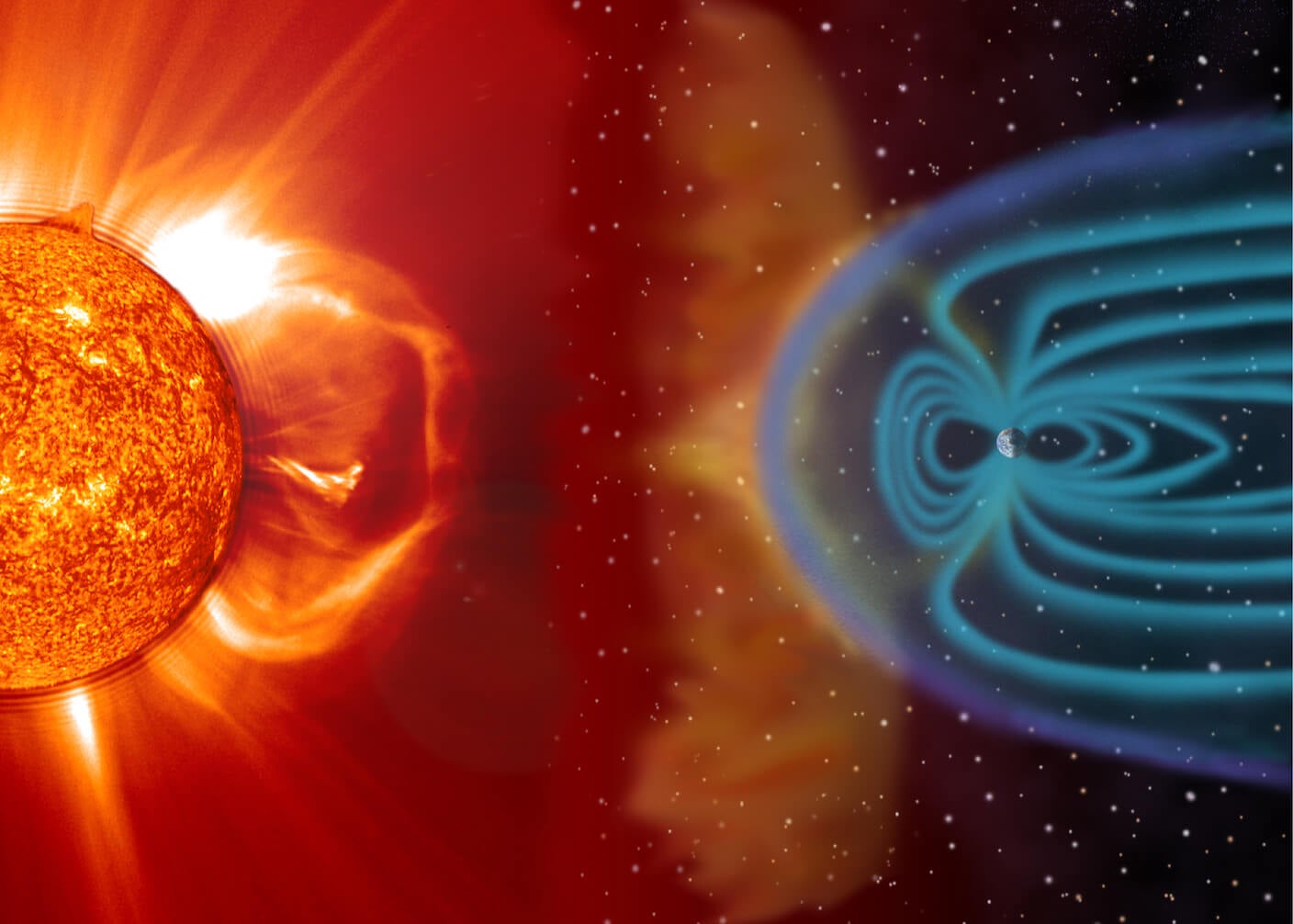
In 1859, a solar storm called the Carrington Event blanked telegraph machines across continents and reminded humanity that the sun can be a weapon. Today, researchers at Boston University and the University of Michigan are proposing to build an orbital shield against such catastrophe—a constellation of satellites that would release hundreds of tons of ionized gas to weaken incoming solar storms before they strike.
The threat is real and growing more consequential. The sun regularly hurls massive bursts of radiation and magnetic fields toward Earth. Most dissipate harmlessly in the planet's magnetic envelope, sometimes painting the sky with auroras. But the most violent eruptions can trigger geomagnetic storms violent enough to scramble GPS, silence radio networks, and corrupt electrical grids. A Carrington-scale event today could inflict between $2.4 and $3.4 trillion in damage to power infrastructure alone—a sum that dwarfs the annual budget of most nations.
The proposed solution, called StormWall, mimics the body's own defense mechanism. Earth already possesses a natural shield: a doughnut-shaped reservoir of plasma hovering above the atmosphere. When a solar storm disturbs the planet's magnetic field, this plasma flows toward the sun and slows the rate at which the sun's magnetic field reconnects to Earth's. StormWall would amplify this process dramatically. The system consists of satellites orbiting roughly 22,000 miles from Earth, carrying canisters of lithium, barium, or sodium gases. When sensors detect an incoming solar storm, these satellites would release the gases. Solar radiation would rapidly ionize them into plasma, artificially fattening the planet's protective shield. "It's as if you could install an airbag in the magnetosphere," said Daniel Welling, a space physicist from the University of Michigan.
Computer simulations suggest the approach would work. Releasing around 400 tons of gas could reduce a major geomagnetic storm's strength by over 50 percent. The defense would be swift—the plasma cloud could be in position by the time the storm arrives—and temporary, dissipating within hours. Deploying the full constellation would require six launches using heavy-lift rockets like SpaceX's Starship or China's Long March 9, a feat the researchers estimate could be accomplished in under two months.
The technical challenges are surmountable, but others remain formidable. Space weather forecasting must become more accurate and timely to provide sufficient warning. More substantively, the international community would need to agree that temporarily altering the near-Earth space environment is justified—a diplomatic hurdle that could prove as demanding as the engineering. The researchers have identified potential side effects, including electromagnetic waves generated as the released material ionizes, that warrant further investigation.
Yet the calculus seems to favor action. Allison Jaynes, a space physicist at the University of Iowa, called the idea "highly innovative and appears to be quite feasible in the near term." Given what a solar storm of historical magnitude could do to hospitals, water treatment plants, supply chains, and financial systems that depend on continuous power flow, the risks of inaction may outweigh the risks of deploying a temporary, reversible planetary defense. StormWall represents not just a technological ambition but a recognition that Earth's shield, though invisible, is worth defending.