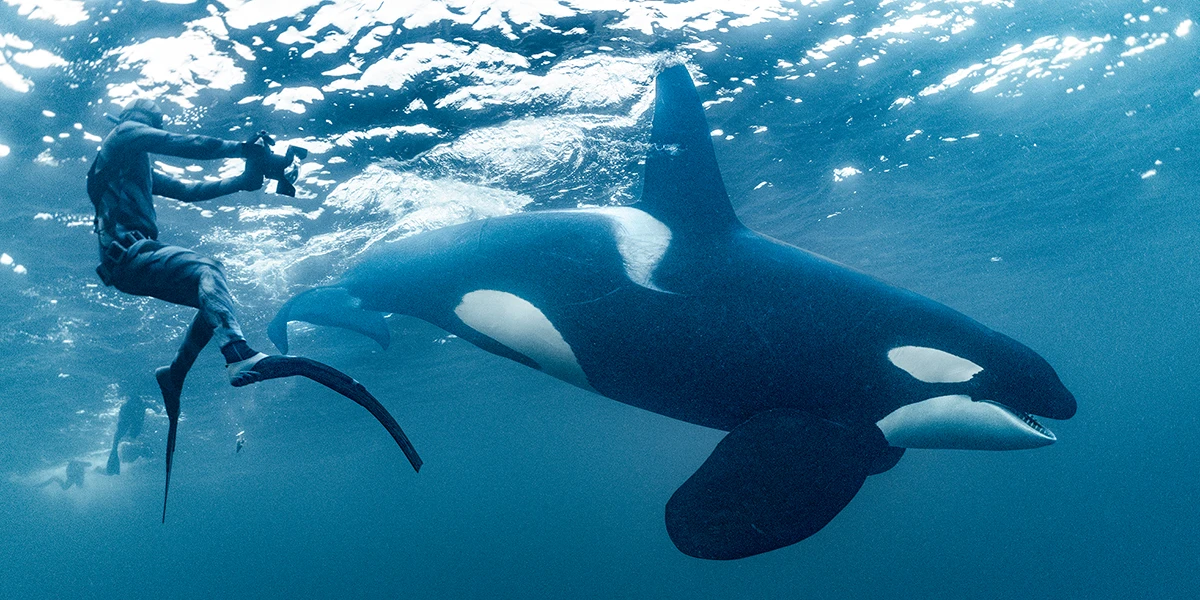
When winter arrives in Norway, millions of herring crowd into the country's western fjords to wait out the cold months. And they bring a following: hundreds of killer whales, the largest members of the dolphin family, arriving to hunt. What unfolds in the icy waters near the Arctic Circle is one of the most sophisticated displays of cooperative hunting ever documented in the animal kingdom.
Approximately 3,000 orcas make their home in the Norwegian Sea and Barents Sea region, and researchers believe roughly half of them follow the herring into Norway's waters each year. Scientists have photo-identified about 1,400 individuals in these waters over four decades of study. These are not anonymous creatures — they are known, named, and watched by the Norwegian Orca Survey team, which has spent years monitoring their population dynamics, social behavior, and feeding ecology.
Norwegian orcas have perfected a technique called carousel feeding, a cooperative hunting method so refined it resembles a choreographed performance. Working in family pods typically numbering 10 to 40 individuals, the whales dive deep to isolate a group of herring from the larger school, then herd the fish into a tight ball near the surface. The orcas stun their prey with powerful, precisely aimed tail strikes, sometimes even executing acrobatic somersaults to deliver devastating fluke swipes. Once the herring are immobilized, the whales dine with surprising delicacy — using only their lips, tongue, and teeth to fillet each fish and spit out the bones.
This is not instinct alone. Norway's orcas must learn to carousel feed, learning vital skills from their families. The pods are matriarchal societies — multigenerational families centered around grandmothers and great-grandmothers whose adult offspring and their young remain together for life. These strong, lasting bonds allow knowledge to pass down through generations, creating a culture as much as a population.
The herring they pursue are a superfood, rich in nutrients, fat, and protein. An individual orca consumes between 300 and 600 herring daily — roughly 100 to 110 pounds of fish — and spends 40 to 60 percent of each day hunting and eating. Males can grow up to 30 feet long and weigh more than 5 tons, while females reach nearly 26 feet. A wild male typically lives 30 to 40 years; a female, 50 years on average, with some living 80 years or more.
The herring themselves are remarkable, too. Millions of tons of Norwegian spring-spawning herring crowd into the narrow fjords, massing at depths between 150 and 600 feet until it's time to migrate south and spawn. Those that survive the orcas' winter feast and the journey downstream will spawn in spring between Bergen and Trondheim. The strongest, cleverest herring can live up to 25 years.
What makes this story hopeful is what the last 40 years of research have shown: given space and stable prey populations, these intelligent, social creatures thrive. The Norwegian Orca Survey team continues to monitor contaminants, facilitate citizen science, and promote conservation — ensuring that the carousel keeps spinning each winter, that the knowledge passes on, and that future generations will witness this extraordinary collaboration between predator and prey.