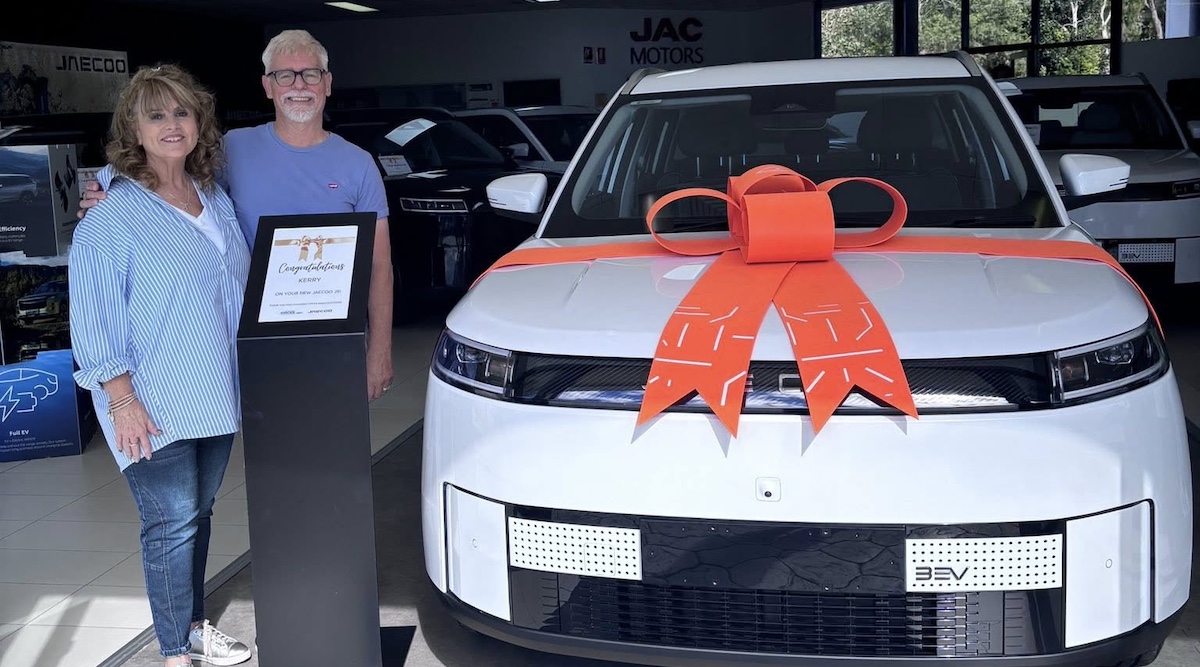
Kerry Jeston ordered her first electric vehicle sight unseen while standing in Ireland, convinced by a YouTube review her husband had sent and a test drive her son conducted without her. Since Jaecoo's launch in Australia early this year, the Chinese EV sub-brand—a new entrant to the Australian market—has sold 1,845 units and consistently ranked in the top ten, proving that a compelling product story can move cars faster than traditional marketing.
The Jaecoo J5 represents something quietly significant: the arrival of genuinely affordable electric vehicles in a market still dominated by premium options. At AU$37,000, Kerry's choice was radical for her family, yet practical. They kept their three combustion-engine vehicles—a classic 1978 Porsche, a 2027 Amarok ute, and a 2024 Volvo XC40—but wanted to test the waters. Kerry's excitement was palpable when she described the technology crammed into the price point. "The technology is amazing for a $AU 37,000 car with 400 km of range," she said. "I used to drive a BMW X4 and thought that was pretty high spec."
What impressed her most wasn't flashy marketing but practical engineering: AI integration, cameras for lane-changing assistance, leather seats that are scratch-resistant and antibacterial—features that matter when you have four grandchildren under four, two dogs, and beach living demands durability. The vertical touchscreen, wireless phone charger, and 360-degree parking camera became daily-use tools rather than gimmicks. Voice commands let her adjust air conditioning and seat heating on a highway drive. Storage pockets throughout the cabin held her handbag securely. These aren't revolutionary; they're thoughtful.
The purchase decision crystallized around value. Kerry's family noticed the same J5 selling in the UK for approximately £30,000—roughly AU$60,000—making Australian pricing feel deliberately competitive as Jaecoo establishes its foothold. Steve, the car enthusiast in the family, had considered the BYD but found its boot too small; the Jaecoo offered greater functionality. An eight-year unlimited kilometre warranty reassured them about buying an emerging brand, while service costs—AU$155 for the 20,000 km service and AU$225 at 40,000 km—stayed reasonable.
The choice also reflected timing. While they were overseas, fuel protests erupted through Dublin's streets, farmers blocking routes in response to petrol prices and fuel uncertainty. Climate anxiety and household economics aligned. A trickle charger came with the car; they've installed solar on their roof and are finalizing a Level 2 charger in their garage. The infrastructure and the vehicle arrived together.
Kerry's only hesitation was the learning curve with the technology—a minor friction point for a first-time EV buyer stepping into an unfamiliar digital ecosystem. But the Jaecoo's standard features felt premium enough that she didn't experience buyer's remorse. The sleek, modern design genuinely resembles a baby Range Rover, she noted, defying the budget-car aesthetic entirely.
For now, the experiment continues. Their three ICE vehicles remain parked. If happiness with the J5 continues—and Kerry's tone suggests it already has—the Volvo may find a new home. The Jaecoo, it seems, has already found one.