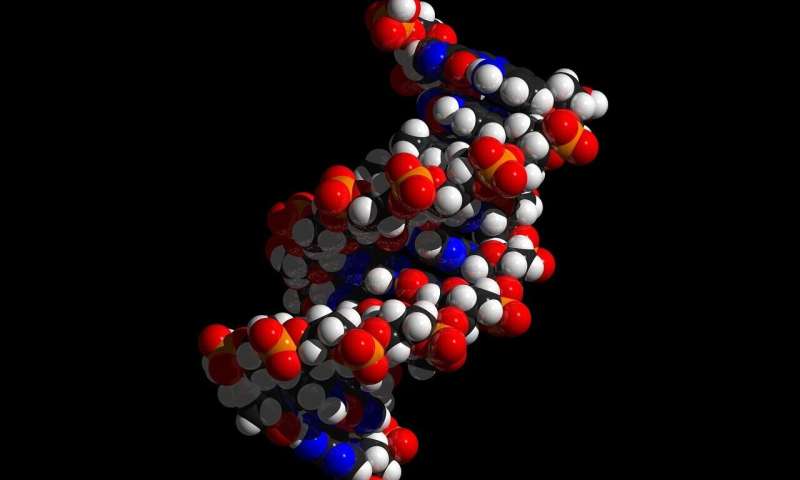
Scientists at Northwestern Medicine have uncovered a hidden layer of genome organization: four-stranded DNA structures called G-quadruplexes are directly reshaping how our genes turn on and off. The discovery, published in the Proceedings of the National Academy of Sciences, reveals that these overlooked structures interact with a master protein called CTCF in ways that fundamentally challenge how we understand the human genome.
For more than a century, scientists have known G-quadruplexes exist—regions where DNA folds into stable, stacked shapes instead of the familiar double helix. Yet only recently have researchers begun to grasp their real-world importance in living cells. Vipul Shukla, Ph.D., the senior author and assistant professor of Cell and Developmental Biology at Northwestern Medicine, describes the finding as "a new layer of regulation in the genome." While we typically think of DNA as a simple sequence of nucleotides, G-quadruplexes represent something fundamentally different: a way that linear DNA sequences transform into alternative structures and conformational folds.
The Northwestern team conducted a large-scale proteomics screen to identify proteins that bind to G-quadruplexes. They found dozens of them—many involved in core cellular processes like RNA splicing, gene regulation, and chromatin remodeling. But the breakthrough came with CTCF, a protein already famous for organizing the genome's large-scale architecture. CTCF acts like a master conductor, folding DNA into loops and domains that bring distant regions into contact with each other. Inside a cell's nucleus, this three-dimensional folding is crucial: it creates the physical infrastructure that controls which genes get expressed.
The new research shows G-quadruplexes are essential to this process. Remarkably, about 35 percent of chromatin loops were found to be associated with G-quadruplex structures. Even more striking: roughly a quarter of all CTCF-mediated loops depend on G-quadruplex interactions. Shukla explains that these findings challenge the traditional loop extrusion model. Scientists previously believed a molecular motor created transient loops until it hit a roadblock—usually CTCF itself. "CTCF bound to a G-quadruplex is an even stronger roadblock," Shukla said. "Once you form loops by G-quadruplex and CTCF, these loops tend to be much more stable." Stability matters enormously: stable loops are more reliable at controlling gene expression.
The implications extend directly to human health. Because chromatin loops regulate gene activity, the CTCF–G-quadruplex interaction affects which genes get turned on and off. The Northwestern team identified hundreds of genes that showed altered expression when CTCF was removed and then restored. A subset of these appeared to be regulated specifically through G-quadruplex-dependent looping.
What surprised Shukla most was the sheer number of different proteins that interact with G-quadruplexes. "We weren't anticipating identifying so many important regulators of genome function," he said. "This kind of puts G4s at this cross-section of genome biology." That positioning suggests G-quadruplexes influence far more than just gene expression—potentially affecting transcriptional control, RNA processing, and chromatin accessibility too.
The discovery has immediate clinical relevance. Shukla and his team are now investigating how G-quadruplex-driven changes in genome architecture may contribute to cancer and neurodegenerative diseases. These findings open a new frontier in understanding not just how our genomes work, but how they can go wrong—and potentially, how to fix them.