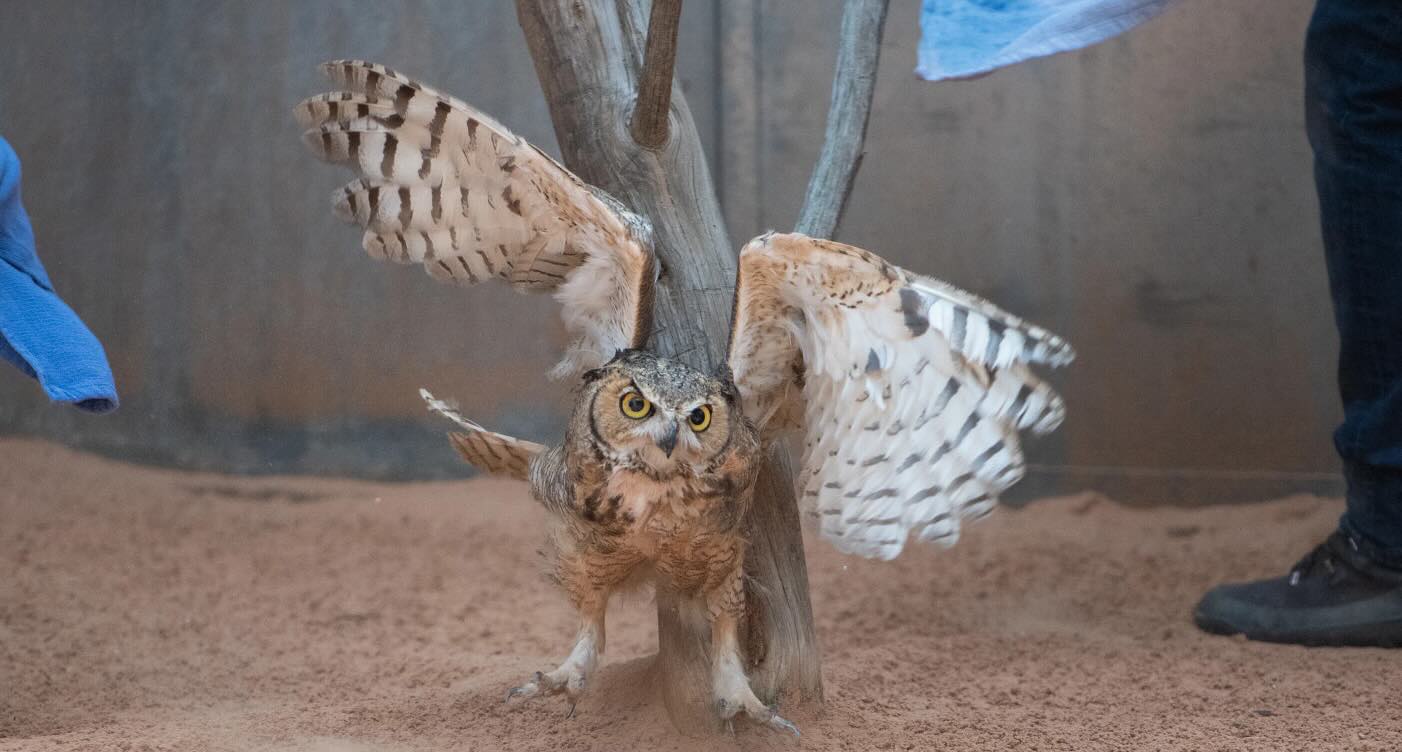
When a good Samaritan discovered a young great horned owl trapped in a concrete mixer in October, its future looked grim. But what followed was an extraordinary six-month rescue operation that required the wildlife team at Best Friends Animal Society's sanctuary in Kanab, Utah, to master an entirely new medical procedure—and ultimately set the bird free with wings silent enough to hunt in the wild.
The concrete had done catastrophic damage. After the team at Wild Friends carefully removed the hardened material, they faced a sobering reality: the owl's feathers were damaged beyond the point of natural recovery. For a raptor, silent flight isn't a luxury—it's essential for survival. Great horned owls rely on their specially structured feathers to glide soundlessly through the night while hunting, an ability this owl had lost.
The team waited through the spring, hoping the owl's molt would replace the damaged feathers naturally. When that didn't happen as expected, they took an unconventional step: they enrolled in a training course on imping, a delicate feather-replacement procedure they had never performed before. Donor feathers, carefully adhered to the damaged shafts, would have to do the work that nature's molt couldn't accomplish on schedule.
Fortune intervened when a wildlife rescue group in Northern Utah donated feathers from a great horned owl of similar size that had recently passed away. Supervisor Bart Richwalski meticulously tracked the young owl's feather patterns over weeks, snipping damaged shafts in advance and preparing a surgical roadmap. On May 1, the team assembled: veterinarian Kelsey Paras and three Wild Friends staff members gathered for the 90-minute procedure.
Richwalski described the intensity of those opening moments: "The first few feathers were extremely nerve-wracking, but as we got into the groove, the imping became more comfortable, and everything went smoothly." The team laid out donor feathers to replicate each wing, then carefully aligned, cut, and adhered each replacement. When it was over, eleven feathers in the right wing had been successfully replaced. The left wing, thankfully, required no work.
The true test came next. The owl had to prove it could fly silently before the sanctuary would release it. Inside the large aviary, the team watched and waited. When Richwalski finally saw the owl fly to the highest perch and measured its wingbeat with a decibel reader, the sound was quiet enough for freedom.
The moment of release was electric. As the aviary roof slowly retracted, the owl hesitated for just a moment, then gained speed and flew straight up and out into the Utah wilderness. For Richwalski, who had cared for the owl since its rescue in St. George, the emotion was overwhelming. "I don't know that my heart was beating until I saw him leave," he said. "I was beside myself, knowing that after all this time, he was healthy and back in the wild. It was such a good feeling."
The team's meticulous care reflects a deeper philosophy at Best Friends Animal Society. "Every animal has intrinsic value," said Judah Battista, the organization's Chief Sanctuary Officer, "and the care that our team took with this owl really reflects that belief." What began as a rescue from concrete has become a testament to patience, innovation, and the possibility of redemption—even for a creature that arrived at the sanctuary with its future sealed in hardened stone.