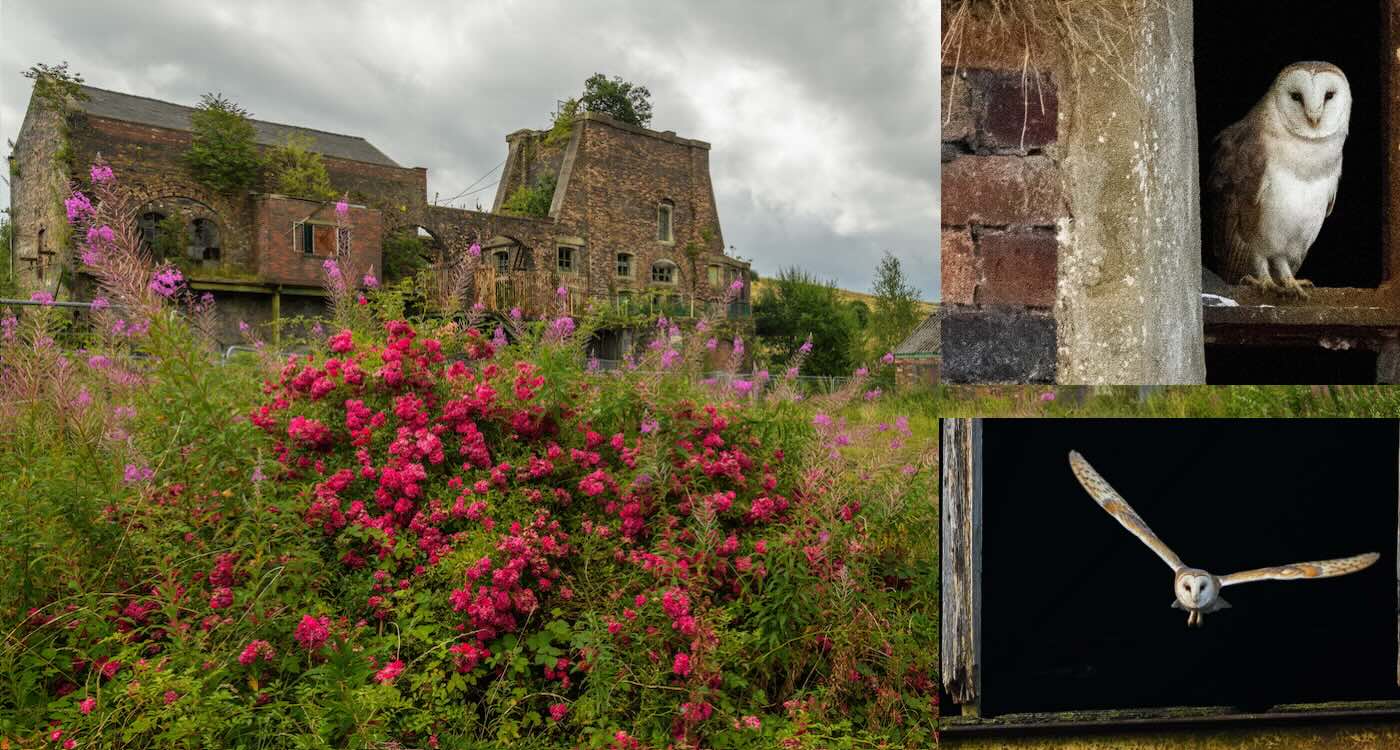
Fifty years after the last chunk of coal was hauled from the earth, barn owls now hunt silently through the skeletal towers of Chatterley Whitfield, and wild strawberries have begun their quiet invasion of the slag heaps. The mine in Staffordshire, England, which closed in 1976 after decades as a working colliery, has become something unexpected: a living canvas of rewilding, where industrial heritage and nature have found an uneasy, beautiful coexistence.
Photographer Andrew Mason returned to the place his father worked in the 1960s to document what has emerged from decades of abandonment. With the permission of Stoke-on-Trent's City Council, Mason set up observation blinds to capture images of barn owls and short-eared owls inhabiting the derelict buildings—using the towering structures as perfect vantage points to spot prey across the overgrown landscape. The site's iconic pit head wheels, once used to lower miners deep underground, still stand as skeletal monuments to the industrial age, now serving as unlikely backdrop to the return of wildlife.
Chatterley Whitfield was no ordinary mine. It was the largest coal mine in the region and the first in the United Kingdom to produce a million tons of coal in a single year—a record of extraction that once defined the site's purpose and identity. The mine operated continuously until March 25, 1977, when it officially closed. Two years later, it reopened as a mining museum, attracting tens of thousands of visitors annually before eventually shutting down for good in 1993.
What makes the site remarkable now is not what humans have built or extracted, but what nature has reclaimed. The 15 listed buildings that dot the landscape, protected by their inclusion on Historic England's heritage register, have become sanctuaries for wildlife. Mason's photographs reveal barn owls in flight against rusting towers, the white birds ghostly and elegant against the industrial backdrop. Short-eared owls shelter in the high buildings. Badgers and foxes roam the grounds—species Mason hopes to capture on trail cameras he plans to install soon. And then there are the wild strawberries, growing improbably from old coal slag, a detail that captures something essential about nature's patient, quiet persistence.
"There really is a strange beauty in the juxtaposition of the ghostly white owl of the night flying amongst these old industrial buildings that are still standing," Mason reflected on his work. His photographs transform the abandoned mine from a ruin into a monument to transformation—not the human kind measured in tons extracted, but the ecological kind measured in species returned and ecosystems healed.
The story of Chatterley Whitfield speaks to a larger truth about industrial sites across the world: that abandonment need not mean permanent loss or decay. Given time and protection, the land remembers how to be wild. The owls circling overhead 50 years later are not mourning the mine's closure—they are thriving in it.