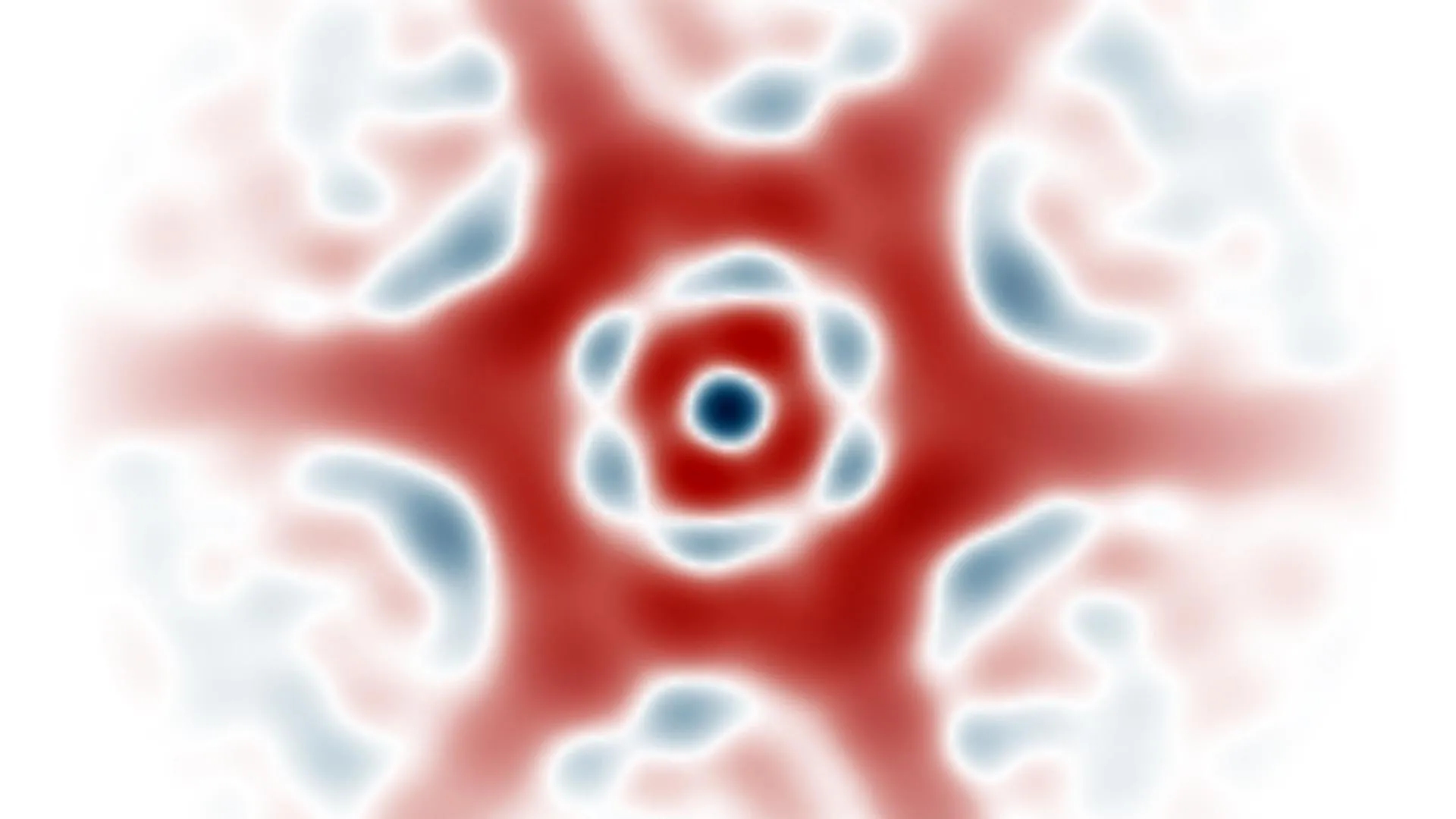
Dr. Sebastian Saner and his team at the University of Oxford have coaxed a single trapped ion into a quantum superposition so strange, it defies classical intuition—not by combining ordinary states, but by weaving together pieces of reality that are already profoundly quantum. This breakthrough reimagines the iconic Schrödinger’s cat paradox, not as a cat simultaneously alive and dead, but as a creature stitched from two ghostly, nonclassical motions, each existing in a realm where uncertainty itself bends to the experimenters’ will. At the heart of this work is a trapped ion—specifically, a single calcium ion suspended in vacuum by electromagnetic fields—whose motion becomes a playground for sculpting exotic quantum states.
Quantum superpositions have long been the engine behind quantum technologies, from ultra-precise sensors to quantum computers. But most of these rely on qubits, which exist in combinations of just 0 and 1. The Oxford team ventured beyond this binary limit by exploiting the ion’s motion, a quantum harmonic oscillator capable of occupying many energy levels. Instead of building superpositions from coherent states—quantum analogs of classical motion—they used squeezed states, where quantum uncertainty is redistributed in nonclassical ways. By entangling the ion’s internal state with its motion and then measuring the internal state mid-circuit, they forced the motion into a tailored superposition of these nonclassical components.
The result was a programmable quantum sculpting tool. By adjusting laser pulses and electromagnetic fields, the researchers could control the size, separation, and orientation of the superposition’s components. They reconstructed the states using quantum tomography, revealing telltale interference patterns and, crucially, regions of Wigner negativity—a definitive signature that these are not mere classical mixtures but genuinely quantum states with no classical counterpart. As Dr. Raghavendra Srinivas, the project’s supervisor, put it: “We were really encouraged by our colleagues’ reaction when we showed them what we had made.”
This level of control opens new pathways for quantum computing, where such states could offer built-in resilience to noise and more efficient error correction. They also serve as a testbed for probing the elusive boundary between quantum and classical worlds. While today’s quantum computers rely heavily on qubits, the future may lie in higher-dimensional systems like these oscillators, capable of encoding more information and withstanding decoherence better. The Oxford team is now collaborating with theorists to quantify just how “quantum” these states truly are—a step toward harnessing their full potential.
This experiment isn’t just a laboratory curiosity; it’s a glimpse into a future where quantum engineers don’t just compute with 0s and 1s, but design reality at the level of motion itself. As quantum technologies evolve, the line between thought experiment and engineered state continues to blur—ushering in an era where Schrödinger’s cat isn’t just alive and dead, but woven from the very fabric of quantum strangeness.