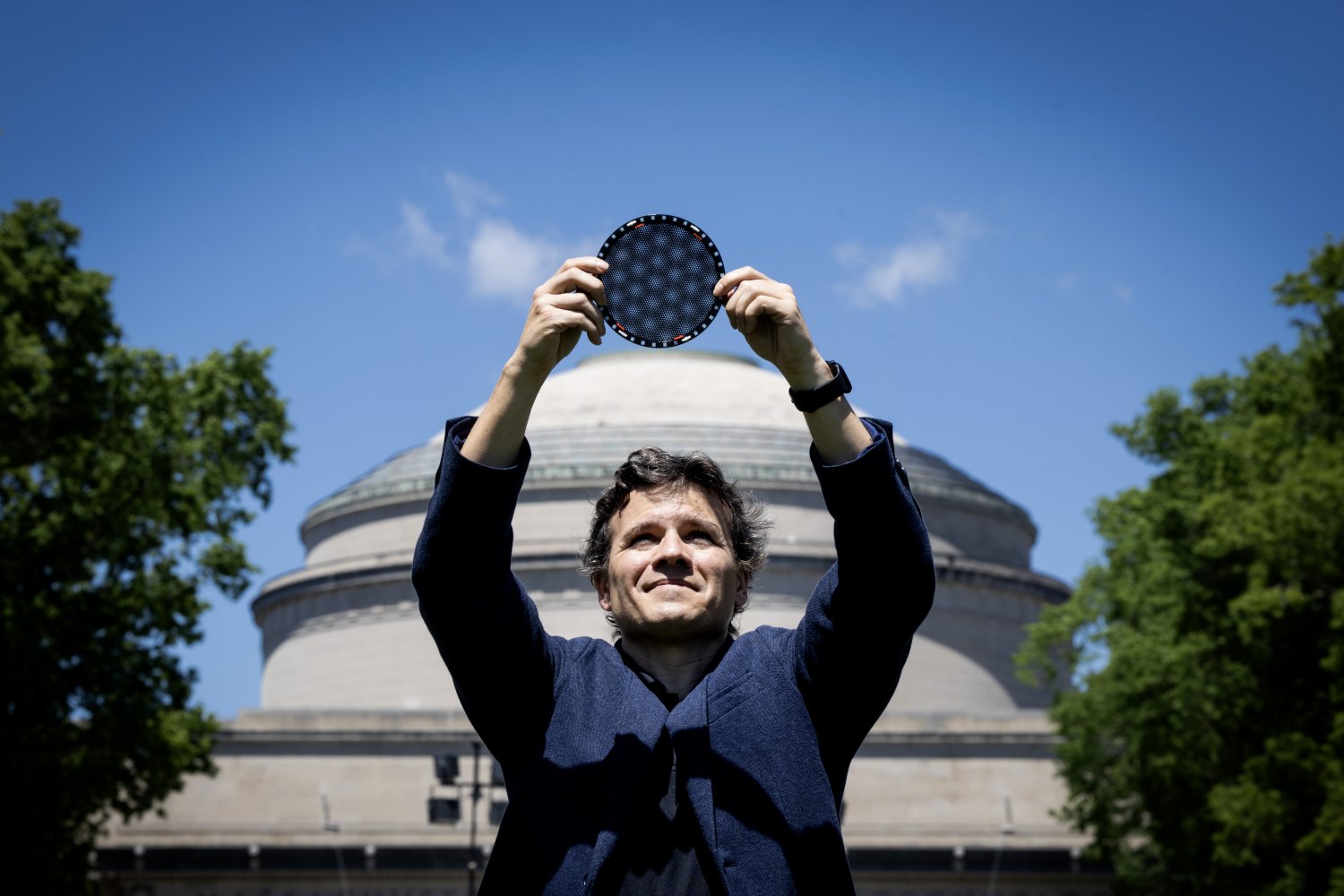
In 2018, Pablo Jarillo-Herrero's lab achieved something remarkable: they coaxed superconductivity out of a material by simply rotating it. The MIT physicist and his team had stacked two layers of graphene—pure carbon arranged in a honeycomb lattice—and twisted one layer at just the right angle. Electricity flowed through with zero resistance. It was a moment that would reshape nanoscience and launch an entirely new field.
That breakthrough has now earned Jarillo-Herrero, a Cecil and Ida Green Professor of Physics at MIT, the 2026 Kavli Prize in Nanoscience, one of the world's most prestigious honors in fundamental science. He shares the award with Eva Y. Andrei of Rutgers University and Allan MacDonald of the University of Texas at Austin—three physicists whose work established "twistronics," a field where rotating two-dimensional materials to specific angles unlocks extraordinary properties like superconductivity and magnetism. They will split $1 million as part of the biennial Kavli Prize, given by the Norwegian Academy of Science and Letters, the Norwegian Ministry of Education and Research, and the Kavli Foundation.
The journey to this discovery spans more than a decade. In 2009, Andrei and her research group used scanning tunneling microscopy to examine graphene's electronic structure as they varied its twist angle. They found that tiny geometric changes—not chemical changes—profoundly altered how electrons behaved. This insight was fundamental: materials could be engineered through geometry alone. Two years later, MacDonald provided the theoretical explanation, demonstrating why certain discrete angles—called "magic angles"—produced these unusual electronic structures. His framework became the foundation for understanding what scientists now call moiré materials.
Then came Jarillo-Herrero's 2018 experiment, the crowning validation. His team created magic-angle twisted bilayer graphene and observed the emergence of correlated insulating phases and superconductivity. "It was a big surprise, because the technique we used, though conceptually straightforward, was hard to pull off in the lab," Jarillo-Herrero reflected. The work opened floodgates. Researchers worldwide began exploring engineered quantum materials with new possibilities, investigating how twisting and layering could produce phenomena once thought impossible at such scales.
The implications extend far beyond the laboratory. Superconductors—materials that conduct electricity with no resistance—could revolutionize power transmission, transportation, and computing if they could operate at room temperature. Today's superconductors require extreme cooling. Jarillo-Herrero's work raises the tantalizing possibility that room-temperature superconductivity might be achievable through these twisted quantum materials. "This work could potentially lead to the creation of superconductors at room temperature, which would have an enormous technological impact," notes Deepto Chakrabarty, MIT's physics department head.
Jarillo-Herrero emphasized the importance of fundamental science in his own reflection on the award. "Although it often doesn't have a direct near-term application, in the long run it happens to be the most transformative and impactful in society," he wrote. His recognition brings the total number of MIT faculty Kavli Prize recipients to nine, underscoring the institute's role in advancing human understanding at the smallest scales. With twistronics now established as a legitimate frontier in condensed matter physics, the revolution Jarillo-Herrero and his colleagues sparked continues to unfold.