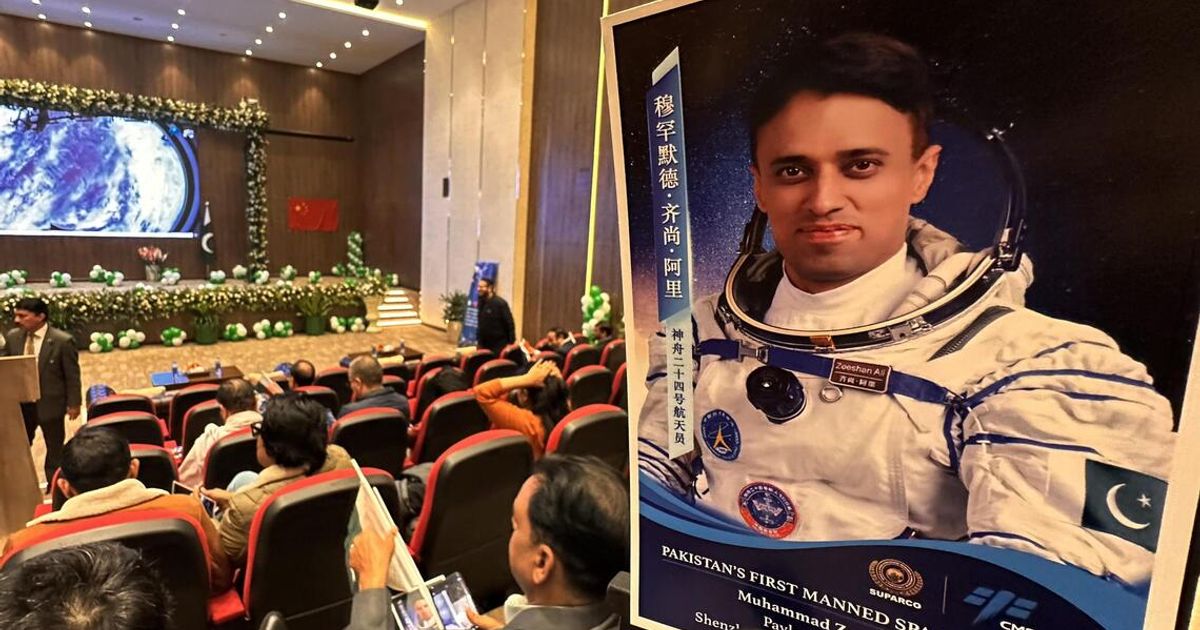
At 5:18 a.m. on Nov. 25, a packed room in Islamabad watched Muhammad Zeeshan Ali rise into space aboard China’s Shenzhou-24. Pakistani and Chinese flags waved as the country’s national anthem played, and the launch drew cheers from scientists, students and officials who had stayed up through the night.
Ali, a Pakistan Air Force pilot and payload specialist, became the first foreign astronaut to fly on a Chinese space mission and the first person from outside China to board the Tiangong space station. He is also the first Pakistani to reach orbit. The achievement marks a new step for a space program that has worked with China as it builds its ability to send people into space.
Ali flew with two Chinese crewmates and is expected to spend one week in orbit. He will return to Earth aboard the Shenzhou-23 spacecraft, which was already docked at Tiangong. During his stay, he will conduct four experiments, including studies of microalgae, materials that can repair themselves for use on spacecraft, and growing quinoa beyond Earth. Those projects were chosen from more than 300 experiment proposals submitted by Pakistani universities.
The road to the mission was demanding. More than 50 people were screened for astronaut selection. Nineteen went to China for tests, and two were chosen: Ali and Khurram Daud, a navy officer. Their training included centrifuge tests and underwater drills, and took about seven months rather than the six originally planned.
At Pakistan’s Space and Upper Atmosphere Research Commission, agency chief Muhammad Yousaf Khan had worried that the early launch time would keep people away. Instead, he found every seat taken. “That shows how attached everyone is to our astronaut, this mission and the hard work behind it,” he said. Physics and astronomy student Zainab Abbasi told reporters she had never imagined she would see a Pakistani astronaut go to space so soon in her life.
Pakistan’s space program began in 1961, and its first rocket, Rehbar 1, launched the following year. The country has launched six satellites in the past 30 months, Khan said, but Ali’s flight brought a different kind of excitement. Pakistan and China signed a deal in February 2025 to establish a Chinese government training program for Pakistani astronauts. Raza Akbar, a professor at the Institute of Space Technology, said building Pakistan’s own space technology would be gradual, beginning with collaboration, training and shared development.
For the people watching in Islamabad, the mission was both a national milestone and a glimpse of what could come next. Amna Ijaz Aziz, also of the Institute of Space Technology, told Ali: “You’ve made history for all of us.” She added that children would learn his name in future classes—a sign that this one-week journey may shape how a new generation imagines its place in space.