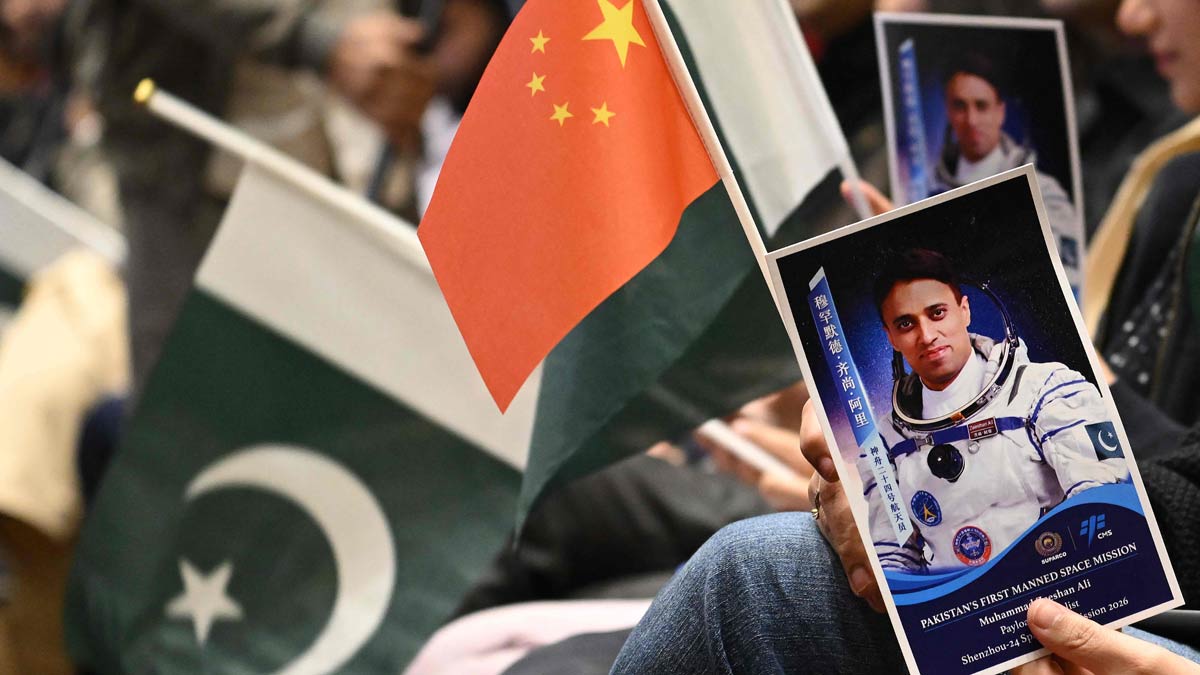
At 5:48 a.m. on November 25, 2026, a Long March-2F rocket climbed into the cold morning sky above China’s Gobi Desert, carrying Muhammad Zeeshan Ali toward a first for Pakistan. The 40-year-old fighter pilot became the country’s first professionally trained astronaut to enter Earth’s orbit—and the first foreign astronaut to visit China’s Tiangong space station.
The launch from the Jiuquan Satellite Launch Centre marked a new step in China-Pakistan space cooperation. Hundreds of spectators gathered before sunrise as the Shenzhou-24 spacecraft lifted off. Chinese authorities confirmed it reached orbit. About three and a half hours later, at around 9:18 a.m. Indian Standard Time, it docked with Tiangong, joining the orbiting laboratory.
Ali travelled with Chinese mission commander Tang Hongbo and flight engineer Wu Yi. It was Wu’s first spaceflight and Tang’s third, making Tang the first astronaut to visit Tiangong three times. Three astronauts from the earlier Shenzhou-23 mission, already living aboard the station, watched the launch on a live broadcast.
Getting ready meant more than learning how to work in space. Ali spent seven months in Beijing studying conversational and technical Mandarin, the language he would need to understand instructions and warnings. He also learned Chinese songs and poetry, practised traditional handwriting and played table tennis. His training included centrifuge rides that mimic the forces of launch, along with rescue, survival and emergency drills. Another Pakistani candidate, Khurram Dawood, trained alongside him and reached the final selection stage.
On Tiangong, Ali is a payload specialist, an astronaut who helps carry out research. He is set to take part in four joint China-Pakistan projects. They include studies of cyanobacteria, tiny organisms that use sunlight to make energy and release oxygen, and tests of how quinoa seeds respond to radiation and near-weightlessness. Other work will examine graphene composites, which are strong and light, and materials that can repair small damage on their own.
Those projects form part of a wider mission with more than 90 experiments and technology tests, covering topics such as human health, space medicine and how materials burn in near-weightlessness. Researchers will also study how blood vessels age in space, work that could inform medical care on Earth.
Pakistan has had a visitor to space before: Namira Salim flew on Virgin Galactic’s suborbital Galactic 04 mission in October 2023. That flight briefly reached space but did not enter orbit. Ali’s journey is different: Shenzhou-24 reached a sustained orbit around Earth.
His flight also reflects a close partnership. Pakistan relies on China for astronaut training, launch, a place aboard Tiangong and the return journey. The countries signed a space cooperation agreement in February 2025, building on earlier satellite partnerships. Ali is expected to return after about a week aboard the departing Shenzhou-23 spacecraft. Tang and Wu are due to remain at the station for about six months. For Pakistan, the mission is both a scientific opportunity and a beginning: a chance to build experience in human spaceflight while its researchers work alongside China’s.