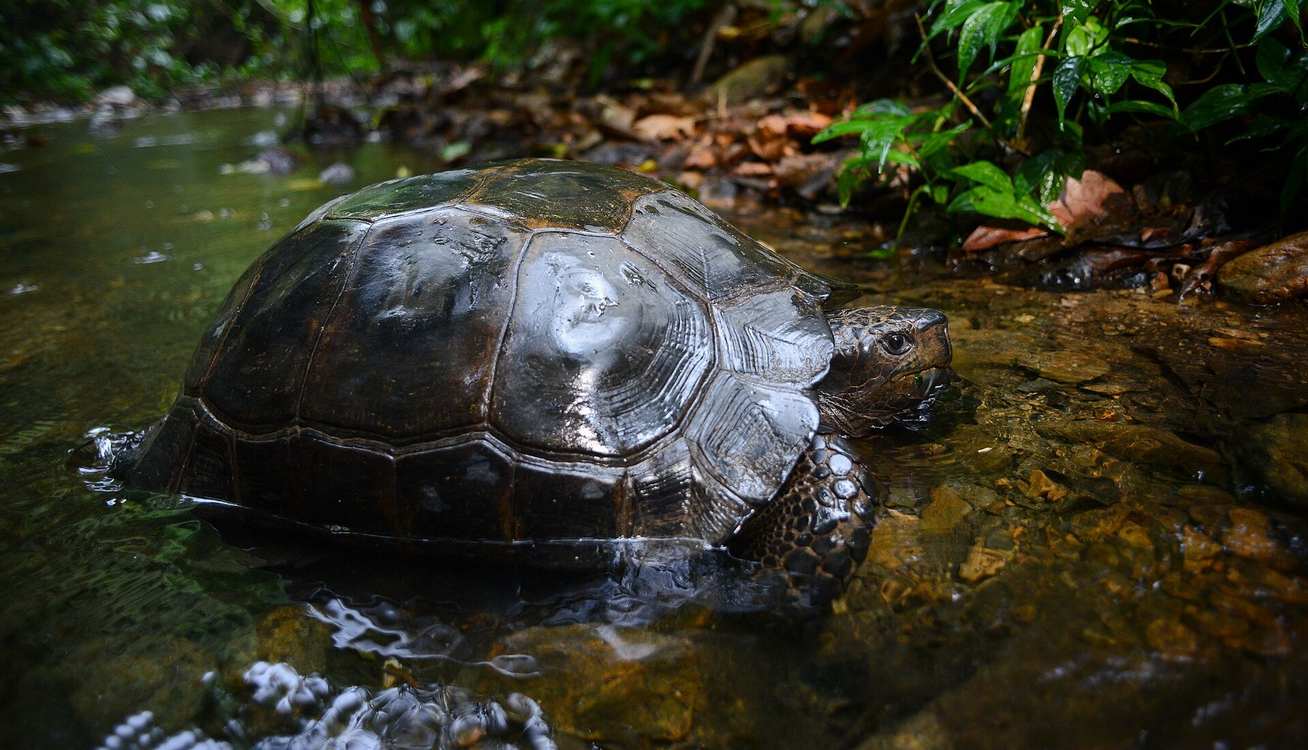
Iteichube leaves home at 8 a.m. every morning wearing an olive drab t-shirt that reads "Tortoise Guardian," walking forest paths in search of nibbled leaves and depressed ground—the telltale signs of one of mainland Asia's largest and rarest animals. In the far-eastern Indian state of Nagaland, on the frontier borderlands with Myanmar and Nepal, this 33-year-old resident of the Old Jalukie Conservation Reserve is part of a quiet revolution in how we save species from extinction: replacing professional conservationists with passionate locals, and government reserves with community-managed tribal lands.
The Asian giant tortoise was sliding toward collapse. The critically-endangered species had become so rare that the Nagaland Zoological Park began a captive breeding program as a lifeline. When the program started, it had just 13 tortoises—seven females and six males, some rescued from Nagaland markets where they were destined to be eaten, others recovered from village homes where they'd been kept as pets. The turning point came when villagers voluntarily donated their own pet tortoises to the breeding effort, a shift that transformed a community that had once hunted the species into its protectors. From those 13 founding tortoises, 114 individuals have now been born—roughly half of the entire estimated wild population remaining across all of Asia.
Shailendra Singh, Director of the Turtle Survival Alliance Foundation India, which oversees reintroduction alongside the Nagaland Forest Department, has watched this transformation unfold. "The community that once exploited them was sensitized to restore and nurture the species back in the wild from the brink," Singh explained. Over 100 of these captive-bred tortoises have been released into Nagaland's tribal reserves, where young men and women—trained in basic conservation strategies but armed mainly with commitment—track their movements and wellbeing with almost one-to-one involvement. This intimate connection creates something that distant government programs rarely achieve: genuine attachment between people and the animals they protect.
Iteichube himself has become deeply invested in understanding the tortoises. "We started by simply tracking them, but today we realize how important they are in keeping our forest vibrant and alive with their unique ways," he says. He's learned to recognize the tortoises' distinctive nesting behavior—they build leaf mounds between two and seven feet high to lay their eggs inside, a strategy unique among the world's tortoise species.
The model works because it leverages what Nagaland already has: extraordinary local stewardship. The state's territory is 80 percent community forest reserves—407 of them in total, representing fully half of all such reserves across India. These weren't imposed from above; they emerged from local commitment to land management. When the federal government had tried reintroduction efforts in the past, they failed to adequately protect the tortoises or even track them. The Nagaland approach has proven far more effective.
Now the model is spreading. Manipur, Nagaland's neighboring state, recently hatched its first clutch of artificially incubated Asian giant tortoises at the Manipur Zoological Gardens, signaling plans to launch its own reintroduction program. Local elders in these regions have long told stories of childhood rides along forest paths on giant tortoises—moments they assumed were gone forever, lost to development and hunting. Thanks to this collaboration between zoos and communities, that storybook privilege may return. A new generation of forest dwellers may know the weight and ancient patience of these remarkable animals firsthand, not as distant memory but as living reality.