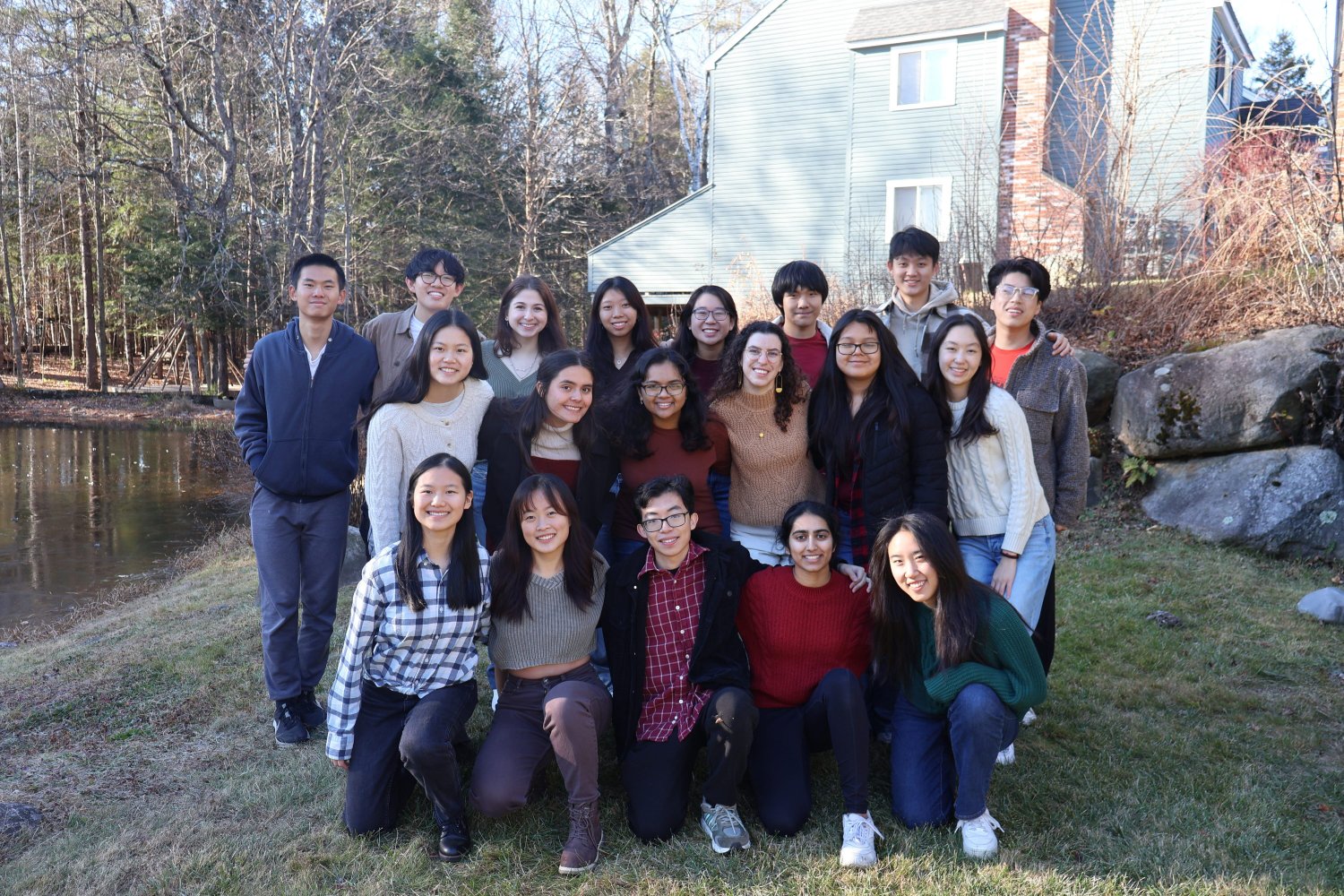
Thirteen years ago, Lukeman Nouri barely knew what MIT was. He was a quiet sixth grader from Saugus, Massachusetts, dragged to a summer program by his parents, skeptical about spending two weeks learning STEM. What he remembers most clearly from that first day was extracting DNA from a strawberry, making elephant toothpaste, and writing his very first computer program in Scratch. By the end of those two weeks, MIT had become his dream college. He would spend the next six years pursuing that dream — and this August, he'll be back on campus as a co-director of dynaMIT, the very club that changed his life.
That's the remarkable arc of dynaMIT, a student-run program at MIT that has been teaching free STEM workshops to Boston-area middle schoolers every summer for 13 years. This August, the club will welcome 80 young people to campus: 40 students in grades 6–7, followed by 40 more in grades 8–9. Each day brings a new topic — chemistry, machine learning, physics, math, biology, earth and space science — delivered through hands-on projects like solar s'mores, paper rockets, and interactive experiments designed to spark curiosity.
But what sets dynaMIT apart isn't just what happens during those two summer weeks. It's who comes back. Several former attendees have gone on to apply and be accepted to MIT itself, and some now lead the program. Dominique Dang, a Quincy native, remembers seeing the dynaMIT table at a fair and signing up because she hadn't received much STEM exposure in middle school. "I had so much fun, and it introduced me to creating things, and not just reading about them in a textbook," she says. Dang is now studying computer science and molecular biology at MIT and serves as the club's co-director. "I knew I wanted to be a scientist, but I didn't know what type of science I wanted to study, so having dynaMIT expose me to a different STEM topic each day was a transformative experience."
Erick Liang grew up in Boston's Chinatown and Roslindale neighborhoods. As a first-generation, low-income student, he says having a program like dynaMIT was "really important" for him. "DynaMIT exposed me to different fields of science I had not encountered yet in elementary or middle school and helped spark my interest in STEM," says Liang, who is now majoring in nuclear science and engineering and physics. Megan Zhu, the club's other co-director, came from Rapid City, South Dakota, and says she was immediately drawn to the organization's community mission. "Education has always been something that I was passionate about, and I wanted to emphasize giving back to the community," she says.
This summer, dynaMIT is adding a new activity called Sponge City — where students will build miniature cities designed to withstand storms and manage runoff water, exploring climate change and clean water access. The club is also partnering with MIT's Koch Institute for Integrative Cancer Research for lab tours and an experiment on cell heterogeneity and tumor formation.
For Nouri, the return is deeply personal. "I'm looking forward to giving this cohort the same great experience that I had six summers ago," he says. "DynaMIT was so much fun, and I learned so much from it that I feel a responsibility to help make it just as impactful for future students." Dang calls it "a great full-circle moment." And Zhu, who plans to pursue an MD/PhD and eventually teach at the university level, sees it as proof that the program works. "The club is also an excellent community at MIT," she says.