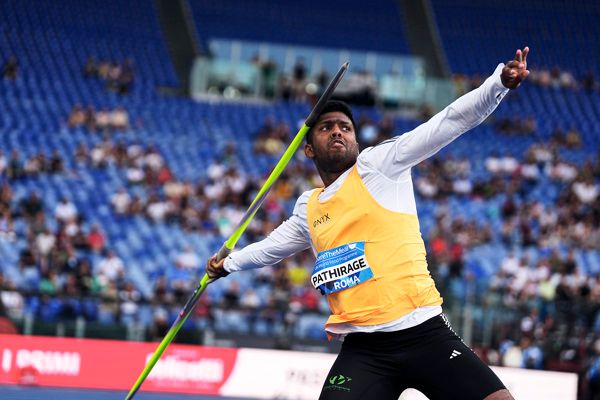
At Rome's Golden Gala, Rumesh Tharanga Pathirage hurled the javelin 92.62 metres in his second round—a throw that rewrote the meeting record and sent the Sri Lankan sprinting toward a milestone few Asian throwers have ever reached.
The moment mattered because Pathirage wasn't just chasing a personal best or a regional achievement. His throw made him the second-best javelin thrower in Asian history and landed him eighth on the world all-time list, surpassing the 20-year-old meeting record of 90.34 metres set by Andreas Thorkildsen. The world-leading distance also stood as the best javelin throw since the 2024 Olympic final—a rare feat of excellence in a sport where incremental improvement is the norm.
Opening with 84.49 metres in his first attempt, Pathirage had already secured victory before his breakthrough second round. He beat two-time world champion Anderson Peters, who threw 83.91 metres, and world bronze medallist Curtis Thompson at 83.89 metres. Pathirage's joy was palpable in his own words: "Winning today felt like a Sri Lankan festival," he told reporters, reflecting on conditions he described as ideal and a mental stability that carried him through despite having only two valid attempts to work with.
The Rome meeting became a stage for extraordinary breakthroughs across multiple events. In the men's 110 metres hurdles, Trey Cunningham of the United States became the 29th person ever to break the 13-second barrier, clocking a world-leading personal best of 12.98 seconds. His victory erased Allen Johnson's 27-year-old meeting record set in 1999. The 2022 world silver medallist had lost his luggage on the journey to Rome but found solace in hand-carry spikes and kit—a small detail that underscored his determination. "Beating the meeting record set 27 years ago by Allen Johnson, who is an all-time great, is special," Cunningham said, his momentum building toward what he called the World Ultimate Championship where, he noted, "It's going to be the 16 fastest people and only one winner."
Emma Zapletalova added a third meeting record when she won the women's 400 metres hurdles in 52.58 seconds, improving her own world lead and establishing a Slovakian national record. The world bronze medallist's performance vaulted her to third on the European all-time list, ahead of Olympic silver medallist Anna Cockrell, who ran 52.77 seconds.
Likina Amebaw led an Ethiopian dominance in the women's 5000 metres, clocking a world-leading personal best of 14 minutes and 18.41 seconds. The top four finishers all set personal bests, with Aleshign Baweke second in 14:18.54 and Freweyni Hailu third in 14:18.94. Even Olympic steeplechase champion Winfred Yavi, who faded in the final kilometre after leading through 4000 metres, improved her Bahraini national record to 14:30.06.
The evening belonged to those willing to push beyond existing boundaries—whether a javelin thrower from Sri Lanka redefining what's possible in his sport, or American hurdlers and European distance runners all finding their own versions of breakthrough.