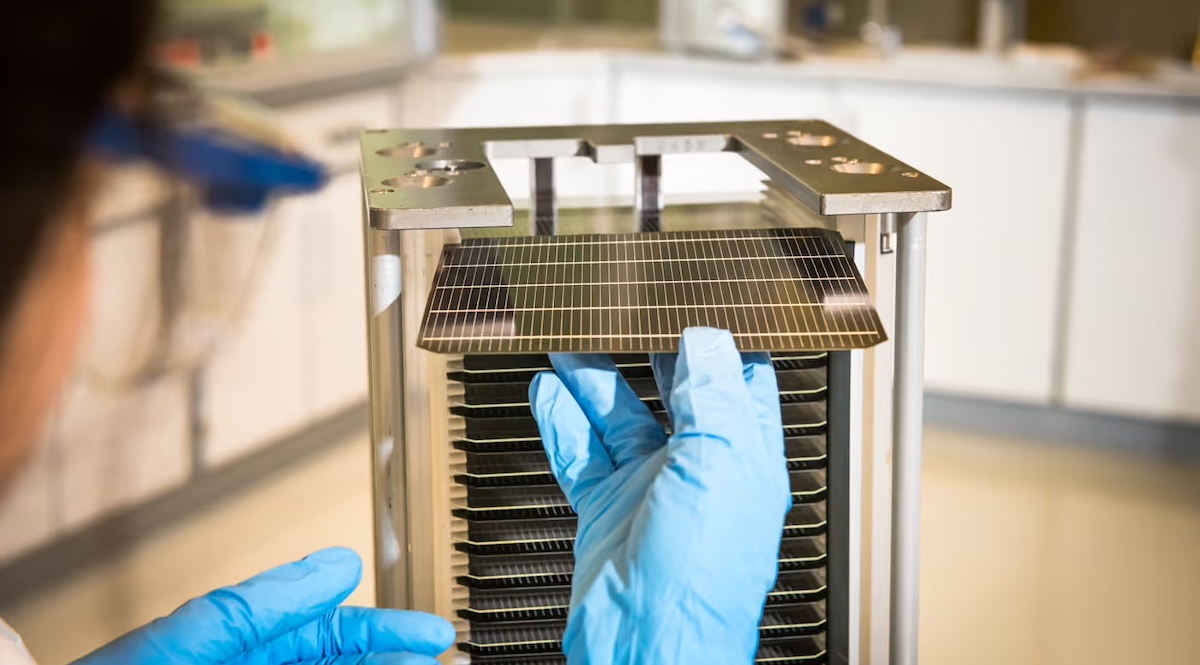
At a bustling trade fair in Munich, a shimmering solar module quietly hums with the promise of a brighter, cleaner future—546 watts of it, to be exact. Developed through a groundbreaking collaboration between Oxford PV and the Fraunhofer Institute for Solar Energy Systems ISE, this bifacial tandem module spans just 2.13 square meters yet delivers an impressive 25.6% efficiency, setting a new benchmark for solar technology. On display at The Smarter E / Intersolar 2026, the module is more than a prototype—it’s a tangible leap toward maximizing the power of sunlight.
Solar energy stands at a pivotal moment. As global demand for clean electricity surges, efficiency gains are no longer just desirable—they’re essential. Traditional silicon solar cells are approaching their physical limits, topping out at around 29.4% theoretical efficiency. But by layering a perovskite cell just a few hundred nanometers thick atop a silicon heterojunction cell, tandem technology pushes that ceiling to 43.3%. Oxford PV, a pioneer in this field, has now brought this next-generation tech into industrial production at its pilot facility in Brandenburg an der Havel, Germany.
The innovation doesn’t stop at the cell. Fraunhofer ISE’s Matrix Shingle technology reimagines how solar cells are connected. Instead of soldering strips with copper connectors, the team used lead-free, electrically conductive adhesive to bond cut solar cells into a staggered, overlapping matrix—like roof shingles. This low-temperature process reduces mechanical stress and eliminates the need for copper, cutting costs and improving durability. Because the perovskite-silicon tandem cells operate at lower current densities, they can be cut into wider strips, boosting manufacturing throughput. The result? A 491-watt rooftop module and a 546-watt bifacial version, both achieving 25.6% efficiency across their entire surface.
But perhaps the most compelling advantage lies in resilience. Thanks to the matrix layout, current can reroute around shaded areas, generating up to twice the power of conventional modules under partial shading—a common challenge for real-world installations. These glass-glass modules, sealed at the edges to protect moisture-sensitive materials, are built to last.
Funded by Germany’s Federal Ministry for Economic Affairs and Energy through the HoTSun research project, this collaboration unites two European innovations into one powerful solution. As tandem technology inches closer to mass adoption, it’s not just about higher wattage per square meter—it’s about accelerating the energy transition with smarter, more efficient solar panels. The sun, it turns out, still has a few surprises left.