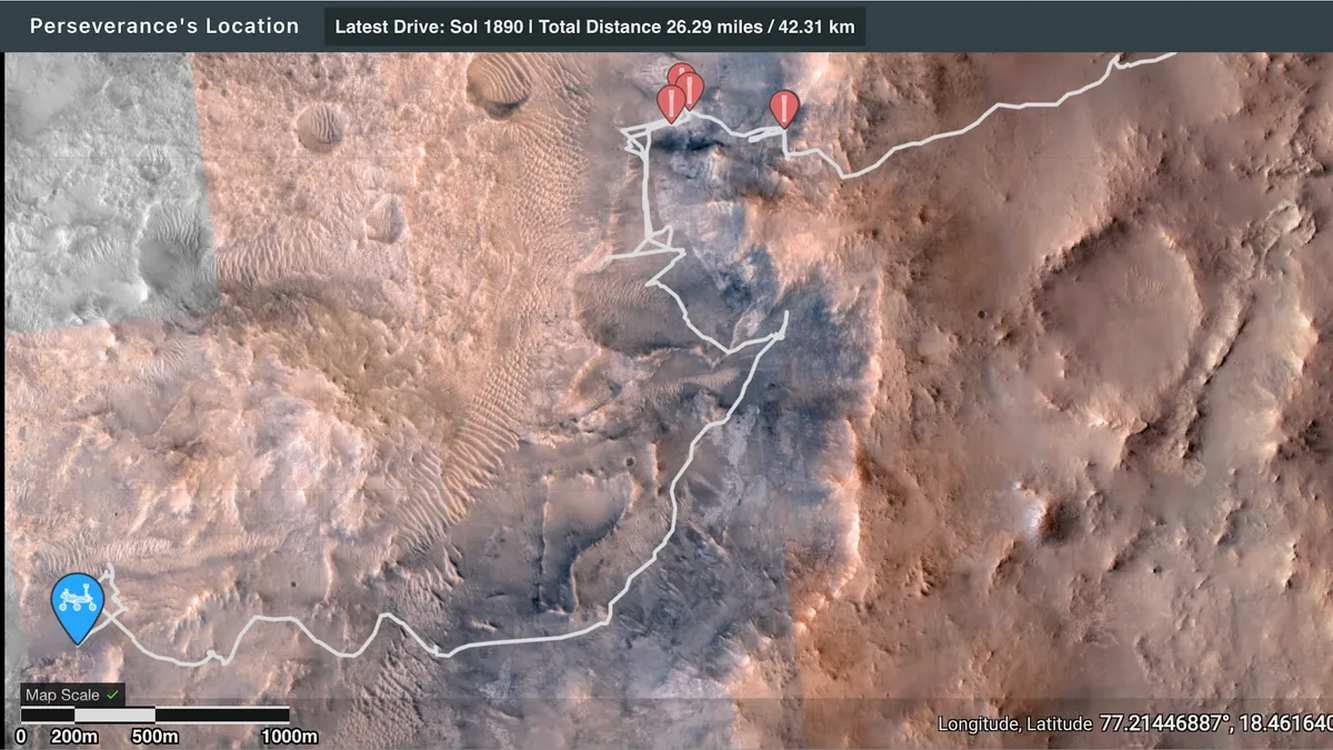
Ken Farley still remembers the tense silence in the control room at NASA’s Jet Propulsion Laboratory when Perseverance first touched down in Jezero Crater—now, five years later, the rover has rolled across 26.2 miles of Martian terrain, completing a literal marathon on another world. What began as a mission to seek signs of ancient life has unfolded into one of the richest chapters in planetary exploration, with Perseverance reshaping our understanding of Mars’ watery past. Its journey has not just been about distance; it’s been a deep dive into time, revealing sediments laid down when Mars was still young and possibly alive with flowing water.
When Perseverance landed in February 2021, scientists hoped Jezero Crater might once have held a lake. The rover’s findings confirmed it—spectacularly. By drilling into the crater floor and later ascending to the ancient river delta, Perseverance uncovered lakebed sediments that lie in horizontal, orderly layers, just like those formed in lakes on Earth. In 2022, its RIMFAX radar pierced 20 meters beneath the surface, mapping the buried crater floor and revealing how deeply the delta’s sediments had settled. That same year, the rover captured something rarer still: a solar eclipse on Mars, as the lumpy moon Phobos slipped across the sun. Thanks to Mastcam-Z’s solar filter, the footage showed unprecedented detail, a fleeting moment of cosmic choreography seen from the dusty surface of another planet.
By the end of 2023, Perseverance had finished its work inside the crater and began exploring the canyon where the ancient river once poured into the lake. Here, rich carbonate deposits—potential preservers of biological signatures—glistened in orbital images. The rover’s sampling campaign accelerated, amassing nearly 100 rock and regolith samples, including some of the earliest molten rock on Mars and water-sculpted formations that hint at a dynamic, Earth-like past. Among them may be the oldest sample ever collected on another planet. These specimens, sealed in tubes lined with sterilized sapphire—dubbed the ‘cleanest surfaces in the universe’—await a future mission to bring them home.
Yet, despite the triumphs, a question lingers: how will these precious samples return to Earth? The original $11 billion plan has been scrapped, and NASA is now reimagining a faster, cheaper alternative. Even astronaut Jared Isaacman has mused about sending humans to Mars to retrieve them by hand. For now, the tubes remain on the surface, waiting. But Perseverance keeps rolling—beyond the crater rim, beyond expectations—proving that the most enduring discoveries are made one wheel turn at a time.