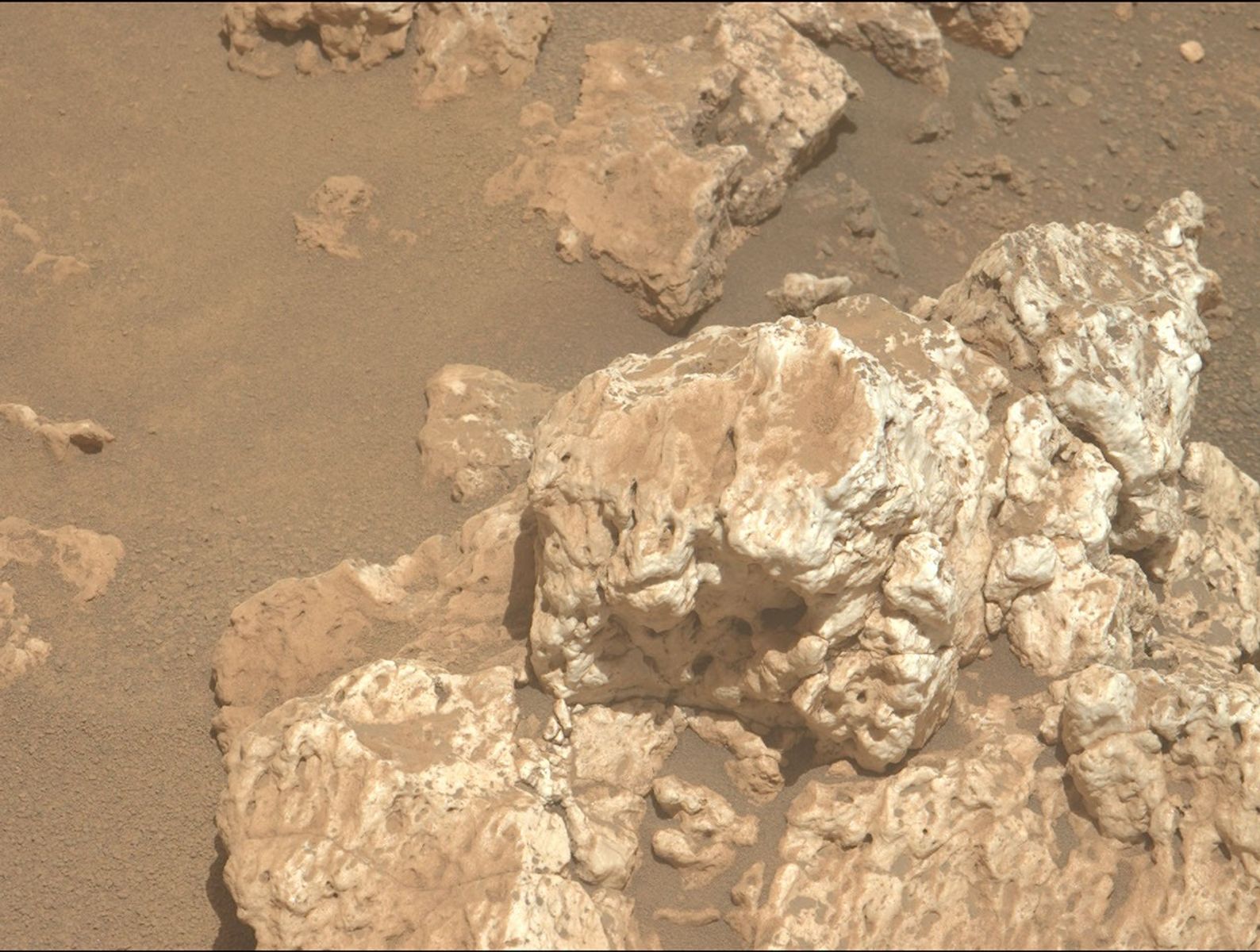
Against Mars’ dark, dust-covered ground, a cluster of pale rocks at a place called Idubi shines bright enough to stand out even beside rocks the Perseverance rover has already studied. The rover team’s latest findings show these fragments are rich in hydrated silica, a material that forms in water and can preserve tiny traces of ancient life.
Idubi lies in the Lac de Charmes region, outside Jezero crater, where ancient crust is exposed. Perseverance is exploring this area to learn how water shaped Mars long ago. Water is central to the search because some environments where it exists can support life. Rocks formed in or altered by water may also keep clues about the planet’s past, even after the water itself is gone.
The bright rocks first caught the team’s attention because they looked different from the darker terrain around them. They were even brighter than igneous rocks—formed from cooled molten material—and impactite rocks, made by the force of an impact, that the rover had examined before. The team suspected the fragments had a different origin and directed Perseverance to investigate. Data from the rover’s SuperCam instrument, sent back to Earth, confirmed that the rocks are not igneous. Instead, they contain abundant hydrated silica.
On Earth, hydrated silica can form in several kinds of water-related settings, including hot-water systems, soils, and groundwater. Those settings matter because some may have offered conditions suitable for life. The mineral is also valuable to scientists looking for signs of past life: it can preserve microfossils, the tiny remains or traces of ancient organisms. That does not mean the Idubi rocks contain evidence of life. It means they may be a good place to look for clues and to study how water once moved through this part of Mars.
Perseverance has encountered silica-rich rocks before, on the inner rim of Jezero crater. But those deposits were too small for the rover to use its close-up science instruments and collect the detailed chemical and mineral information needed to understand how they formed or how well they might preserve signs of life. The Idubi rocks are larger, giving the team a better chance to examine them closely. A detailed campaign using the rover’s nearby science instruments is already underway.
The work could help scientists piece together Mars’ water history and assess whether ancient environments there had conditions that might have supported life. For now, the bright fragments offer a promising target, not a conclusion. As Perseverance studies them in detail, researchers will look for evidence that can reveal how the rocks formed and whether their mineral structure has preserved a record of the distant past.