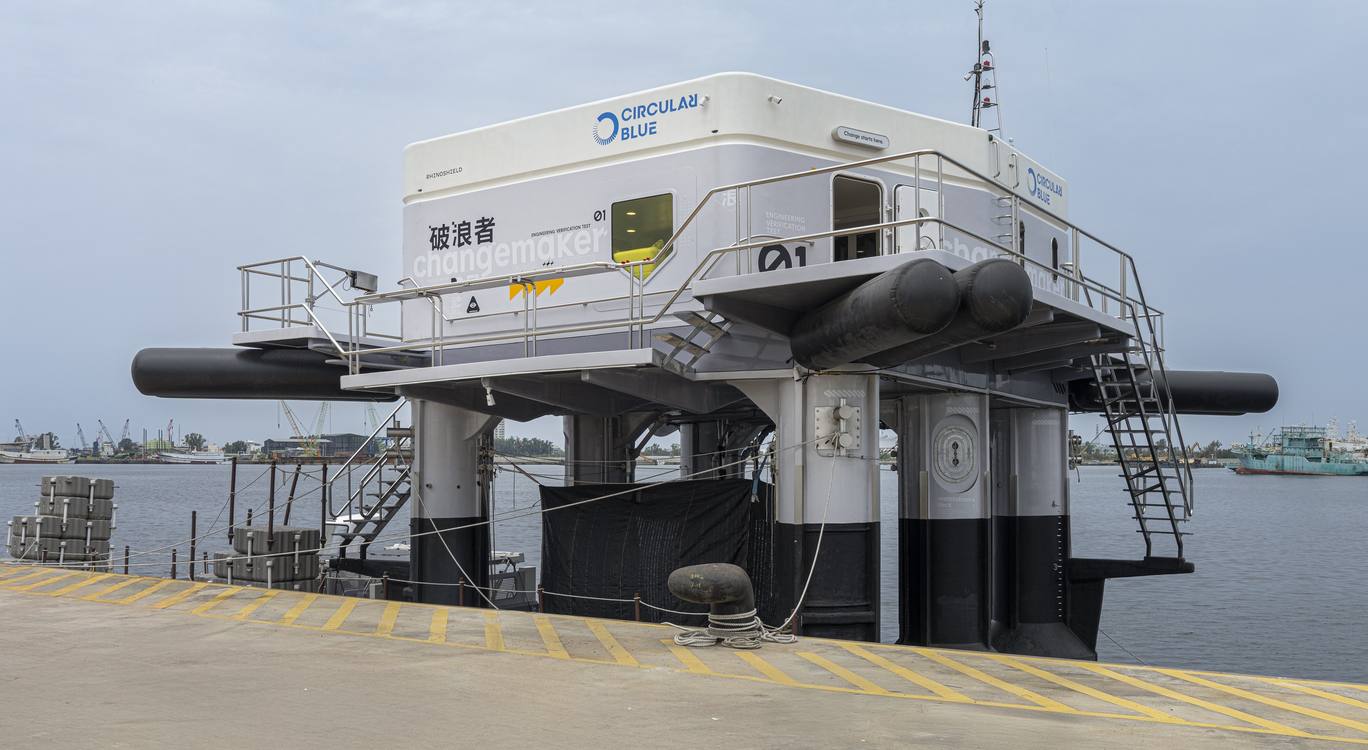
Off the coast of Taiwan, a platform that resembles an offshore oil rig but serves an entirely different purpose floats on the open water, quietly collecting the plastic choking our oceans. This is Circular Blue, a seaborne innovation from RHINOSHIELD, one of the world's largest phone case manufacturers, and it represents a deliberate shift toward what corporate responsibility could look like in an age of environmental crisis.
The story begins with CEO Eric Wang's simple but stark observation: "I look into ocean plastic a lot, and I realize that not a lot of people are collecting it." That realization led RHINOSHIELD to invest 18 months of design and development and approximately $2 million to build a platform that could operate autonomously, identifying and capturing marine waste at scale. The result is a floating hub equipped with AI-driven drones that work in concert—an aerial drone launches from the platform to scout for floating waste and identify pollution hotspots in real time, then feeds that location data to a solar-powered collection vessel that retrieves it. Onboard filtration captures debris of all sizes, from microplastics to larger debris.
What makes Circular Blue remarkable is that it doesn't require human intervention to operate. The platform can accommodate up to four crewmembers and marine research programs, but its core mission runs autonomously, powered by solar energy and guided by artificial intelligence. The drones scan coastlines, identify the highest-impact collection areas, and direct resources accordingly—a system designed to make ocean plastic cleanup more strategic and efficient than traditional methods.
But RHINOSHIELD's commitment to combating plastic waste extends beyond this single platform. Under Wang's leadership, the company has redesigned its entire product line around a single principle: every phone case should be made of one plastic polymer, from the flexible interior to the rigid exterior. This approach mimics the simplicity of a plastic bottle, making every case as easy to recycle as it is to manufacture. With RHINOSHIELD producing approximately 5 million phone cases annually, this decision to standardize production around monomaterial design could dramatically reduce the amount of composite waste entering landfills and oceans.
"Every year we make about 5 million phone cases, and if everything is made of one material, and everything can be identified, there would be so much less waste in the world," Wang explained. It's a philosophy that recognizes that preventing waste at the source is as important as cleaning it up after it's already escaped.
The Circular Blue platform represents proof of concept for a larger vision. Company sources indicate that a North American expansion is expected in the future, suggesting that what began as an experiment off Taiwan's coast may soon become a multi-ocean initiative. Whether this platform becomes a model for other industries—or whether it remains a singular achievement—the project demonstrates that meaningful corporate action on environmental issues doesn't have to choose between profitability and purpose. It can pursue both, guided by the conviction that building fewer things made of fewer materials, and cleaning up what does escape, are both necessary parts of the solution.