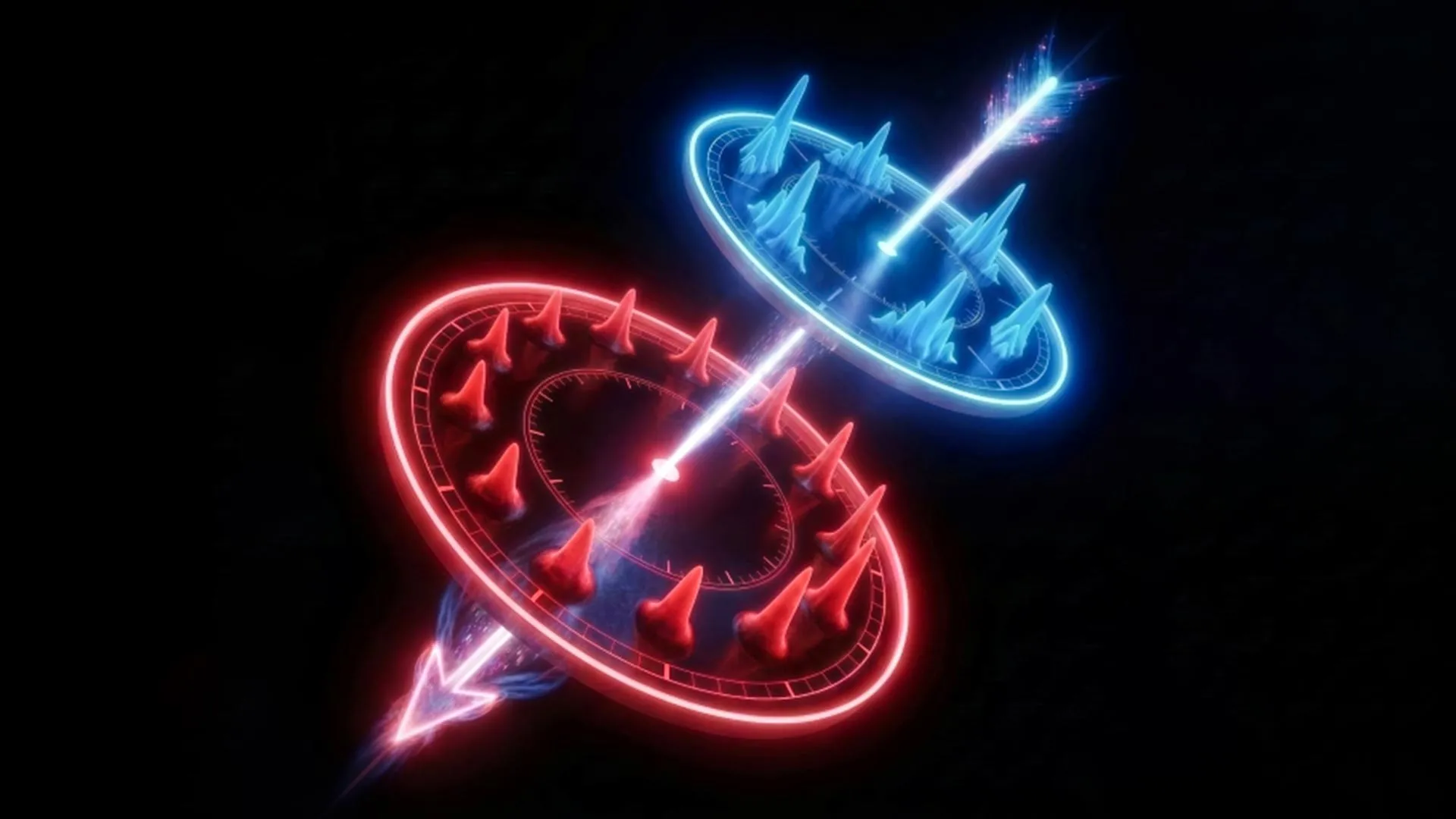
A team of international physicists has finally cracked a laser puzzle that has stumped the field for years: why some ultrafast lasers pulse in a strange, rhythmic pattern that looks almost like breathing. The breakthrough, led by researchers including Dr. Sonia Boscolo from Aston University's Institute of Photonic Technologies, unites two completely separate mathematical models into a single framework for the first time—a discovery that could reshape how scientists design the next generation of light-based technologies.
Ultrafast lasers are remarkable machines. They generate bursts of light so brief they last only picoseconds or femtoseconds—trillionths of a second. These lasers already transform lives: eye surgeons use them to reshape corneas with micron precision, doctors employ them for biomedical imaging, manufacturers rely on them for cutting-edge precision processing. Understanding how they actually work matters enormously, because better control could make them safer, more stable, and more effective for specialized applications.
Inside an ultrafast laser, pulses of light bounce repeatedly through a chamber called a cavity. Under the right conditions, these light pulses organize themselves into remarkably stable wave packets called solitons, which maintain their shape as they travel—unlike ordinary light pulses that gradually dissipate. Most of the time, solitons behave predictably, firing off regular pulses like a steady heartbeat. But in "breather" lasers, something stranger happens. The pulses rhythmically grow and shrink during successive trips through the cavity, oscillating in a pattern that really does resemble breathing. This happens because the laser exists in a non-equilibrium state where the output constantly evolves rather than settling into stability.
For decades, researchers noticed that breather lasers displayed two distinctly different breathing patterns. Above a certain power threshold—the minimum needed to sustain pulse emission—the solitons oscillate rapidly, completing a breathing cycle in just a few cavity roundtrips. Below that threshold, the rhythm slows dramatically. A single breathing cycle might take hundreds or even thousands of roundtrips to complete. Until now, scientists needed two entirely separate mathematical models to explain these contrasting behaviors, as if they were describing completely different phenomena.
The new unified model, published in Physical Review Letters, changes everything. Dr. Boscolo and her colleagues created a revised framework that accounts for two critical processes simultaneously: the rapid evolution of light inside the cavity itself, and the slower changes happening in the laser's energy supply. By combining these dynamics, they demonstrated that both breathing patterns actually arise from related underlying physics—they are two expressions of the same phenomenon, not separate mysteries requiring separate solutions.
"Our new simulation accurately predicts both the fast and slow cycles in one go, something that was previously thought to be impossible with a single model," Dr. Boscolo explained. The team's work reveals that below-threshold breathing emerges from a combination of Q-switching and soliton shaping, while above-threshold breathers are dominated by Kerr nonlinearity and dispersion—two different mechanisms, but now understood within one coherent theoretical structure.
The implications ripple outward. As demand grows for more powerful and dependable laser technologies, this unified framework offers engineers a practical tool to predict complex laser behaviors more efficiently, without juggling multiple disconnected simulations. The researchers hope their work will become essential guidance for designing the ultrafast lasers of tomorrow—the ones that will perform eye surgery with greater precision, deliver clearer biomedical images, and enable manufacturing advances yet to be imagined.