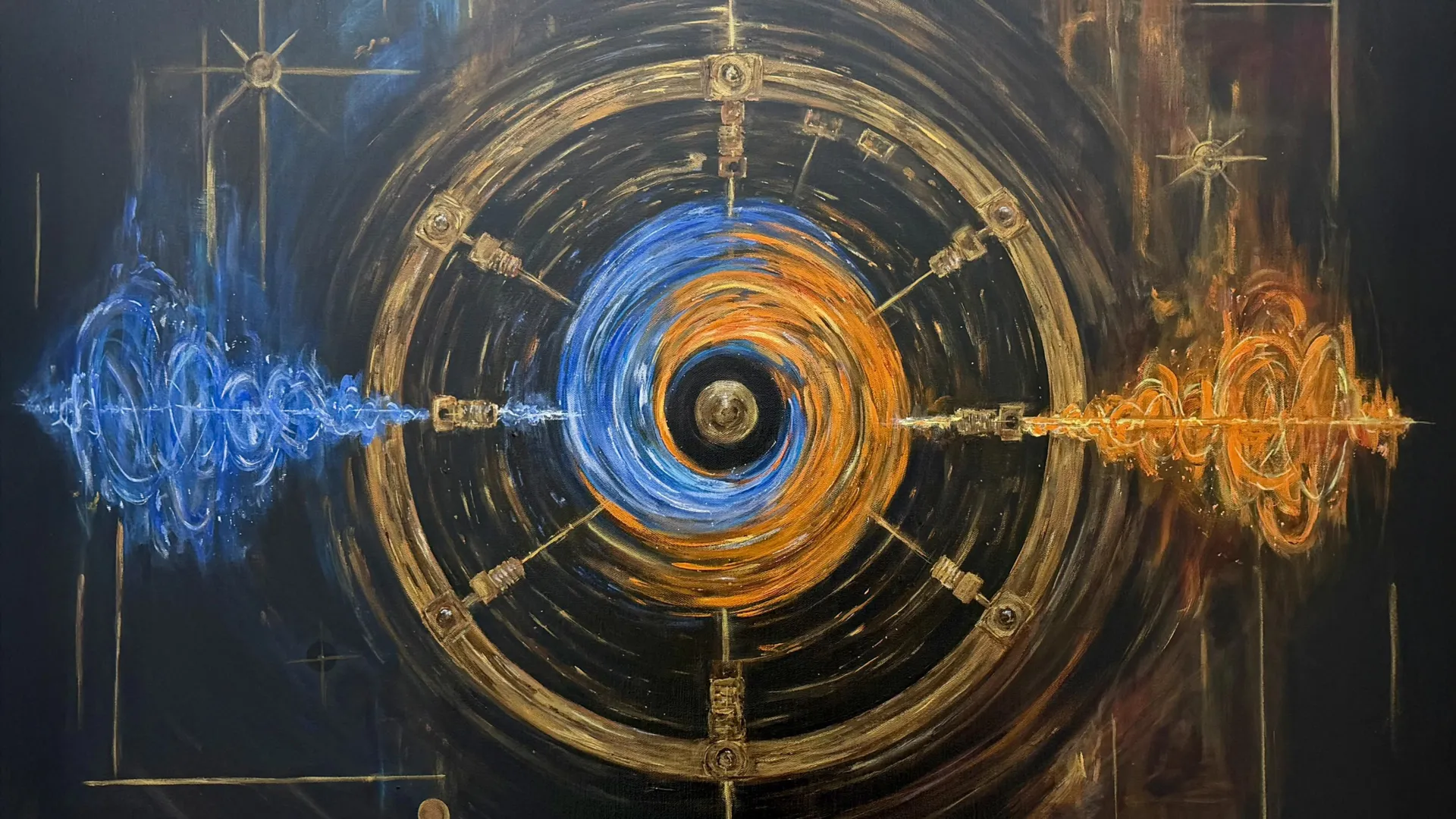
More than 50 years ago, physicist Sir Roger Penrose had a wild idea: maybe you could steal energy from a spinning black hole. His concept was clever. A particle entering the black hole's "ergosphere" — a region where spacetime itself gets dragged along by the black hole's spin — could split in two. One piece would fall in, but the other would escape carrying more energy than the original particle started with. Later, physicist Yakov Zel'dovich expanded on this, predicting that waves bouncing off a rapidly rotating object could also gain energy and grow stronger.
Now, researchers at the City University of New York Graduate Center have brought this idea out of the realm of pure theory and into something you can actually test in a lab — without needing a black hole.
The team, working at the CUNY ASRC (Advanced Science Research Center), built a device that creates the illusion of extreme rotation without anything actually spinning. Instead of rotating an object mechanically, they created a ring of electronic resonators whose properties were rapidly adjusted across both space and time. The hardware itself never moved, but the timed changes generated a traveling pattern around the ring. To electromagnetic waves passing through, it felt exactly as if they were encountering an object spinning at extraordinary speed.
"Waves with the appropriate rotational characteristics extracted energy from the system and became amplified, reproducing the essential physics of the Penrose-Zel'dovich process," said co-lead author Hady Moussa, a former PhD student with the CUNY ASRC Photonics Initiative.
The team published their findings in the journal Nature. Lead author Hadiseh Nasari, a postdoctoral researcher, said the experiment transforms a long-standing theoretical concept into a practical research tool. "This successful experiment moves ideas about extreme rotational dynamics from theory to practice," she said.
The approach, called synthetic rotation, can imitate motion beyond the speed of light — something impossible with physical spinning. That opens up new frontiers for scientists who want to study extreme physics without needing to visit a black hole. The researchers say the same principles could eventually improve wireless communications, optics, photonics (the science of controlling light), and quantum technologies. Additional work will be needed before these ideas become real devices, but for now, physicists have a powerful new way to explore some of the universe's most extreme environments using nothing more than carefully timed electronic signals.