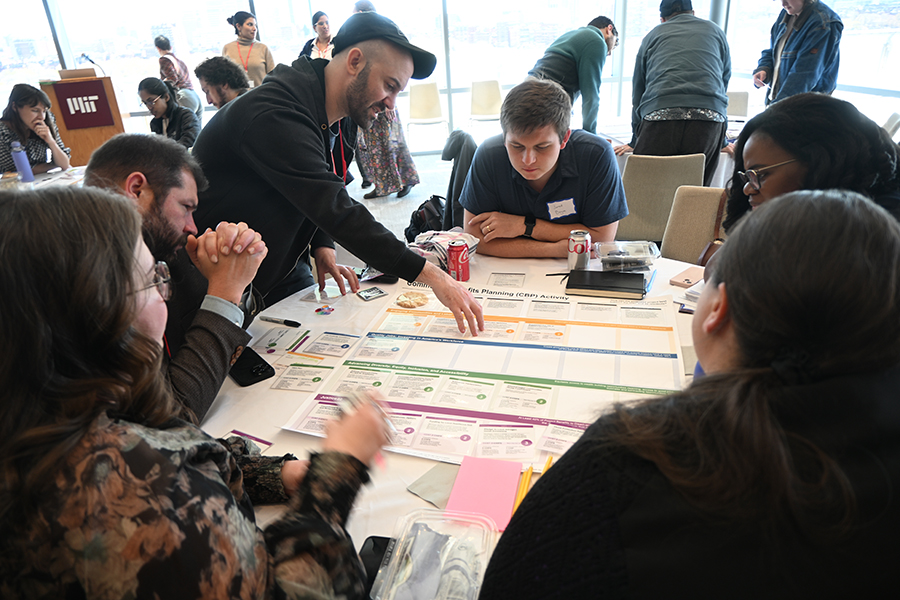
When Nicholas Hood describes Greene County, Pennsylvania, the accumulated weight of environmental harm is impossible to ignore. Coal mines, old oil wells, fracking operations that have poisoned water and spiked rates of asthma and lymphoma — and now, data centers. "So, ask yourself, do you think we want that?" he said at MIT's second Living Climate Futures Symposium in April, voicing the question that frontline communities are increasingly asking of their own futures.
The Living Climate Futures initiative represents a fundamental shift in how climate solutions get made. Rather than imposing one-size-fits-all strategies from above, MIT's 20-person research team across the Institute collaborates directly with communities worldwide to understand how climate change disrupts daily life in specific places, then co-creates responses rooted in local knowledge and priorities. Funded by the MIT Human Insight Collaborative and based at the School of Humanities, Arts and Social Sciences, the initiative brings together environmental organizations, researchers, and students to examine climate challenges from New England to Mongolia.
The April symposium spotlight on data center expansion in Greene County reveals how communities are actively resisting what they recognize as environmental injustice. Jason Capello, a community advocate with the Center for Coalfield Justice — an organization that has fought to improve fossil fuel regulations in the region since 1994 — explained the pattern clearly: developers deliberately build data centers in places where populations lack political power to resist, betting on minimal opposition. The costs are concrete: pollution from water-based cooling systems, diesel generators, and natural gas power plants create fine particulate matter linked to childhood asthma, heart attacks, strokes, and lung disease.
But resistance is working. Livia Garofalo, a cultural and medical anthropologist at Data and Society's Trustworthy Infrastructures team, documented that communities armed with protests, petitions, canvassing, and public hearings have successfully stopped or significantly limited data center projects. To strengthen that power, researchers at the symposium shared tools and strategies. Michael Cork, a biostatistics postdoc at Harvard, presented an analytical tool that estimates emissions, models pollution spread, identifies who faces exposure, and predicts health and economic impacts. That data becomes ammunition for negotiations.
Perhaps most powerfully, MIT associate professor Amy Moran-Thomas and Stanford postdoc Anjuli Jain Figueroa walked participants through an educational game developed by Northeastern University's Sara Wylie — a practice simulation where communities negotiate community benefit agreements. These CBAs spell out binding commitments from developers: specific jobs, affordable housing, environmental safeguards. Rather than accepting or rejecting projects outright, communities learn to negotiate what they actually need. Moran-Thomas also facilitated workshops on writing persuasive op-eds, turning participant expertise into public voice.
The Greene County case illustrates why place-based climate action matters so urgently. These communities have already borne decades of extractive harm. The Living Climate Futures initiative doesn't ask them to accept new threats as the price of progress. Instead, it partners with them as experts in their own futures — equipped with research, analytical tools, and strategies that turn local knowledge into leverage. That's how climate solutions that actually work get built.