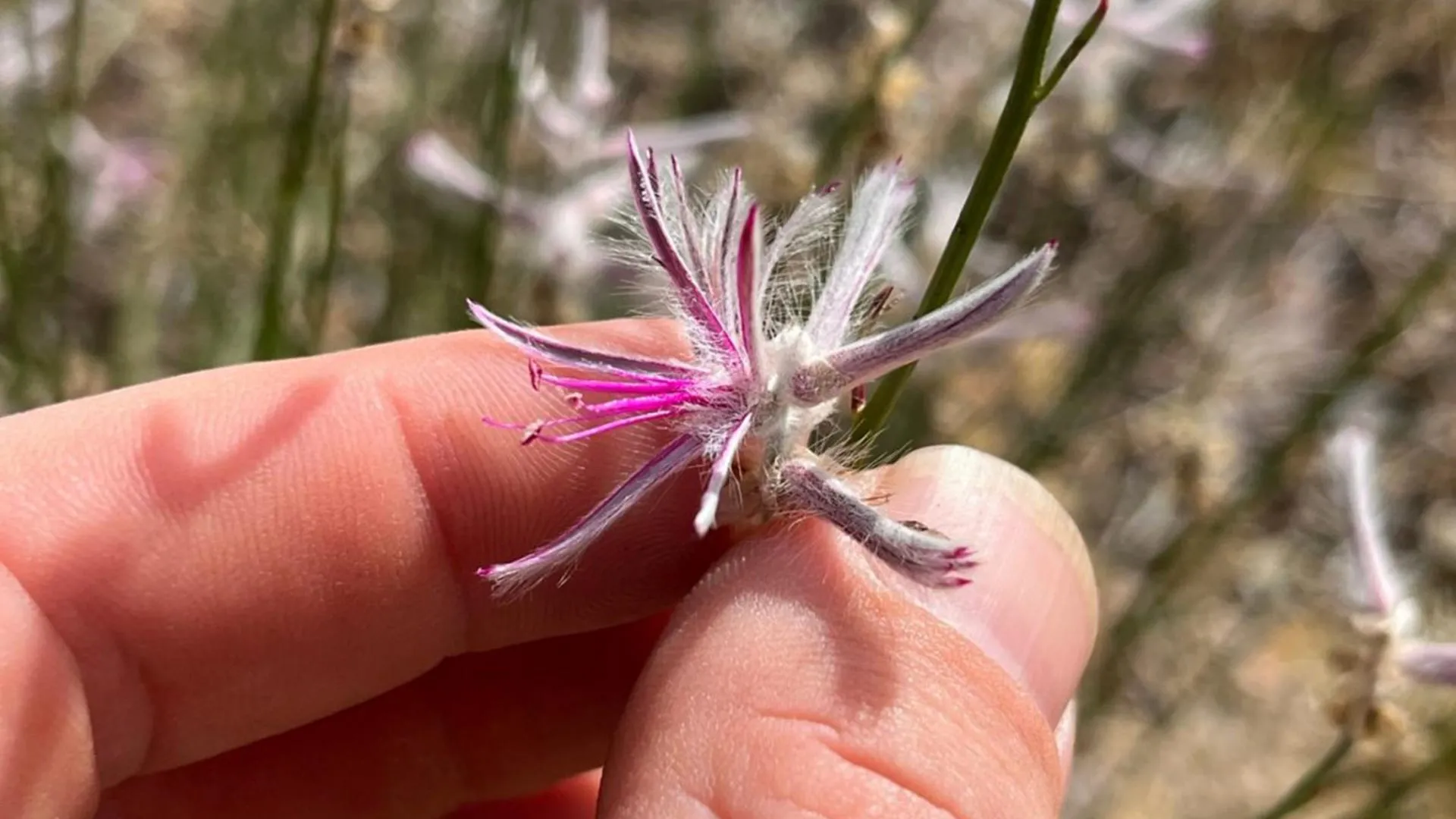
Aaron Bean was banding birds on a remote Queensland property near the Gulf of Carpentaria when he spotted something that made him stop. An unusual shrub with delicate purple-pink flowers like feathered fireworks grew in the rugged landscape—a plant that hadn't been officially seen in the wild for nearly 60 years. He photographed it, uploaded the images to iNaturalist once he had phone service again, and set off a chain of events that would rescue a species from the brink of oblivion.
Among millions of observations on the citizen science platform, the photos eventually reached Anthony Bean, a botanist at the Queensland Herbarium who had actually described Ptilotus senarius himself a decade earlier. He recognized it immediately. What followed was confirmation that the species still survives, moving it from presumed extinct to critically endangered—a shift that means conservation groups and scientists can now legally protect it.
"It was very serendipitous," said Thomas Mesaglio from the UNSW School of Biological, Earth and Environmental Sciences, who documented the rediscovery in the Australian Journal of Botany. The discovery captures something profound happening in modern science: ordinary people with cameras are becoming essential partners in biodiversity research, especially in places scientists simply cannot reach.
Australia's vast size and biodiversity make comprehensive scientific surveying impossible. Roughly one third of the continent is privately owned, which creates a gap that citizen science now fills. "If you are the property owner or you're someone who has permission from the owner to be there then suddenly it opens up this whole new world," Mesaglio explained. A professional horticulturist happening to notice an unusual plant while doing unrelated work, combined with the right expert seeing the right photograph at the right moment, demonstrated how these connections matter.
The global context makes the find even more significant. Before Ptilotus senarius reappeared, roughly 900 plant species had disappeared from the wild since 1750. Every rediscovery pushes back against that tide. The Queensland government is already investing in this potential through programs like Land Libraries, which trains and equips landowners to document wildlife and plant species on their properties and upload observations to citizen science platforms.
Mesaglio sees the impact rippling outward. Research shows that iNaturalist observations have already been cited in scientific papers involving 128 countries and thousands of species. The platform isn't just a place for casual nature lovers—it's a functioning research infrastructure. "The more information you can provide and the more context you can provide, the more potential uses that that record will have in the future," Mesaglio said, encouraging users to include not just photos of flowers but details of leaves, bark, stems, soil conditions, nearby vegetation, and even how a plant smells.
What began with one person pausing to photograph something interesting has become a model for how science and conservation adapt to their challenges. Private landowners, professional horticulturalists, and botanists connected by a photo upload are proving that biodiversity research no longer depends only on institutional resources. It depends on attention, curiosity, and the willingness to share what you see.