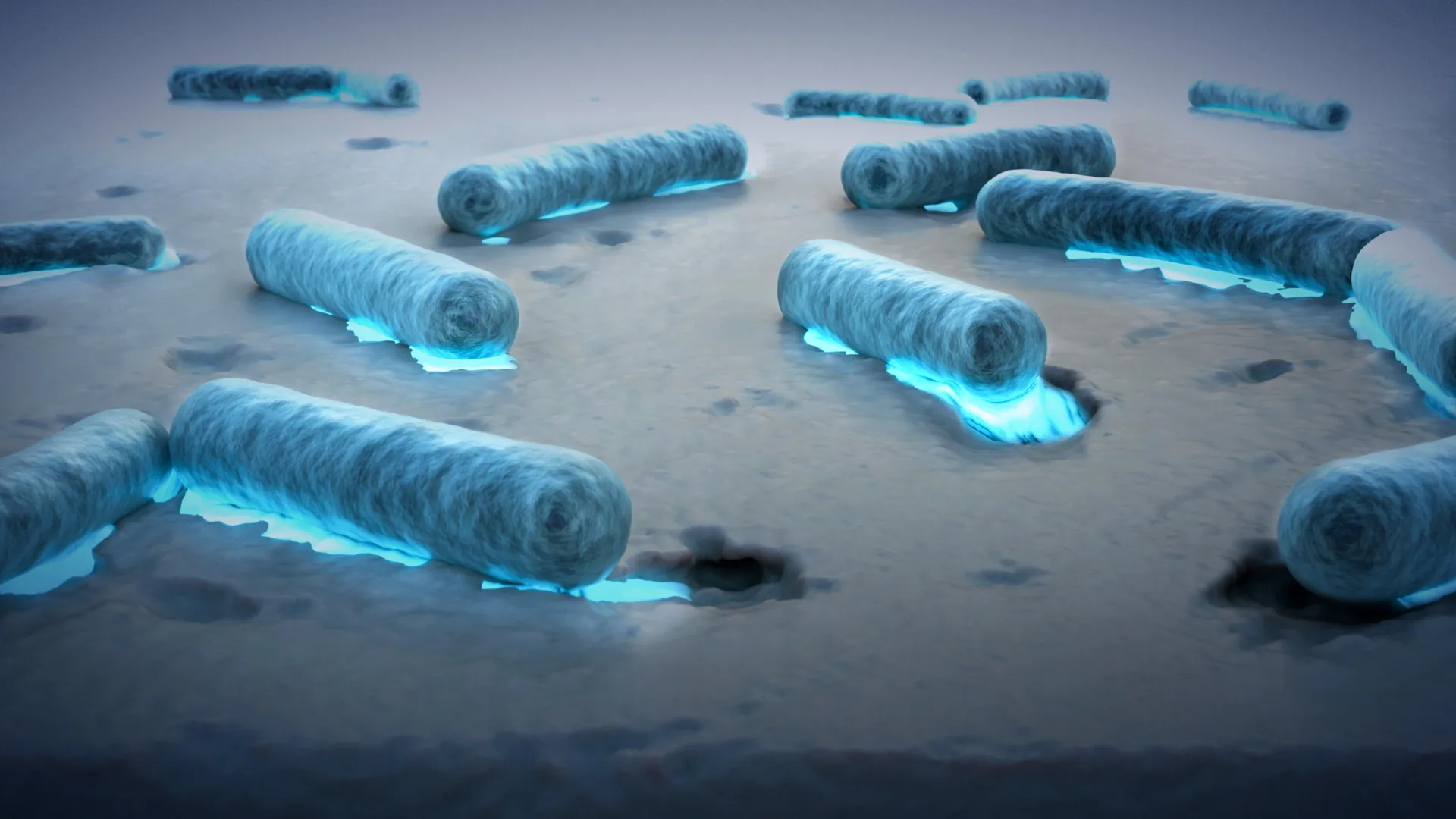
Nearly two kilometers beneath the ocean's surface, where sunlight never reaches and food is scarce, tiny bacteria have quietly taught themselves to eat our trash.
Scientists at KAUST — the King Abdullah University of Science and Technology in Thuwal, on the Red Sea — have found that marine microbes across the globe have evolved enzymes that can digest PET plastic, the same tough stuff in your water bottle and your fleece jacket. The key is a small structural feature on an enzyme called PETase. The team calls it the M5 motif, and it acts like a molecular fingerprint that tells scientists when an enzyme is the real deal.
"The M5 motif acts like a fingerprint that tells us when a PETase is likely to be functional, able to break down PET plastic," says Carlos Duarte, the marine ecologist who co-led the study.
For a long time, scientists believed PET was nearly impossible to break down in nature. That idea started to crack in 2016, when a bacterium found in a Japanese recycling plant was discovered surviving on plastic waste. But nobody knew whether ocean microbes had come up with their own versions independently)Skip.
Using artificial intelligence modeling, genetic screening, and lab tests, Duarte's team proved that the M5 motif separates true plastic-eaters from look-alikes that do nothing. Marine bacteria carrying the full motif efficiently took apart PET samples in experiments, and genetic maps showed these genes are highly active throughout the oceans — especially in areas choked with plastic pollution.
To find out just how far this talent reaches, the researchers studied more than 400 ocean samples collected worldwide. Functional PETases with the M5 motif turned up in nearly 80 percent of the waters tested, from floating garbage gyres at the surface to barren depths roughly two kilometers down.
In the deep sea, where carbon is scarce, this is a survival edge. As co-leader Intikhab Alam, a senior bioinformatics researcher, notes, the ability to snack on synthetic carbon may give microbes a crucial advantage. It's a striking sight: microorganisms adapting to human pollution on a planetary scale.
But Duarte warns against celebrating too soon. "By the time plastics reach the deep sea, the risks to marine life and human consumers have already been inflicted," he says. The microbes work far too slowly to offset the enormous flow of plastic entering the oceans each year.
The real promise lies on land. If scientists can copy and supercharge these natural enzymes, they could help treatment plants — and eventually homes — break down plastic far more efficiently. The M5 motif gives engineers a roadmap, showing the structural traits that work in the real world, not just in test tubes.
Humanity's fight against plastic pollution may have just found powerful allies in the planet's most unexpected place: the deep, dark ocean.