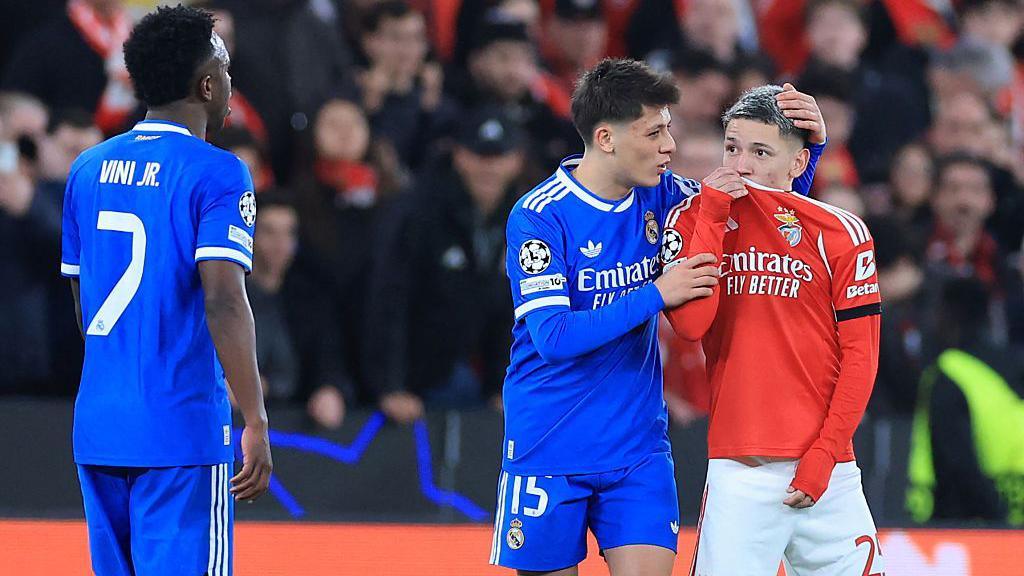
In a move that could reshape conduct on football's biggest stage, world football's governing body approved strict new rules to combat racism and homophobia at this summer's World Cup. Players who cover their mouths when speaking to opponents during confrontations now risk an immediate red card, following a landmark decision at the International Football Association Board meeting in Vancouver, Canada.
The rule change emerged from a controversy that made headlines earlier this year. During a Champions League match between Benfica and Real Madrid, Argentine winger Gianluca Prestianni was accused of directing racist abuse toward Brazil's Vinicius Jr. Prestianni raised his shirt while speaking to the Real Madrid star, a gesture later found to constitute homophobic conduct. Following a UEFA investigation, he was banned for six matches—three of them suspended. The incident sparked urgent discussions about player behavior and prompted football's lawmakers to act.
Fifa president Gianni Infantino championed the red card approach, arguing it would serve as a powerful deterrent. "If a player covers his mouth and says something, and this has a racist consequence, then he has to be sent off, obviously," Infantino said at the meeting. "There must be a presumption that he has said something he shouldn't have said, otherwise he wouldn't have had to cover his mouth." The final decision remains with referees, who will assess all circumstances before issuing cards.
The new regulations also target teams that abandon matches in protest. Following chaotic scenes at the Africa Cup of Nations final between Morocco and Senegal—when Senegalese players walked off the pitch following a contentious penalty decision—the rules now mandate red cards for those who leave the field and potential forfeiture of matches. Team officials who incite such walkouts face the same consequences.
Beyond behavioral measures, FIFA announced a significant boost to World Cup funding. With the tournament expanding to 48 nations for the first time, the governing body raised its contribution by 15 percent to $871 million. Preparation money for each nation doubles from $1.5 million to $2.5 million, while qualification payments increase from $9 million to $10 million. Delegation subsidies now total $16 million per team, addressing concerns that hosting costs in the United States, Mexico, and Canada could have left national associations out of pocket. FIFA also confirmed a second yellow card amnesty, wiping suspensions after the group stage and quarter-finals to prevent stars from missing key matches.
For football fans worldwide, the changes signal a new era of accountability. Whether the measures will truly stamp out abuse remains to be seen, but by adopting concrete penalties, FIFA has sent its clearest message yet that racist and hateful conduct will not be tolerated on the world's greatest sporting stage.