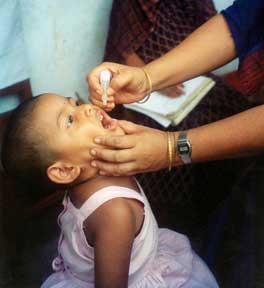
In 1988, polio paralyzed an estimated 350,000 people each year across the globe. By 2018, that number had collapsed to 33 cases. This stunning reversal—one of medicine's greatest triumphs—rests on the shoulders of two vaccines that have systematically choked off one of humanity's most feared viruses.
The story begins with competing visions. Hilary Koprowski demonstrated the first successful polio vaccine in 1950, a weakened live virus taken by mouth. It worked, but the United States declined to approve it. Then in 1955, Jonas Salk announced a breakthrough with an inactivated, killed-virus vaccine given by injection. A third pioneer, Albert Sabin, refined the oral approach, bringing his attenuated vaccine into commercial use in 1961. The World Health Organization would later declare polio vaccine essential medicine, and these two approaches—IPV by injection and OPV by mouth—have since become the backbone of global eradication efforts.
The vaccines work through elegant simplicity. The injectable IPV produces protective antibodies to all three poliovirus types in at least 99 percent of recipients after three doses. The oral vaccine, OPV, achieves immunity in more than 95 percent of people after three doses, and offers an additional advantage: it creates immunity in the intestine, the primary entry point for wild poliovirus. Both carry exceptional safety profiles, though the oral version carries a rare risk—roughly three cases of vaccine-associated paralytic poliomyelitis per million doses—a trade-off that pales against the 5,000 cases of paralysis per million people who contract untreated polio.
But the oral vaccine's greatest strength also became a weakness. Because it uses an attenuated active virus, it can occasionally revert into what scientists call circulating vaccine-derived poliovirus (cVDPV)—a form that paradoxically emerges from vaccination itself and can trigger new outbreaks. By 2017, cases of cVDPV outnumbered wild polio for the first time. This prompted the development of a novel oral polio vaccine type 2 (nOPV2), genetically stabilized to prevent such reversions and making the vaccine safer still.
The choice between injection and mouth mirrors the tension between safety and accessibility. IPV requires sterile syringes and trained personnel, making mass campaigns logistically complex. OPV needs no needles, no special equipment, and minimal training—it can be administered anywhere by anyone, which explains why it has long been the favored tool of the global eradication initiative. The oral vaccine is also easier to manufacture at scale, and when given, the attenuated virus is briefly shed by vaccinated individuals, potentially immunizing unvaccinated contacts and amplifying the vaccine's reach.
These two tools, wielded systematically across decades, have pushed polio to the brink of extinction. The disease that once terrorized entire populations—leaving children in iron lungs, crippling the famous Franklin D. Roosevelt—has been nearly erased from human experience. Only a handful of cases per year remain, confined to a shrinking geographic footprint. The vaccines sit today on the WHO's List of Essential Medicines, a designation that reflects not just their efficacy but their role in reshaping the landscape of global health.