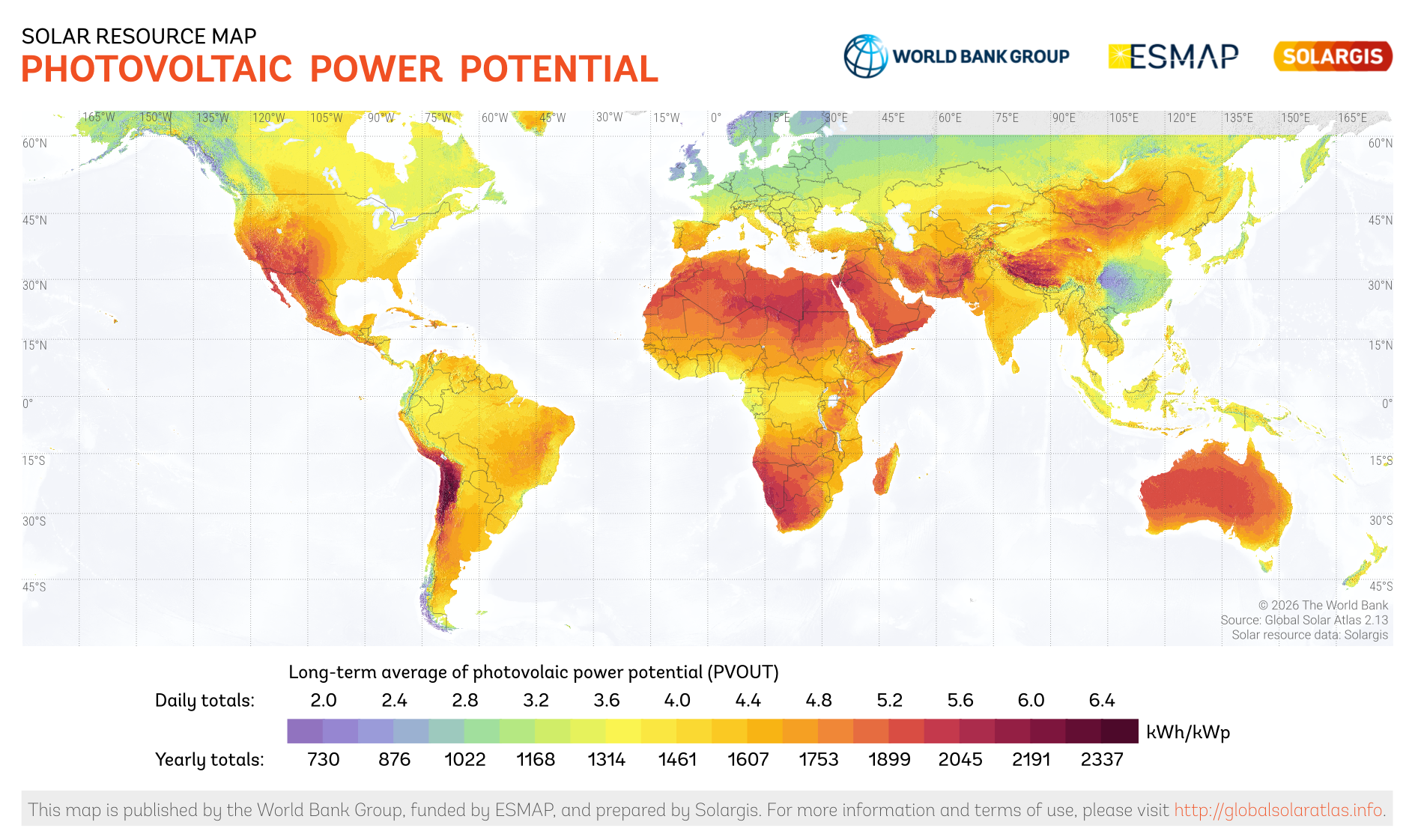
Here's some good news that might surprise you: most of the people on Earth already live in places with plenty of sun and wind to power their lives with clean energy.
Researchers Professor Ray Wills from the University of Western Australia and Professor Peter Newman from Curtin University looked at where sunlight hits strongest and where winds blow hardest around the globe. Their finding? Almost everyone is already living in the "sweet spot" for renewable energy.
About two-thirds of all humanity — that's roughly 5 billion people — live in low to mid latitudes, where sunshine is abundant. Picture the kind of warm, bright regions where you'd actually want to spend time on vacation. Much of Africa, Latin America, the Middle East, India, Southeast Asia, Australia, much of the United States, and southern Europe all sit in the highest solar resource bands on the map. In these regions, solar power isn't a experimental technology — it's likely the cheapest way to generate new electricity.
But it gets better. The researchers also looked at wind patterns. A large group of people — numbering in the low billions — live in the 35 to 60 degree latitude bands, where strong, steady winds sweep across the continents. This includes Western and Central Europe, much of North America, southern South America, and parts of China, Japan, and Korea. These wind regions often peak at different times of day and year than solar, which means the two energy sources naturally complement each other.
Here's the really hopeful part: together, solar and wind can provide the majority of electricity almost everywhere on Earth. Add batteries to store energy, and many places can run almost entirely on renewables. The researchers call this "Wright's Law" — basically, every time the world doubles how much solar or battery capacity it builds, the cost drops again. Solar panels and batteries have already dropped in price by enormous amounts, and there's no sign the trend is slowing down.
"Large grids, abundant wind and solar, and growing fleets of batteries are not a cost burden; they are the mechanism that keeps driving costs down," the researchers write.
So what does this mean? The shift to clean energy isn't held back by a lack of sun or wind. It's really about whether cities and countries plan well and invest quickly enough. The faster we build, the cheaper everything becomes — and the sooner we can leave fossil fuels behind.